The early days of the American Revolution were marked by uncertainty, courage, and a growing determination among the colonies to resist British authority. In the city of Boston, political tension had been building for years before open conflict finally erupted in 1775. The struggle for independence had already produced protests, boycotts, and heated debates, but the outbreak of armed conflict transformed the resistance into a full scale revolution.
One of the most famous early battles of the war took place on June 17, 1775 at the Battle of Bunker Hill. Although the fighting actually occurred mostly on nearby Breed’s Hill, the name Bunker Hill became permanently attached to the event in historical memory. The battle was one of the first major confrontations between colonial forces and the British army, and it quickly became a powerful symbol of American determination.
Among the patriots who played a crucial role in the battle was Joseph Warren, a respected physician and political leader in Massachusetts. Warren had already earned a reputation as a passionate supporter of colonial rights and an influential organizer of the patriot movement in Boston.
Encounter the strange and the unseen — from Bigfoot to regional monsters hiding in America’s forests.
Before the Revolutionary War began, Warren had been deeply involved in the committees that coordinated resistance to British rule. He worked closely with other prominent figures of the patriot cause and helped spread information about colonial grievances. Many historians consider him one of the key leaders who prepared the colonies for the coming struggle.
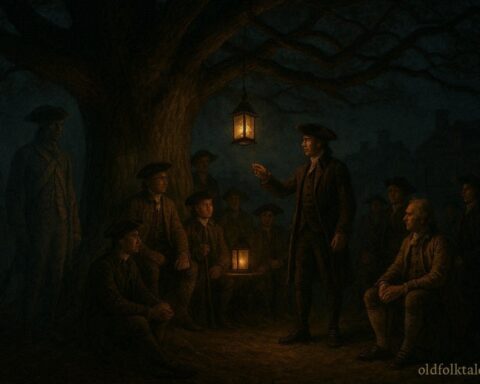
Despite his importance as a political leader, Warren believed strongly in sharing the risks faced by ordinary soldiers. When colonial forces prepared to defend the hills overlooking Boston in June of 1775, he chose to join them on the battlefield rather than remain safely behind the lines.
Although Warren had recently been appointed a major general, he volunteered to fight as a common soldier during the battle. He believed that standing alongside the men defending the hill would demonstrate his commitment to the cause of independence.
On the day of the battle, colonial forces constructed defensive earthworks on the hills overlooking Boston Harbor. They understood that British troops would likely attempt to capture these positions in order to gain control of the surrounding area. As expected, British soldiers launched a series of assaults against the colonial defenses.
The fighting that followed was intense and chaotic. Waves of British troops advanced uphill toward the colonial positions while musket fire echoed across the battlefield. The colonists, though outnumbered and poorly supplied, fought with determination.
During the final stages of the battle, colonial forces began to run out of ammunition. Without sufficient supplies to continue firing, they were eventually forced to retreat from their defensive positions. It was during this chaotic withdrawal that Joseph Warren was killed.
According to historical accounts, Warren remained on the battlefield to help cover the retreat of other soldiers. While attempting to escape the advancing British troops, he was struck by a fatal shot and fell near the earthworks where the colonists had made their stand.
His death shocked the patriot movement. Many leaders believed that Warren would have played a central role in guiding the revolution if he had survived. Instead, he became one of the first prominent martyrs of the American cause.
After the battle ended, the British forces occupied the battlefield, and Warren’s body remained there for some time before it was eventually recovered by friends and supporters. His death was widely mourned throughout the colonies, and his sacrifice became a powerful symbol of dedication to the ideals of liberty and self government.
Over time, stories about the battlefield itself began to take on a mysterious character.
The area where the battle took place later became the site of the famous Bunker Hill Monument, which was constructed in the nineteenth century to honor the courage of the colonial soldiers who fought there. Visitors came to the monument to remember the early sacrifices that shaped the struggle for independence.
Yet alongside the historical memorials, a legend began to circulate among local residents and visitors. According to this story, the spirit of Joseph Warren never completely left the battlefield where he had given his life.
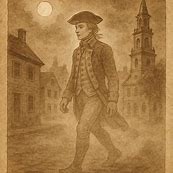
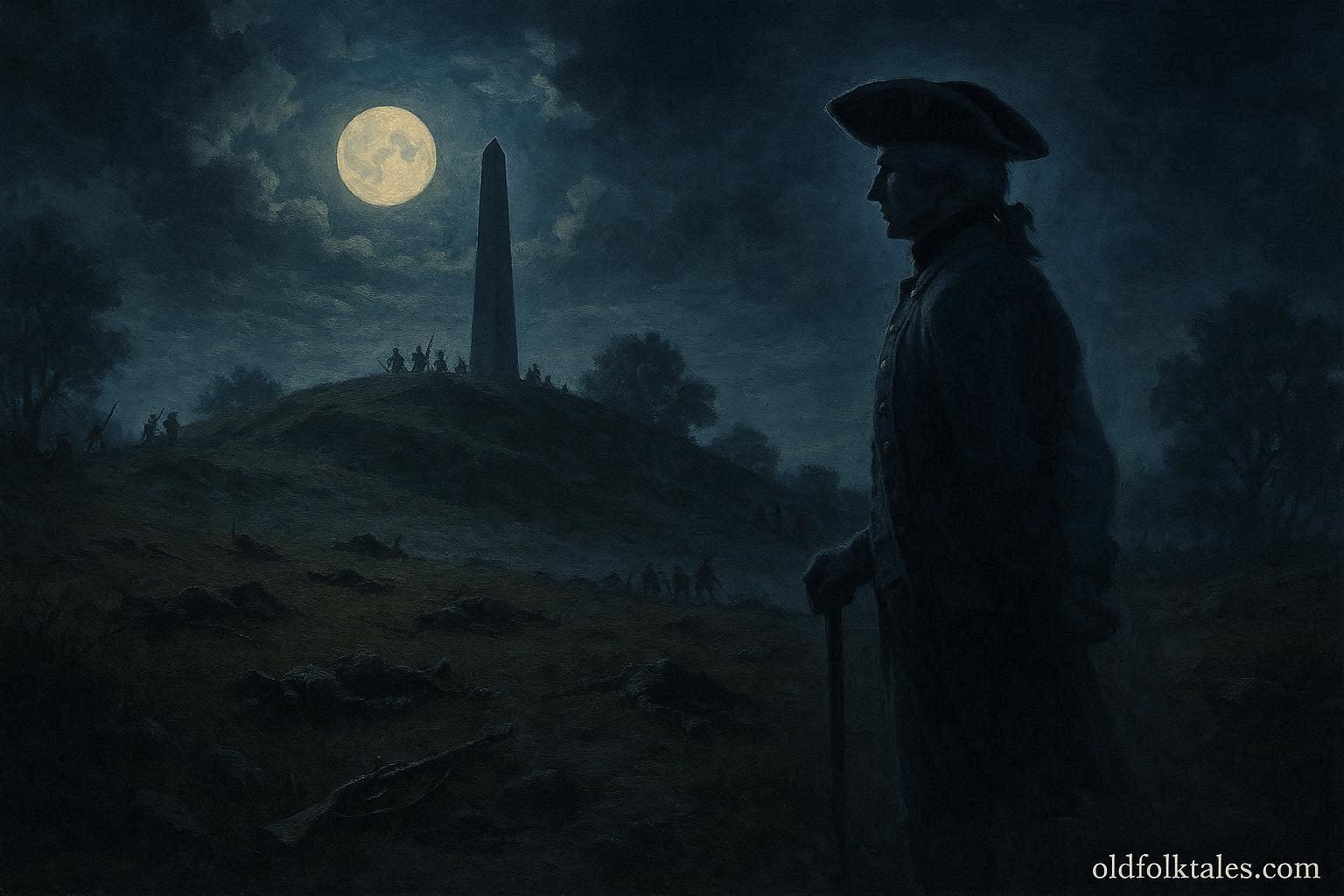
The legend claims that on certain quiet nights, especially when the moon shines brightly over the historic hill, a solitary figure can sometimes be seen walking slowly across the grounds. Witnesses who claim to have seen the figure describe a man dressed in clothing resembling that worn during the Revolutionary War.
According to the legend, the figure appears to be calmly surveying the land, as if examining the battlefield long after the fighting has ended. Some witnesses say the figure pauses near the area where Warren is believed to have fallen before fading gradually into the shadows.
Over the years, a few night watchmen and visitors have reported unusual experiences while near the monument grounds after dark. Some describe seeing a distant figure standing near the hillside. Others report hearing faint footsteps on quiet nights when the park is otherwise empty.
While such stories are difficult to confirm, they have become part of the local folklore surrounding the site. For many storytellers, the legend represents the enduring spirit of those who fought for independence during the earliest days of the Revolutionary War.
Folklore scholars often explain that ghost stories connected to battlefields are common in many cultures. Locations where intense historical events occurred often inspire legends about lingering spirits or watchful guardians. These stories reflect the emotional impact that such places continue to hold in collective memory.
In the case of Joseph Warren, the legend also reflects the respect many Americans feel toward the sacrifices made by early revolutionary leaders. His willingness to fight alongside ordinary soldiers and his death during one of the first major battles of the war made him a symbol of courage and devotion to the cause of liberty.
Historians emphasize that the true legacy of Joseph Warren lies in his leadership, his influence on the patriot movement, and the inspiration his sacrifice provided to the colonies during the difficult early months of the war.
The legend of his ghost walking the battlefield may not be provable, but it carries symbolic meaning. It suggests that the ideals for which Warren fought continue to be remembered and protected by future generations.
Today visitors who climb the long staircase inside the Bunker Hill Monument can look out across the surrounding city of Boston and imagine the dramatic events that once unfolded on those hills. The quiet park surrounding the monument offers a place for reflection on the courage of the individuals who stood there during one of the earliest battles of the American Revolution.
For some storytellers, the legend of the ghost of Joseph Warren adds a final layer of meaning to the historic site. The image of a fallen patriot returning to watch over the battlefield serves as a reminder that the struggle for independence was built upon sacrifice, bravery, and an enduring commitment to freedom.
Whether viewed as a ghost story or as a symbolic expression of historical memory, the legend continues to echo through Boston’s Revolutionary War traditions. It reflects the belief that the spirit of those who fought for liberty remains connected to the places where their courage changed the course of history.
Explore how American legends shaped the nation — from frontier heroes to Revolutionary War tales.
Moral Lesson
The sacrifices made by those who defend their beliefs and their communities continue to inspire future generations to value courage, dedication, and freedom.
Knowledge Check
- Who was Joseph Warren?
He was a patriot leader and physician who supported the American Revolution. - In which battle did he lose his life?
He was killed during the Battle of Bunker Hill in 1775. - Why did Joseph Warren fight as a common soldier during the battle?
He wanted to stand alongside other colonial soldiers defending the hill. - What monument now stands near the battlefield?
The Bunker Hill Monument honors the soldiers who fought there. - What does the legend say about Warren’s spirit?
It says his ghost sometimes appears on moonlit nights surveying the battlefield. - What does the legend symbolize in American folklore?
It symbolizes heroic sacrifice and the lasting memory of the Revolutionary War.
Source
Adapted from materials preserved in the Massachusetts Historical Society Archives
Cultural Origin
Boston Massachusetts Revolutionary War folklore