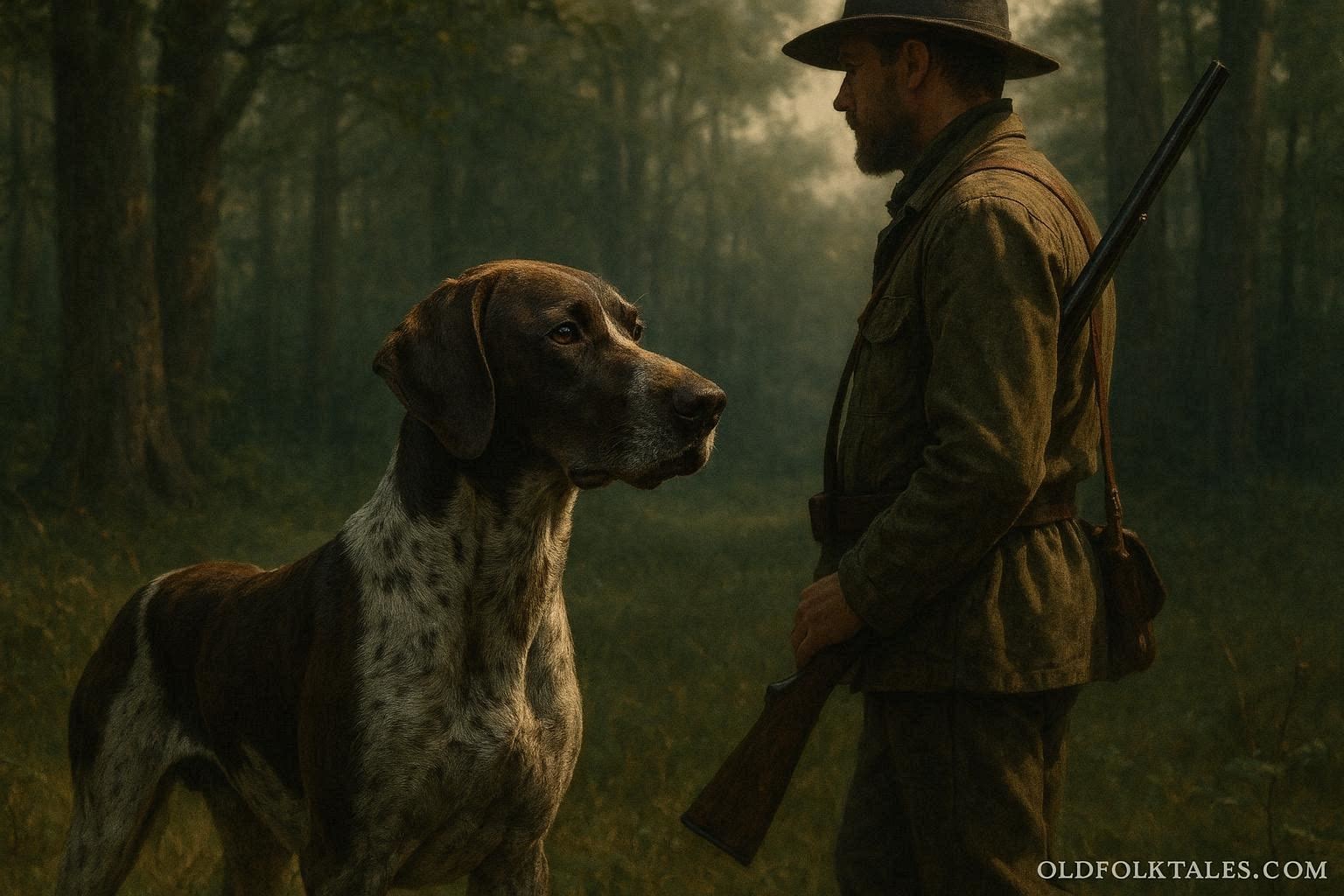
Across the quiet countryside, where fields stretched wide and forests bordered the edges of small homesteads, hunting was more than a task. It was a tradition built on patience, skill, and trust. Those who hunted understood that success often depended not only on their own ability, but on the companions who worked beside them.
Among these companions, there was one whose name would be remembered long after his time.
He was called Old Blue.
From the beginning, Blue showed a level of awareness that set him apart. He was attentive, always observing his surroundings, listening to the smallest sounds, and reacting with a calm focus that made him reliable in the field. He did not rush or act without purpose. Every movement carried intention.
Those who trained him quickly realized that he understood more than most animals.
He learned commands with ease, but more importantly, he seemed to anticipate them. He did not wait to be told what to do when the situation was clear. Instead, he acted in ways that supported those around him, responding to the environment with quiet intelligence.
Step into shadowy legends of restless spirits and ghostly travelers in American Ghost Stories.
As time passed, Blue became known for his tracking ability.
He could follow trails that others could not even see. A faint scent, barely noticeable, was enough for him to begin. Once he started, he remained focused, moving steadily without distraction. Even when the trail became difficult, he did not give up.
Hunters who worked with him trusted his judgment.
If Blue stopped, they stopped. If he changed direction, they followed. He did not act randomly, and over time, his decisions proved to be accurate. This trust became a bond, one built on repeated experiences where his instincts led them to success.
One particular story became widely shared.
A hunter had been tracking an animal for hours, moving through thick brush and uneven ground. The trail had grown faint, and uncertainty began to set in. The signs that once seemed clear had nearly disappeared, and the path forward was no longer obvious.
Blue remained calm.
He lowered his head and continued to search, moving slowly, as though reading something hidden beneath the surface. Then, without hesitation, he shifted direction, leading the hunter away from the original path.
At first, there was doubt.
The new direction did not seem to match the earlier signs. But the hunter chose to trust Blue, following closely as he moved deeper into the forest. The path was not easy, and the terrain made progress slow.
After some time, the reason became clear.
The trail had not ended. It had simply changed.
Blue had detected what others could not, finding the continuation of the path where it seemed to disappear. His persistence led them forward, proving once again that his instincts were reliable.
Stories like this spread across the countryside.
People spoke of his intelligence, his focus, and his loyalty. But more than anything, they spoke of the way he worked alongside others. He was not just a tool or a helper. He was a partner.
His presence brought confidence.
Those who hunted with him felt a sense of assurance, knowing that they were not alone in their efforts. Blue’s steady behavior created a balance, allowing others to remain calm even when situations became difficult.
Over the years, his reputation grew.
He became a figure of respect, not only among those who knew him directly, but also among those who had heard the stories. His name was spoken with admiration, representing the qualities that made him unique.
But it was not only his skill that defined him.
It was his loyalty.
He remained close to those he worked with, attentive to their needs and aware of their presence. He did not wander or act independently without reason. His connection to others was clear, built on trust that went both ways.
As time passed, the days of active hunting grew fewer.
Blue aged, and his movements slowed. Yet even then, his presence remained important. He no longer needed to prove his ability. His story had already been told through countless experiences.
Those who had worked with him remembered.
They spoke of the times when he had led them through uncertainty, when his instincts had guided them, and when his loyalty had made every journey safer. His influence remained, even as his role changed.
After his time, the stories did not fade.
They continued to be shared, passed from one generation to the next. New hunters grew up hearing about Old Blue, learning not only about his skill, but about what he represented.
He became more than a memory.
He became a symbol.
A symbol of loyalty, of partnership, and of the quiet strength that comes from trust and understanding. His story reminded people that success is not always achieved alone, and that true companionship can make even the most difficult paths easier to follow.
Even now, in quiet fields and along forest trails, the story of Old Blue remains.
It lives in the way people speak of trust.
In the way they value those who stand beside them.
And in the understanding that loyalty, once given, creates a bond that cannot easily be broken.
Explore how American legends shaped the nation — from frontier heroes to Revolutionary War tales.
Moral Lesson
Loyalty and trust create strong partnerships that lead to success and lasting respect.
Knowledge Check
- What made Old Blue special?
His intelligence and strong tracking ability. - How did hunters feel about working with him?
They trusted his judgment and relied on him. - What did Blue do when a trail became unclear?
He continued searching and found the correct path. - Why did people respect Old Blue?
Because of his skill, loyalty, and reliability. - What role did he play in hunting?
He acted as a trusted partner, not just a helper. - What does the story teach about companionship?
Trust and loyalty strengthen relationships and lead to success.
Source
Adapted from materials preserved by American Folklore Society
Cultural Origin
Southern rural folklore