In a small southern town where life moved at a steady and familiar pace, people depended on one another more than anything else. The seasons shaped their work, the land shaped their routines, and the community shaped their survival. In such a place, sharing was not just kindness. It was a necessity.
At the center of the town stood a modest bakery.
It was not large or particularly grand, but it was known to everyone. Each morning, before the sun fully rose, the scent of fresh bread drifted through the streets. People would pass by on their way to work, slowing their steps for a moment, breathing in the warmth that seemed to promise comfort before the day began.
The baker was a quiet figure, known more for consistency than conversation. He worked with steady hands, measuring, kneading, and baking with careful attention. There was nothing unusual about his methods, nothing that suggested anything beyond skill and discipline.
Explore ancient Native American creation myths and the symbolic tales that shaped America’s belief systems.
Then came a season of difficulty.
The harvest had been poor, and supplies grew thin across the town. Families began to stretch what little they had. Meals became smaller, and conversations turned more serious. There was no loud alarm, but there was a shared understanding that everyone would need to be careful.
The bakery remained open.
On the first morning after the shortage became clear, people gathered earlier than usual. Some came with concern, others with hope. They did not know how much bread would be available, or if there would be enough for everyone.
The baker opened his doors as he always did.
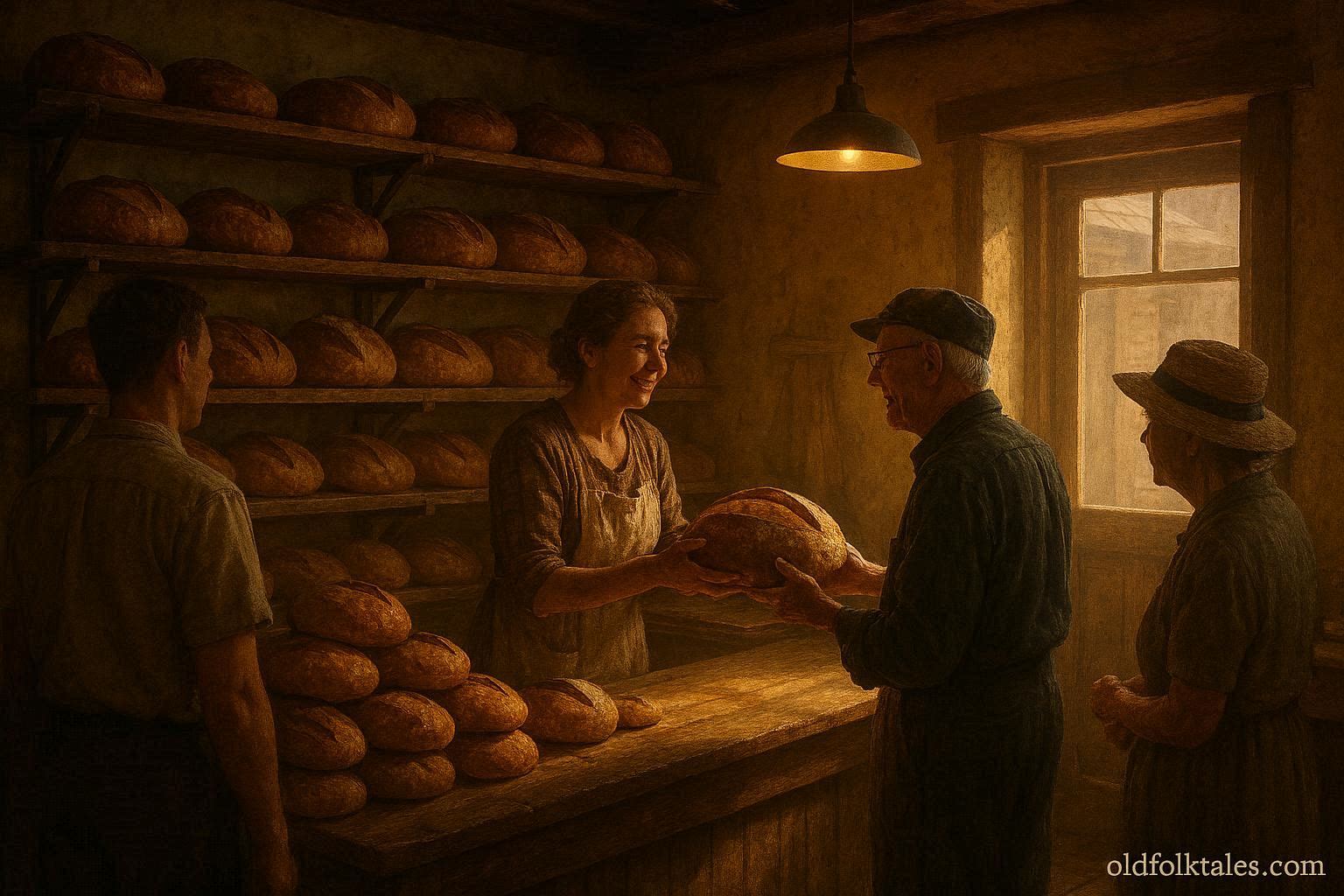
He greeted each person calmly and began to serve. One loaf, then another, then another. There was no sign of hesitation. He did not count aloud or limit what he gave. He simply continued.
At first, no one noticed anything unusual.
But as the morning went on, something began to feel different. The line grew longer, yet the bread did not seem to run out. More loaves appeared from the back, placed gently on the counter, warm and ready.
A woman who had arrived late expected to find nothing left. Instead, she was handed a loaf as fresh as the first one given that morning.
She paused, surprised.
Others began to take notice as well.
The shelves did not empty.
The baskets did not stay bare.
Each time someone thought the last loaf had been given, another would appear.
Whispers spread quietly through the line.
Some wondered if the baker had stored more than expected. Others thought perhaps help had come from somewhere unseen. But no wagons arrived, no deliveries were made, and no extra workers were present.
It was just the baker.
And the bread.
Day after day, the pattern continued.
People came not only for food, but to witness what they could not explain. The bread remained steady. It fed families, neighbors, and even travelers who passed through. No one was turned away.
Children carried loaves home with wide eyes, asking questions their parents could not answer. Elders watched in silence, remembering other times of hardship, yet none quite like this.
There was no rush, no panic.
Only a quiet sense of something unusual unfolding.
Some tried to understand it.
They observed the baker’s movements, watched how the dough was prepared, how the loaves were placed into the oven. Everything appeared ordinary. The same tools, the same routine, the same careful rhythm.
Yet the result was not ordinary.
The bread did not diminish.
It remained.
One evening, a few townspeople stayed behind after closing, hoping to see something different once the doors were shut. They watched as the baker worked alone, shaping dough and placing it carefully aside.
There was nothing strange.
Nothing hidden.
Only patience and focus.
Still, when morning came, the shelves were full again.
As time passed, the town began to change in small ways. People who had once worried about scarcity began to think differently. They shared more freely, knowing that what they received did not seem to lessen the supply.
Neighbors checked on one another more often.
Meals were shared across households.
The sense of fear slowly gave way to something steadier.
Trust.
Not everyone agreed on what was happening.
Some believed it was a blessing tied to the baker’s generosity. Others thought it was simply a story growing larger with each retelling. A few insisted there must be a practical explanation that had yet to be discovered.
But no explanation was ever confirmed.
The bread continued.
It fed the town through the difficult season and beyond. When the harvest improved and supplies returned to normal, the need lessened, but the memory remained.
People did not forget.
They spoke of the time when no one went hungry, when loaves were given without measure, and when something ordinary became something impossible to fully explain.
The bakery stayed where it had always been.
The baker continued his work as before.
Nothing about the place appeared different.
Yet those who had lived through that time knew otherwise.
They understood that what mattered most was not just the bread itself, but what it had revealed. That in a moment of need, something had allowed a community to endure without fear of running out.
Even years later, when the story was told, it carried the same quiet strength.
Not as a loud miracle, but as a steady reminder.
That sometimes, what is shared does not lessen.
And that in giving, something greater can remain.
Discover African American wisdom, Native American spirit stories, and the humor of early pioneers in American Folktales.
Moral Lesson
When people share with others in times of need, what they have can feel more than enough.
Knowledge Check
- Where did the story take place?
In a small southern town. - What problem did the town face?
A shortage of food due to a poor harvest. - What was unusual about the bread?
It never seemed to run out. - Did anyone discover how it happened?
No, the reason was never clearly explained. - How did the town change during this time?
People shared more and supported one another. - What is the main idea of the story?
Sharing and unity can help people overcome difficult times.
Source
Adapted from materials preserved by Duke University
Cultural Origin
Southern communal folklore