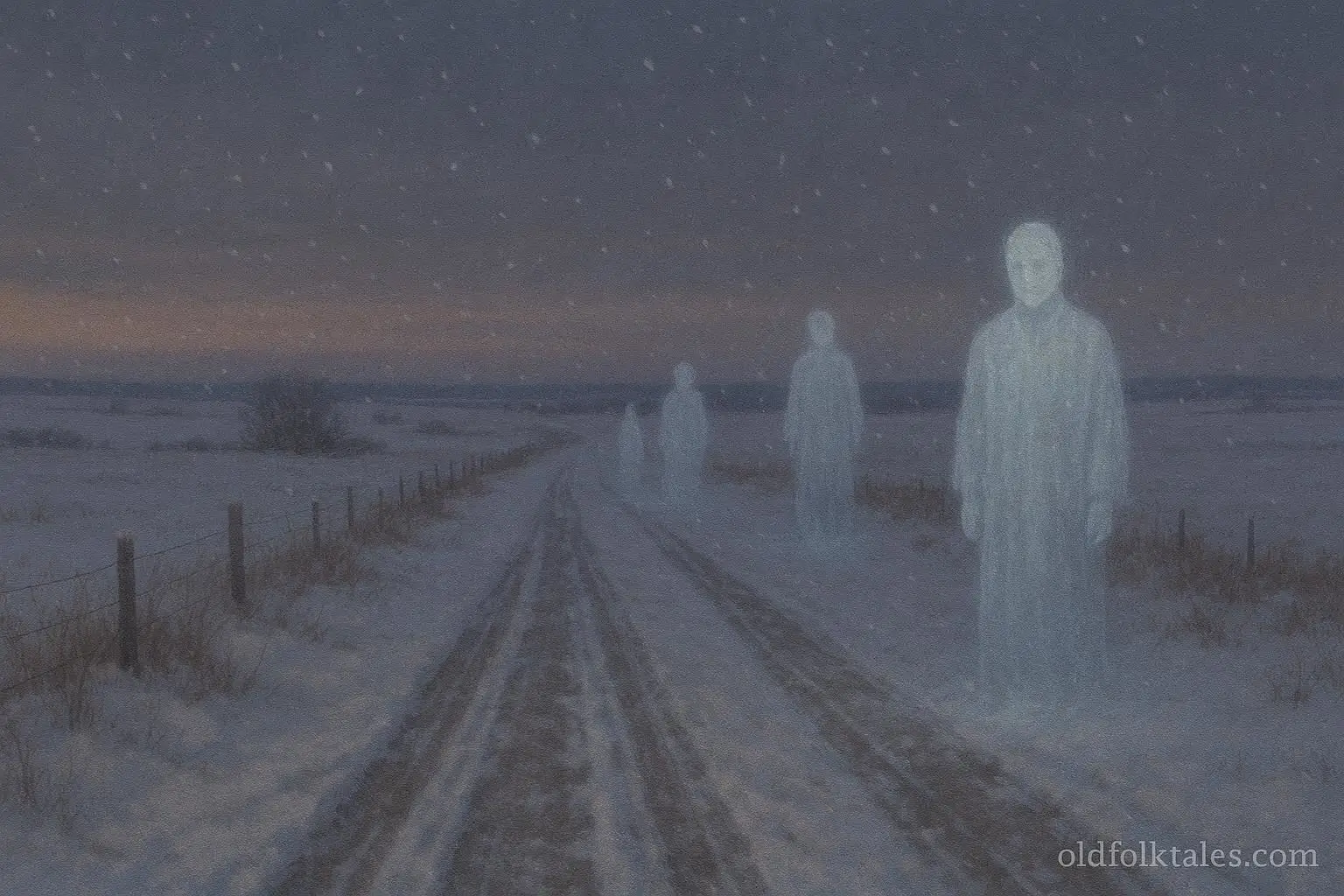
Snow fell quietly across the northern plains, covering the land in a thick white stillness. Old travel routes disappeared beneath drifting snow, yet elders said the paths were never truly lost. Beneath the surface, the land remembered where people once walked. On nights when snowfall was heavy and the wind softened, faint human figures were said to appear along these forgotten roads, moving steadily through the cold as if following a route only they could see.
These winter roads once connected villages, hunting grounds, and seasonal camps. Families traveled them during the cold months when rivers froze and open plains allowed passage by foot or sled. Over generations, these paths became woven into memory, carrying stories of endurance, cooperation, and survival. When people passed away, it was believed their knowledge of the land remained. The spirits of ancestors continued to walk the routes they once relied upon, especially during winter when guidance was most needed.
Witnesses described the spirits as tall, faintly glowing human shapes moving slowly through snowfall. They appeared dressed in simple clothing suited for cold travel, though details remained indistinct. The figures did not rush or hesitate. They walked with purpose, following the curves of old trails now invisible to the living. Those who saw them often felt watched over rather than threatened, as if the spirits were ensuring the land remained known and respected.
Explore the heart of America’s storytelling — from tall tales and tricksters to fireside family legends.
Children were often the first to notice these presences. While playing near snow covered roads or walking with family members, they pointed toward figures adults could barely see. Children described people walking quietly in the snow, sometimes turning their heads as if aware of being observed. Elders believed children were more attuned to ancestral presence because they had not yet learned to dismiss what could not be easily explained.
Adults reported different sensations. Some felt a sudden calm settle over them during heavy snowfall. Others sensed direction, as if encouraged to stay on a safe route or avoid a dangerous area. Travelers occasionally reported following a path they did not remember choosing, only to realize later that it aligned with an old winter road marked in oral history. These moments reinforced the belief that ancestral spirits guided the living subtly, without direct interaction.
The spirits were most often seen during early evening or late night, when snow muffled sound and visibility narrowed. The quiet created space for awareness, allowing the presence of the spirits to be felt rather than loudly announced. Elders taught that winter itself was a teacher, and the spirits embodied lessons of patience, preparation, and respect for the land.
According to oral tradition, these ancestral figures did not wander aimlessly. They walked with intention, moving between familiar landmarks such as hills, frozen rivers, or stands of trees that once marked resting points. Their movement reinforced the idea that knowledge of the land was passed not only through stories but through continued presence. The spirits kept the memory of safe passage alive.
Animals were said to respond to the spirits as well. Dogs paused and watched empty paths. Horses grew calm rather than restless. Birds remained silent as figures passed. These subtle reactions suggested that the spirits were part of the natural rhythm rather than an intrusion. The land recognized its own memory.
Communities developed customs around winter travel based on these beliefs. Before long journeys, families paused briefly, acknowledging ancestors who once walked the same routes. This act was not a request for protection but a recognition of shared continuity. Elders explained that acknowledging the spirits strengthened awareness and responsibility rather than granting supernatural safety.
The spirits were also believed to observe rather than interfere. They watched how people treated the land, whether they respected the old paths or ignored them. When modern roads replaced traditional routes, sightings decreased. Where old paths remained undisturbed, stories persisted. This reinforced the idea that preservation of memory depended on care for the land itself.
Some witnesses reported seeing multiple figures walking together, suggesting families or groups traveling as they once did in life. Others saw single figures moving alone, representing solitary travelers or guides. These variations reflected the many ways people once moved across the winter landscape.
Elders taught that the spirits did not belong to one time. They represented continuity rather than loss. Their presence reminded the living that survival depended on shared knowledge and respect for those who came before. Winter travel was dangerous, and the spirits embodied lessons learned through hardship.
Modern sightings continue, especially during heavy snowfall when roads fall quiet. Drivers have reported slowing instinctively as shapes appeared near the edge of vision. Walkers have felt guided away from unsafe ice or deep drifts. These moments pass quickly, leaving reflection rather than fear.
The legend of ancestral spirits walking winter roads endures because it connects people to place, season, and lineage. It teaches that paths may disappear from sight but never from memory. The spirits walk not to haunt but to remind the living that guidance comes from those who endured before them.
In this way, winter becomes not only a season of cold but of connection. Snow reveals what lies beneath by covering what distracts. Through silence and movement, the spirits affirm that ancestry is not distant. It walks beside the living, steady and watchful, along roads shaped by memory.
Click to explore all American Ghost Stories — haunting legends of spirits, lost souls, and mysterious places across the U.S.
Moral Lesson
Honoring ancestral knowledge and respecting traditional paths strengthens continuity between past and present.
Knowledge Check
- When are the ancestral spirits most often seen?
They are most often seen during snowfall and winter evenings. - Where do the spirits walk?
They walk along old winter travel paths. - Who usually notices the spirits first?
Children. - What role do the spirits play according to tradition?
They guide, observe, and preserve memory. - How do animals react to the spirits?
They become calm and attentive. - What does the legend teach about winter travel?
It emphasizes respect, preparation, and ancestral knowledge.
Source
Adapted from Smithsonian National Museum of the American Indian winter travel oral histories
Cultural Origin
Northern Plains Indigenous communities