Still water often hides the greatest movement beneath its surface. Lakes and rivers of the Great Lakes region appear calm at dawn, their wide surfaces reflecting sky and forest as if nothing stirs below. Yet elders have long taught that deep water is never empty. Beneath these waters lives a being older than memory, known as the Horned Water Serpent.
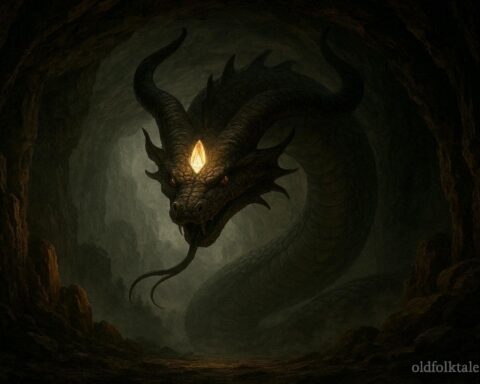
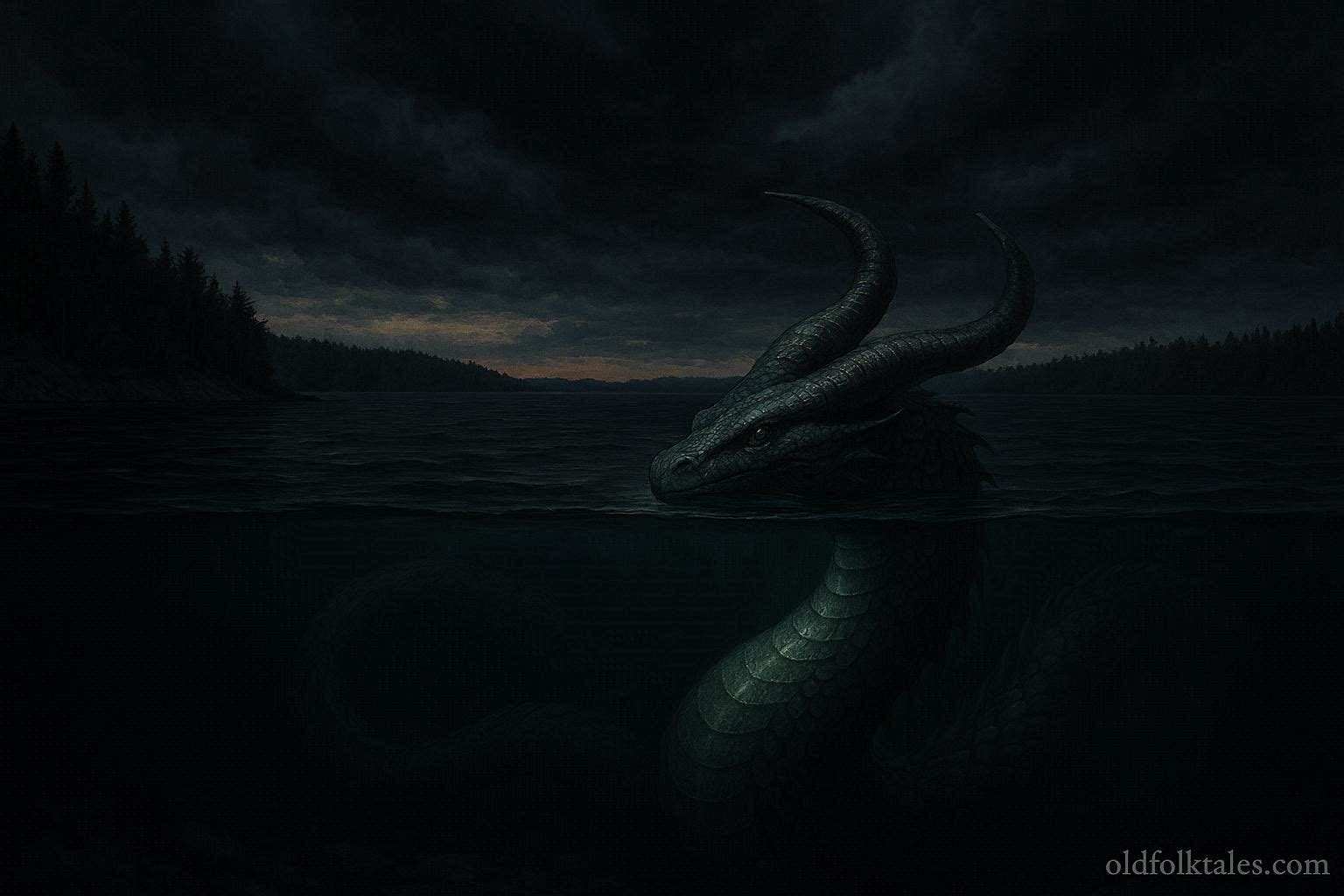
The serpent is not an ordinary animal. It is vast in size, stretching longer than a canoe and thick as a fallen tree. Its body is said to shimmer with dark scales that catch faint light beneath the water. Most striking are the curved horns that rise from its head, marking it as a being of power rather than flesh alone.
The Horned Water Serpent lives in the deepest parts of lakes and rivers. It prefers places where water is dark and cold, far from shore. These locations are often marked by sudden drop offs, strong currents, or areas where drownings have occurred. Elders say these waters are claimed spaces, not meant for careless entry.
Discover African American wisdom, Native American spirit stories, and the humor of early pioneers in American Folktales.
The serpent is closely connected to storms. When sudden winds rise without warning or waves churn on otherwise calm days, people say the serpent has shifted its position. Thunder rolling across water is believed to echo its movement. Lightning striking near shore is seen as a sign that balance has been disturbed.
Stories describe the serpent as intelligent and aware of human behavior. It watches boats, swimmers, and fishermen. Those who move respectfully pass without trouble. Those who boast, mock the water, or ignore warnings risk drawing its attention.
The serpent does not attack without cause. It responds to imbalance. When offerings are neglected, sacred waters polluted, or boundaries ignored, the serpent stirs. Elders explain that drownings are not random but reminders. Water demands humility.
Children were taught early never to swim alone or near deep water without guidance. The serpent served as a teaching figure rather than a threat. Fear was balanced with understanding. Water provides life but also claims it when disrespected.
Some stories describe rare sightings. A great shape moving beneath the surface. Horns breaking the water briefly before disappearing. A long wake cutting across a lake without a visible source. These moments leave witnesses silent and unsettled.
The serpent is said to guard underwater pathways connecting lakes and rivers. These passages are invisible to humans but vital to the balance of the world. When disrupted by careless actions, storms and accidents increase.
Fishermen sometimes reported lines snapping suddenly, pulled downward with impossible force. Elders said the serpent had inspected the offering and rejected it. Such moments required ceremony and reflection before returning to the water.
Animals sense the serpent before humans do. Fish scatter. Birds leave shorelines. Dogs refuse to enter certain waters. These signs were taken seriously and respected.
The serpent also plays a role in spiritual imbalance. When communities ignored teachings or allowed internal conflict to grow, elders said the serpent grew restless. Water reflects the state of those who depend on it.
There are stories of the serpent aiding humans indirectly. Canoes lost in fog sometimes drifted safely to shore. Elders explained that respect had been shown and protection granted. The serpent does not seek destruction but equilibrium.
Ceremonies honoring water were central to maintaining balance. Offerings of tobacco, quiet speech, and intentional movement were ways to acknowledge the serpent without calling it directly.
The Horned Water Serpent is not evil. It is powerful. Power without respect becomes danger. Power with understanding becomes protection.
As modern development altered shorelines and polluted waters, elders warned that imbalance would increase. Storms would worsen. Accidents would rise. These warnings were tied directly to the serpent’s unrest.
Despite fewer oral teachings today, stories persist. People still speak of strange waves, sudden storms, and feelings of unease in certain waters. The serpent remains present because water remains essential.
The legend teaches that water is not a resource to dominate but a living force to honor. The Horned Water Serpent embodies that truth. It watches silently from the depths, responding only when necessary.
Those who listen to the water rarely encounter the serpent. Those who ignore it may never see the being but feel its consequences. Balance does not require belief. It requires respect.
Click to read all American Cryptids & Monsters — creatures of mystery and fear said to inhabit America’s wild landscapes.
Moral Lesson
Respect for water and awareness of natural power are essential for balance and survival.
Knowledge Check
- Where does the Horned Water Serpent live?
In deep lakes and rivers. - What physical feature distinguishes the serpent?
Curved horns on its head. - What natural events are linked to the serpent?
Storms and sudden water disturbances. - Does the serpent attack without reason?
No, it responds to imbalance. - How do animals behave near the serpent?
They show signs of avoidance or distress. - What does the serpent symbolize?
Water power and the need for respect.
Source
Adapted from University of Wisconsin Great Lakes Indigenous cosmology archives
Cultural Origin
Ojibwe and related Great Lakes communities