Long before modern cities rose across the American Midwest, the land near present-day Illinois was home to one of the most advanced pre-Columbian settlements in North America. Today, the remains of that civilization can still be seen at Cahokia Mounds, where massive earthen structures rise from the ground in quiet formation.
By day, the site is a place of history and study.
By night, some say, it becomes something else.
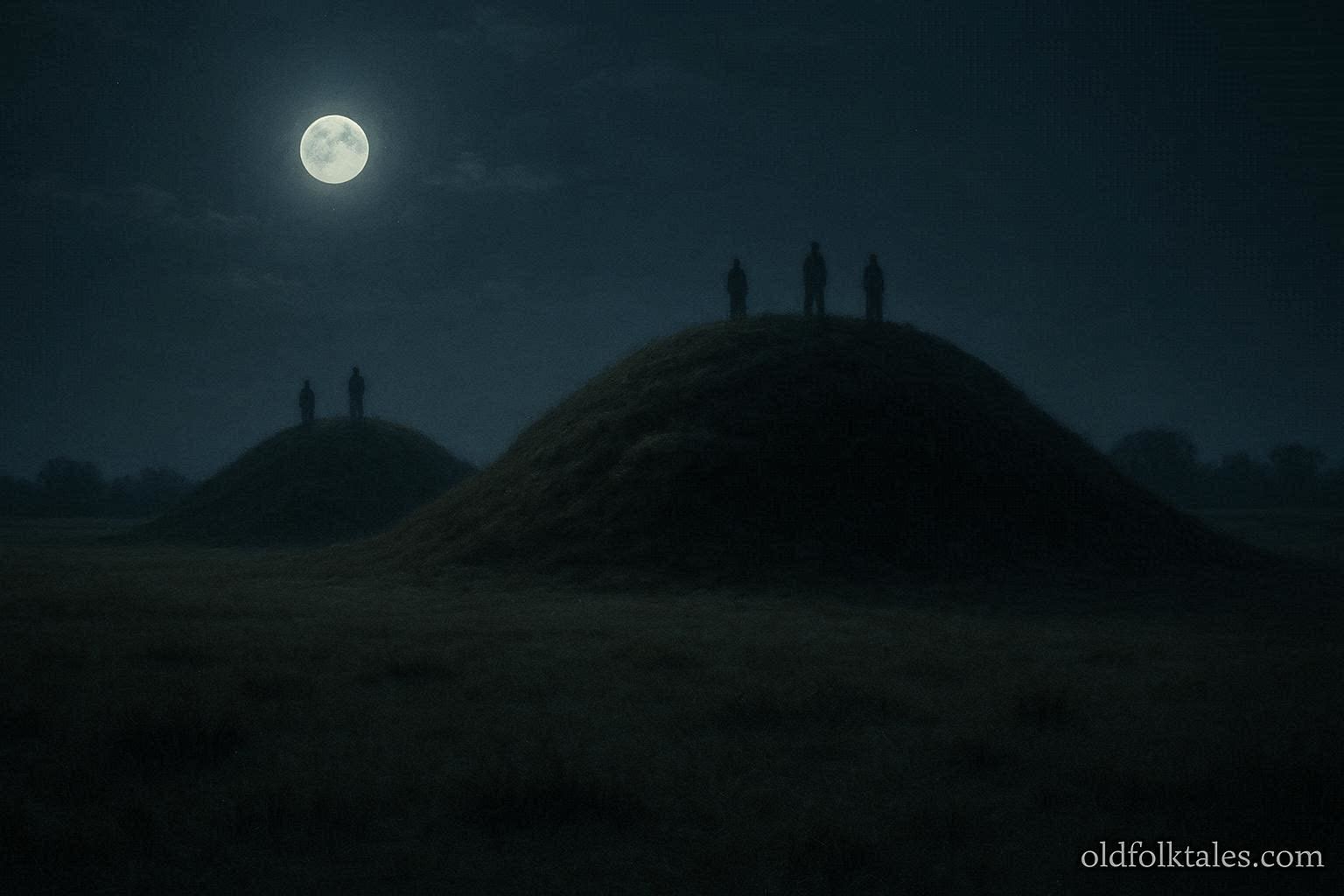
Visitors who remain in the area after sunset often describe a change in atmosphere. The wide open fields grow still, and the mounds, which once served as centers of activity, appear darker against the sky. It is in these moments that stories begin.
The earliest accounts speak of figures.
Not clearly defined, but visible enough to be noticed. Shapes moving along the edges of the mounds, or standing briefly before disappearing. Those who see them often describe a sense of distance, as though the figures belong to another time rather than the present.
One visitor recalled standing near one of the larger mounds just as the light faded.
Explore the heart of America’s storytelling — from tall tales and tricksters to fireside family legends.
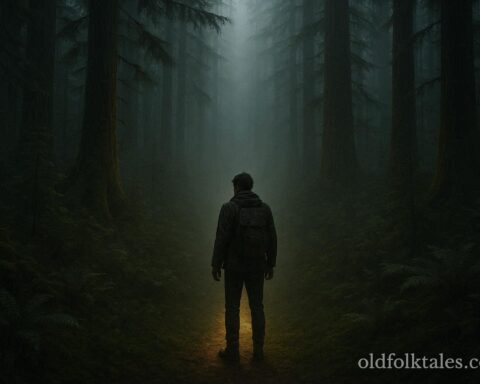
At first, everything seemed normal. The wind moved lightly across the grass, and the horizon remained clear. Then, without warning, a figure appeared at the top of the mound.
It did not move.
It simply stood there.
When the visitor looked again, moments later, it was gone.
There were no nearby paths, no sounds of footsteps, and no sign that anyone had been there at all.
Other reports describe movement.
Subtle shifts along the ground, as though something passes just beyond the edge of vision. These movements are often noticed when a person is not looking directly at them, but become less clear the moment attention is focused.
Alongside these sightings are accounts of sound.
Soft drumming.
Faint voices.
Low tones that seem to rise and fall with the air.
The sounds are not constant. They appear briefly, often late in the evening, and then disappear without leaving any clear source. Some describe them as distant, while others say they seem close but cannot be traced.
The experiences are not limited to a single area.
Different parts of Cahokia Mounds have been associated with similar reports, though no exact pattern has been established. The unpredictability adds to the sense of mystery, as no one can say where or when something might occur.
There are several ways people interpret these events.
Some believe they are natural.
Large open landscapes can carry sound over long distances, and changing light conditions can create visual effects that are easily misinterpreted. The mind, aware of the site’s history, may connect these experiences to the past without realizing it.
Others see a deeper connection.
They believe that places of great historical and cultural importance can hold impressions of what once occurred there. In this view, the sightings and sounds are not active events, but echoes, traces that remain tied to the land itself.
This perspective is often linked to respect for the site’s origins.
The mounds were built by a complex society with its own traditions, structures, and ways of life. The land was shaped with intention, and its significance extended beyond physical construction. For some, the idea that the area still carries a presence reflects that history.
Because of this, many approach the stories with caution.
They do not treat them as entertainment, but as part of a broader understanding of the site. Visitors are often encouraged to observe respectfully, to recognize the cultural importance of the location, and to avoid actions that might disturb the environment.
Over time, the stories have become part of regional folklore.
They are shared among visitors, researchers, and locals, each adding their own experience or interpretation. While not formally documented as evidence, they persist because they are consistently reported in similar ways.
Institutions such as the University of Illinois continue to study the historical and cultural significance of the site, focusing on its construction, purpose, and the people who once lived there. These studies provide valuable insight into the past, even as the unexplained stories remain outside the scope of formal research.
The coexistence of history and legend gives the site a unique character.
It is both a place of learning and a place of mystery.
A location where the past is not only studied, but sometimes felt.
Not everyone who visits Cahokia Mounds experiences anything unusual. Many walk the grounds and see only the visible remains of an ancient civilization. But for those who do encounter something unexpected, the moment often stays with them.
It is not always dramatic.
Sometimes it is just a feeling.
A pause.
A sense that the space holds more than what can be seen.
The meaning of these stories remains open.
They may be shaped by environment, perception, or memory.
Or they may represent something less easily explained.
What remains certain is that the stories continue.
They are passed from one visitor to another, carried forward alongside the history of the land. And as long as the mounds stand, rising quietly from the earth, there will always be those who wonder what else might still be present.
Click to explore all American Ghost Stories — haunting legends of spirits, lost souls, and mysterious places across the U.S.
Moral Lesson
Places with deep history deserve respect, as they carry the stories and experiences of those who came before.
Knowledge Check
- What is the location mentioned in the story?
Cahokia Mounds. - What unusual sightings are reported there?
Figures, movements, and unexplained sounds. - When do most of these experiences occur?
During evening or nighttime. - What is one natural explanation for the events?
Light and sound effects in open landscapes. - What is another interpretation?
That the land holds echoes of past activity. - What is the main idea of the story?
That historically significant places can carry mystery alongside their history.
Source
Adapted from materials preserved by University of Illinois
Cultural Origin
Indigenous folklore