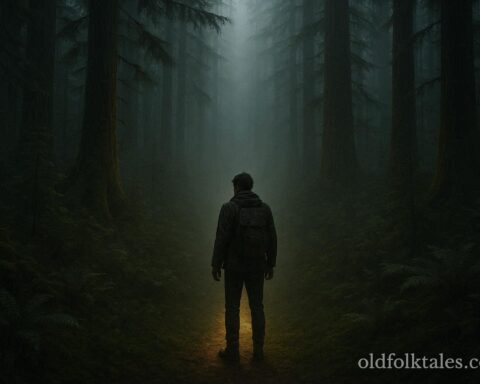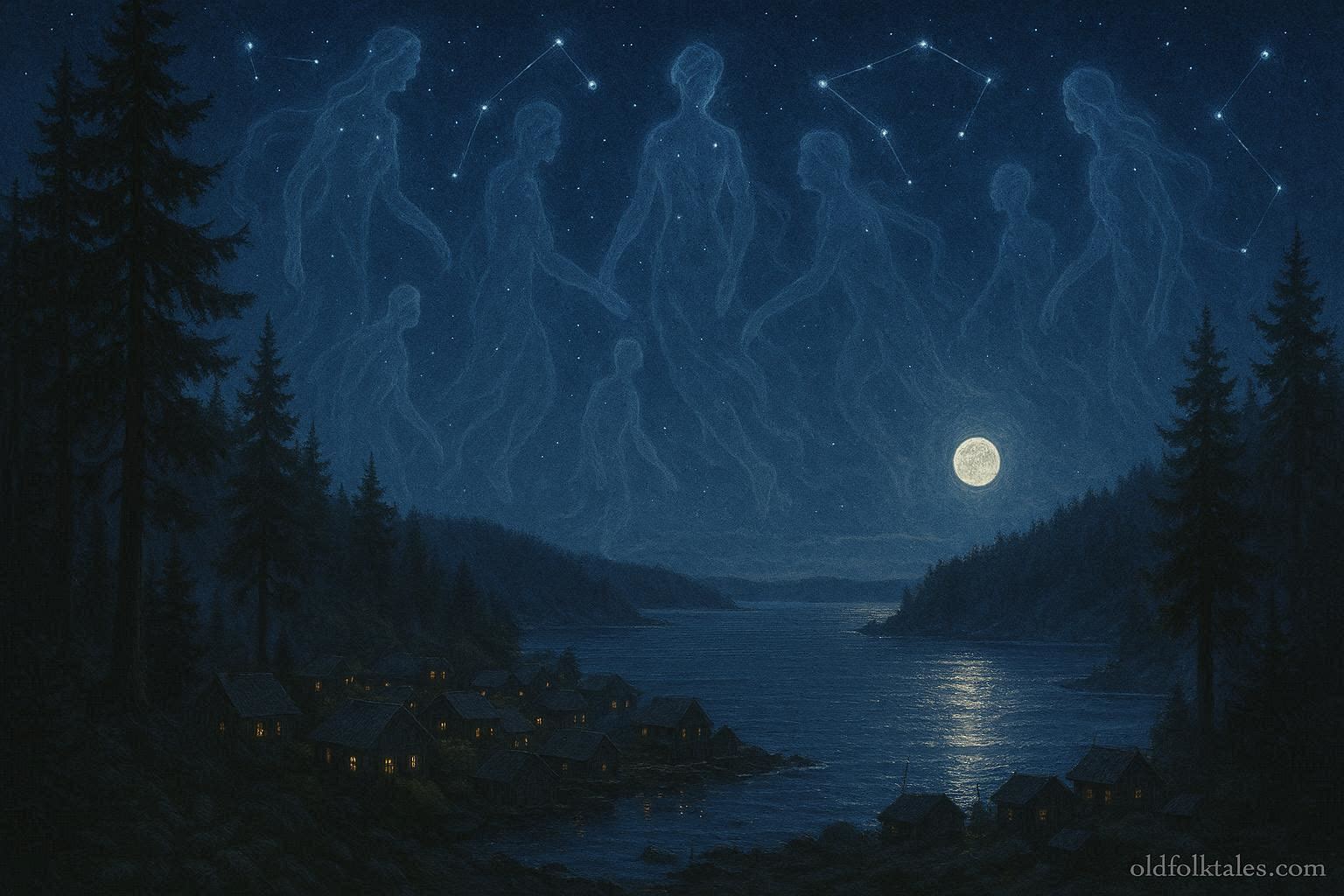
Night along the Pacific Northwest coast did not arrive suddenly. It moved slowly, folding itself over forests, rivers, and inlets like a living blanket. The people who lived there learned to watch the transition carefully. Twilight was not an ending but a conversation between the earth and the sky.
Elders taught that the stars were not fixed ornaments. They were presences. They carried memory. They carried responsibility. Most of all, they carried choice.
Long ago, before constellations were named the same way across maps, people noticed something unsettling. When no one was watching, the stars shifted. Patterns that had guided travel for generations appeared slightly altered by morning. A line of lights that once rose above a mountain ridge would tilt closer to the sea. A familiar cluster would tighten or loosen without explanation.
Explore the heart of America’s storytelling — from tall tales and tricksters to fireside family legends.
This was not spoken of casually. The sky was not accused of error. Instead, people asked what had changed among themselves.
In one village near the mouth of a river, a young girl named Saaya first noticed the movement during a fishing season marked by tension. The salmon run had been poor. Arguments had grown sharper. Families kept more than they shared. Saaya often climbed a smooth rock near the shoreline to watch the stars emerge, counting them as her grandmother had taught her.
One evening, she noticed the Sky Canoe constellation no longer aligned with the river bend it always marked. The canoe seemed to drift sideways, as though avoiding the village entirely.
Saaya told her grandmother, expecting reassurance. Instead, the old woman closed her eyes and nodded slowly. She said the sky had been unsettled before, always during moments when people forgot they were being watched as carefully as they watched the stars.
The elders gathered that night. They did not accuse anyone. They did not name blame. They spoke instead about memory. About agreements older than the village itself. The stars, they said, once walked freely across the sky. They agreed to form paths only after humans promised to honor balance.
Balance was not perfection. It was attention.
Stories passed down explained that some constellations were once people who chose the sky after death. Others were spirits tasked with observing how humans treated land, water, and one another. These beings were not frozen. They adjusted their positions as reminders.
When the stars moved, it was not punishment. It was communication.
Saaya continued watching the sky. On nights when the village shared freely, the constellations seemed calm, evenly spaced, steady in brightness. On nights after conflict, subtle distortions appeared. A star dimmed. A familiar shape bent.
One winter, travelers arrived from upriver, bringing news of illness and scarcity. Fear spread quietly. People spoke less to one another. Fires burned lower. That same week, the Twin Watchers constellation appeared closer together than before, as if closing ranks.
The elders understood. Fear was narrowing the community. The sky reflected that tightening.
In response, the people held a night gathering not to ask for mercy, but to restore recognition. Children were brought forward to name the stars aloud. Elders retold the origin stories so the sky would know it had not been forgotten. Food was shared openly, even when little remained.
By the third night, the Twin Watchers had returned to their familiar distance.
Not everyone believed. Some younger hunters argued that stars moved because people imagined it. They claimed the sky followed laws that did not care about human behavior. To test this, they intentionally ignored the night sky during a long hunt.
They returned days later disoriented. Trails they knew seemed unfamiliar. Landmarks no longer lined up with the stars they expected. It took elders guiding them back at dusk to restore direction.
From then on, no one dismissed the sky again.
The teachings were clear. The constellations did not exist for decoration. They were part of a living system. They shifted when harmony weakened and steadied when respect returned.
Even today, elders say that on rare nights, if you watch carefully and then look away, the stars may return slightly altered. Not enough to frighten you. Just enough to remind you that the sky is not owned.
Explore ancient Native American creation myths and the symbolic tales that shaped America’s belief systems.
Moral Lesson
The story teaches that awareness maintains balance. When people forget their responsibility to one another and the world, the universe responds quietly but unmistakably.
Knowledge Check
- What do the moving constellations symbolize in this legend?
They symbolize a living universe that responds to human behavior and awareness. - Why were children believed to notice star movement more easily?
Because children were thought to observe without fixed expectations or disbelief. - How did the elders respond when the stars appeared disturbed?
They restored balance through storytelling, sharing, and acknowledgment rather than punishment. - What caused the constellations to shift position?
Imbalance within the community such as fear, conflict, or neglect. - Why was ignoring the night sky considered dangerous?
Because it meant severing communication with guiding forces that maintained harmony. - What lesson did the hunters learn from dismissing the stars?
That navigation and certainty depend on respect for forces beyond human control.
Source
Adapted from University of British Columbia Indigenous astronomical oral histories
Cultural Origin
Pacific Northwest Indigenous communities