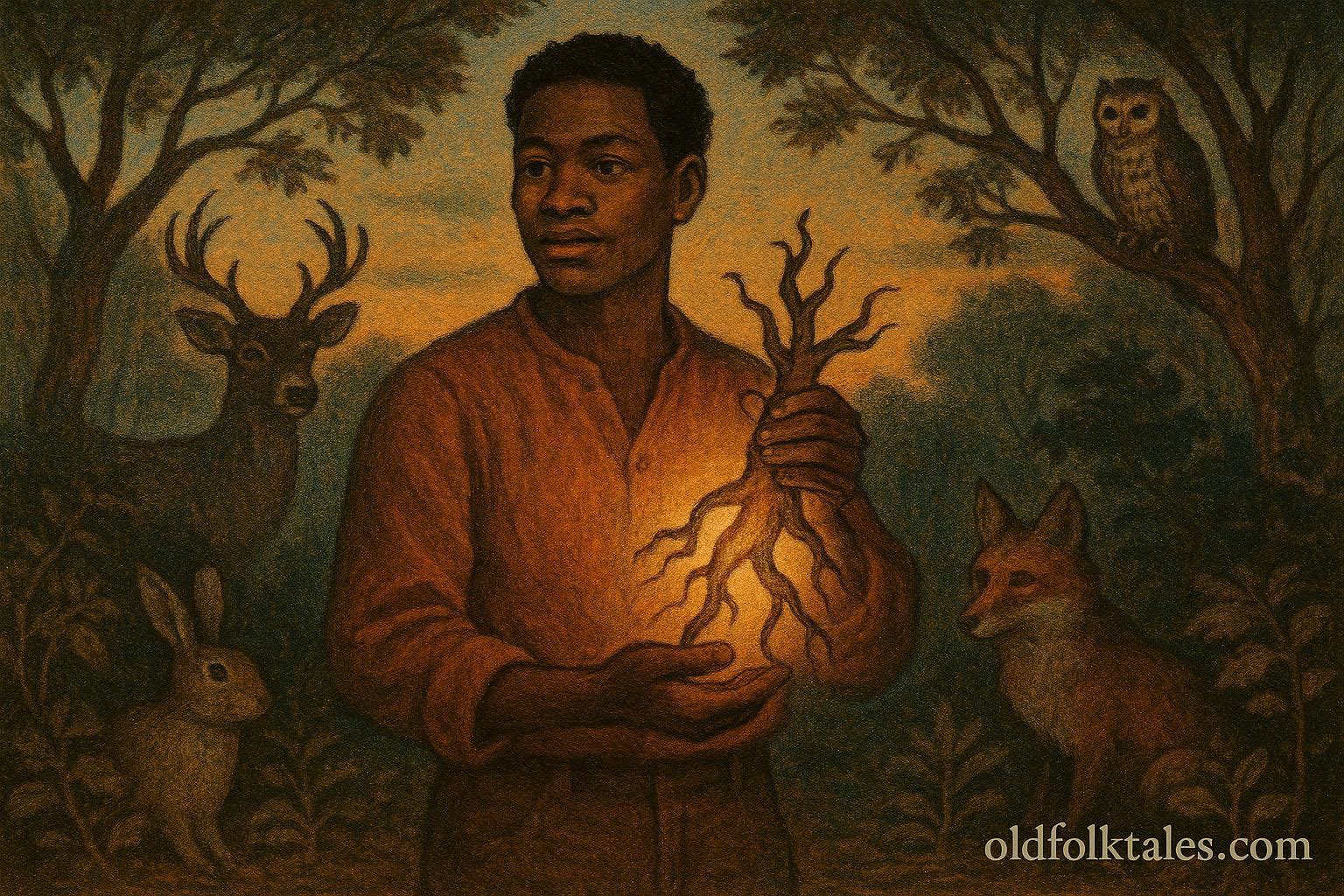
In the deep South, during a time when the land was fraught with hardship and oppression, stories of a clever and unyielding folk hero traveled from house to house, whispered along riverbanks, and passed from elders to children. His name was John the Conqueror, or High John, as people called him, a figure of strength, wit, and resilience whose adventures offered hope to those who felt trapped by circumstances far larger than themselves.
High John was said to have been born with a special charm, a root imbued with mystical powers, which he carried close to his heart. From his earliest days, John exhibited cleverness that defied expectations. He could escape the strictest oversight, solve the trickiest riddles, and navigate dangers that would confound others. Villagers would often say, “Wherever High John walks, trouble follows but never for long.”
One story tells of John confronting a cruel overseer who demanded impossible tasks. The overseer ordered him to plow the entire field alone before sunrise. John smiled subtly, pulling the magic root from his pocket. He whispered to it, and when the overseer returned the next morning, he found the field perfectly plowed, with neat rows stretching far beyond what a single man could accomplish. The overseer could not comprehend how it had been done, and John merely laughed quietly, unseen, at the cleverness that kept him free.
Explore Native American beings, swamp creatures, and modern cryptid sightingsacross the country.
In another tale, John used his wit to evade capture. A band of hunters sought to take him as a prize, believing his charm could bring them fortune. John left decoys, made clever tracks, and even whispered to the animals of the forest to help him mislead his pursuers. Birds distracted the hunters, squirrels led them in circles, and the wind carried his laughter, making them believe he was everywhere and nowhere at once. By the time the hunters gave up, John had vanished into the safety of the woods, leaving behind only tales of his cunning.
High John was not only a trickster but a hero to those who had little power of their own. People would tell him of injustices, and he would use both charm and cunning to right wrongs in subtle ways. He would outsmart greedy landowners, protect children, and retrieve stolen goods, all without drawing attention to himself. His victories were quiet but celebrated in stories, songs, and shared laughter around hearth fires.
One of the most famous adventures involved John crossing a river that had flooded its banks. The villagers feared they would lose their livestock and food stores. John whispered to his root, danced lightly along the riverbanks, and caused a series of clever diversions that led the animals safely to higher ground. When the waters receded, the villagers marveled at the mystery. “It is High John,” they whispered, “who walks the rivers and bends the waters to his will.”
Throughout his tales, John’s freedom was symbolic. Though circumstances tried to confine him, he demonstrated that intelligence, courage, and a touch of the supernatural could preserve one’s dignity and autonomy. He never sought wealth or recognition; his triumphs were about survival, empowerment, and helping others where he could.
Over generations, the stories of High John de Conqueror grew richer. In some, he used his cunning to escape magical traps set by witches. In others, he challenged arrogant spirits with riddles, leaving them humiliated. Each story reinforced his image as a folk hero who represented hope, resistance, and ingenuity. Children would play at being John, reenacting his clever maneuvers and imagining that they, too, could overcome impossible odds.
The folk hero became a cornerstone of African American oral tradition. His tales reminded communities that even in the face of oppression, resilience and creativity could forge paths to freedom. Listeners learned that freedom was not always about brute force. it was about mind, heart, and a spirit that refused to be subdued.
And so, High John de Conqueror’s legend endured, carried by storytellers who understood the power of narrative. Even today, his tales are shared as symbols of cleverness, courage, and the enduring strength of people who, like John, refuse to be conquered.
Click to read all American Folktales — timeless oral stories passed through generations across the United States.
Moral Lesson
Courage, cleverness, and persistence can help overcome oppression, and true empowerment often lies in intelligence and resilience rather than brute force.
Knowledge Check
- Who is High John de Conqueror?
A clever folk hero known for his intelligence and cunning. - What magical item did he carry?
A root imbued with supernatural power. - How did John help others?
By outsmarting oppressors, protecting the weak, and righting wrongs. - What was one of John’s famous tricks?
Using decoys, animals, and clever diversions to evade capture. - What does High John symbolize?
Freedom, resilience, intelligence, and hope in the face of oppression. - How were his stories preserved?
Through oral storytelling, songs, and shared narratives in African American communities.
Source
Adapted from African American folklore hero traditions.
Cultural Origin
African American oral traditions