Beyond the edge of early settlements, where cleared land gave way to thick forests and winding trails, the wilderness stretched wide and uncertain. It was a place of beauty, but also of danger. Paths were not always marked, rivers changed their course, and those who entered without knowledge could quickly lose their way.
In these lands, stories began to spread about a figure who seemed to belong not to any one place, but to the wilderness itself.
They called him Kaintuck.
No one could say exactly where he came from. Some believed he had once been a traveler like many others, someone who had learned the land through experience. Others believed he had always been part of the wilderness, moving through it as naturally as the wind through the trees.
What everyone agreed on was this.
He appeared when he was needed.
Travelers who ventured into unfamiliar territory sometimes found themselves in trouble. A trail would disappear, a river would block their path, or the forest would grow so dense that direction became impossible to judge. In those moments, when uncertainty turned into fear, Kaintuck was said to appear.
Not suddenly.
Not in a way that startled.
But quietly, as though he had been there all along.
Discover chilling ghost tales and haunted places that echo through America’s towns and countryside.
One of the earliest stories told of a small group of settlers attempting to cross a stretch of forest they did not fully understand. They had been following a path for most of the day, but as the sun began to lower, the path faded into the ground. The trees grew thicker, and the land around them became unfamiliar.
They tried to retrace their steps, but nothing looked the same.
The forest had a way of shifting perception, making one direction seem like another. The more they searched, the more uncertain they became. As darkness approached, their situation grew more serious.
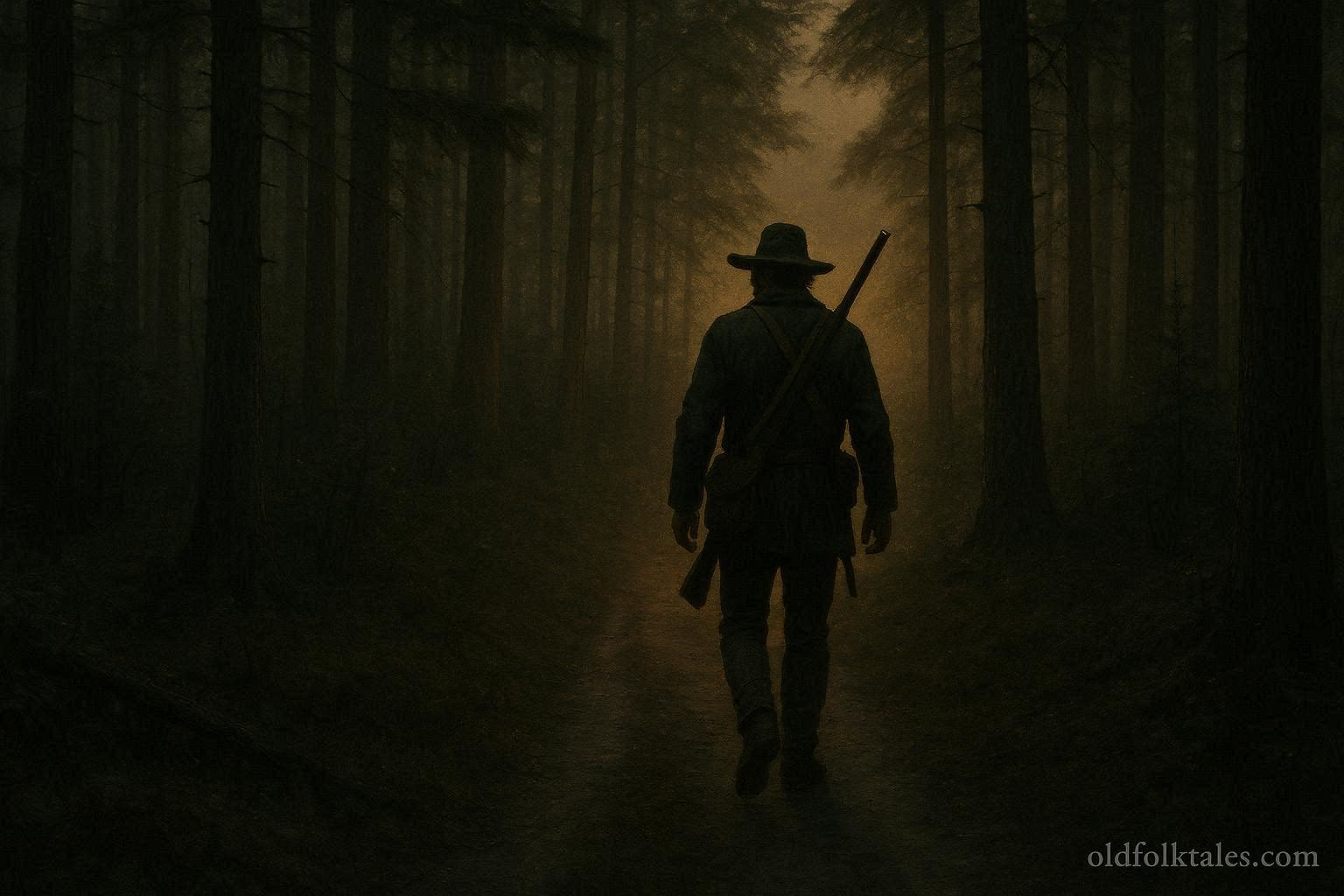
Then, without warning, they noticed a figure standing at a distance.
He did not call out.
He did not wave.
He simply stood, as though waiting.
At first, they hesitated. The wilderness was not a place where trust came easily. But something about the figure felt calm, steady, and certain. When he turned and began to walk, they made a decision.
They followed.
He moved with confidence, stepping over roots and around obstacles as though he knew every part of the land. He did not look back often, but when he did, it was enough to reassure them that they were on the right path.
They walked for what felt like a long time.
The forest gradually began to open, and the ground became easier to travel. Soon, they reached a familiar trail, one they recognized from earlier in their journey. Relief settled over them as they realized they were safe.
When they turned to thank the man, he was gone.
There was no sound of footsteps, no movement in the trees.
Only the quiet of the forest.
Stories like this spread quickly.
Different travelers told similar accounts. Some encountered him near rivers that were difficult to cross. Others saw him when storms approached, guiding them to shelter before the rain began. In every case, he appeared at the moment he was needed most.
And in every case, he disappeared once his purpose was complete.
Kaintuck never stayed.
He did not ask for anything, nor did he explain who he was. His presence was brief but meaningful, leaving behind a sense of guidance that could not be easily forgotten.
Over time, people began to understand his role in a deeper way.
He was not just a man.
He was a symbol.
A symbol of knowledge, of awareness, and of the connection between people and the land. Those who heard his story were reminded that the wilderness was not something to be taken lightly. It required respect, patience, and the willingness to learn.
Elders spoke of Kaintuck as a reminder that guidance can come in unexpected forms.
They encouraged others to remain attentive, to observe their surroundings, and to trust their instincts when faced with uncertainty. They believed that the land itself held wisdom, and that those who listened carefully could find their way.
Even those who never claimed to see Kaintuck felt his presence in other ways.
A sudden clarity when choosing a direction.
A sense of calm in a moment of fear.
A feeling that they were being guided, even when alone.
As years passed and the frontier changed, the story of Kaintuck remained.
It was told around fires, shared among travelers, and passed down through generations. Though the land became more familiar to many, there were always places that remained unknown, always paths that required careful attention.
And in those places, the story continued.
Some say that even now, in the quiet stretches of forest where trails are less traveled, there are moments when a figure can be seen moving ahead, just beyond reach. A guide who does not speak, but leads.
A presence that appears only when needed.
And disappears just as quietly.
The wilderness still holds its mysteries.
And somewhere within it, the spirit of Kaintuck continues to walk, guiding those who are willing to follow.
Click now to read all American Legends — heroic tales where truth and imagination meet, defining the American spirit.
Moral Lesson
Guidance often comes quietly, and those who remain observant and respectful will find their way even in the unknown.
Knowledge Check
- Who was Kaintuck?
A mysterious frontiersman believed to guide travelers in the wilderness. - When did Kaintuck usually appear?
He appeared when people were lost or in danger. - How did he guide the settlers?
He silently led them through the forest to safety. - What happened after he helped them?
He disappeared without explanation. - What did Kaintuck represent?
Knowledge, guidance, and connection to the land. - What lesson does the story teach about the wilderness?
It should be approached with respect and awareness.
Source
Adapted from materials preserved in the Filson Historical Society
Cultural Origin
Kentucky frontier folklore