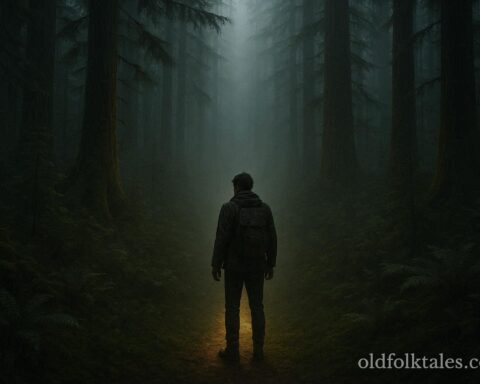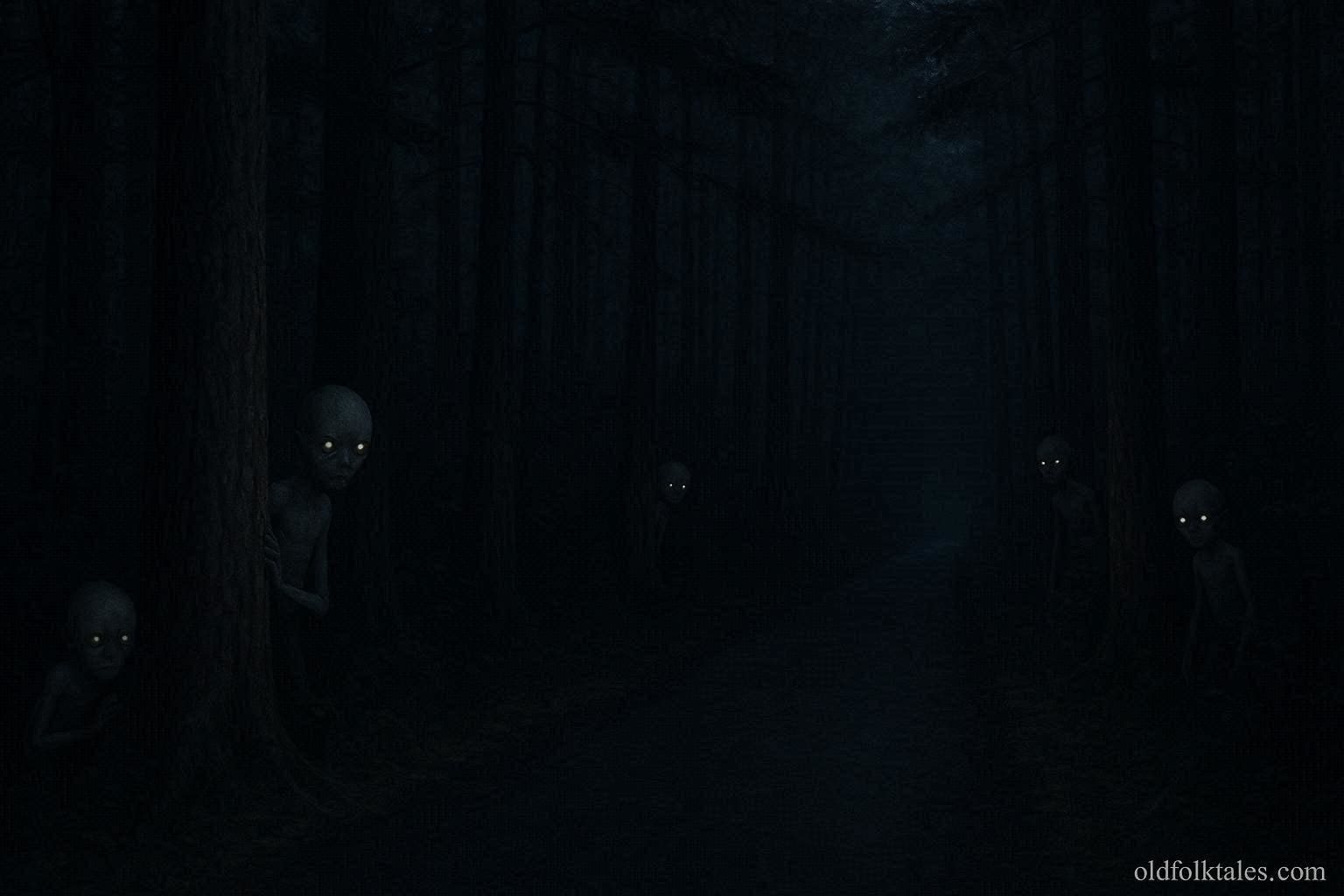
In the quiet forests of Connecticut, where old roads curve through dense trees and abandoned settlements sink slowly back into the land, stories linger that refuse to fade. Drivers passing through these wooded stretches after sunset often feel an unshakable unease, as though something small but watchful moves just beyond the reach of their headlights. Locals have long claimed that these forests are not empty at night. They are home to the Melon Heads.
The Melon Heads are described as small humanoid figures with unusually large, swollen heads and thin, underdeveloped bodies. Their skulls appear disproportionate, bulbous and heavy, forcing their necks to tilt forward as they move. Witnesses often describe their skin as pale or grayish, their eyes wide and reflective in darkness. They are said to move quickly, darting between trees, crouching low, and disappearing silently into brush when approached.
Legends trace their origins to isolated institutions and forgotten experiments from the nineteenth and early twentieth centuries. According to some accounts, children born with severe physical deformities were hidden away by society, confined to remote facilities deep in the forests. When these institutions were abandoned, the children were left behind. Over generations, the stories claim, they adapted to life in the woods, becoming feral and fiercely protective of their territory.
Explore ancient Native American creation myths and the symbolic tales that shaped
Other versions of the tale suggest that the Melon Heads are not the result of neglect but of deliberate experimentation. Local folklore speaks of doctors attempting radical treatments to increase intelligence, only to produce grotesque results. Whether born of tragedy or science gone wrong, the creatures are said to have survived by retreating into the forest, avoiding towns while watching them closely from a distance.
Sightings frequently occur near old roads, particularly those that cut through thick woodland without nearby homes. Drivers report seeing small figures standing at the tree line, motionless and silent, their heads unnaturally large against thin bodies. Others claim to have heard footsteps pacing their cars as they slow down, or soft tapping sounds against doors and windows when vehicles stop unexpectedly.
Residents who grew up near these forests often share childhood warnings passed down by parents and grandparents. Children were told never to wander too far from home, never to follow strange sounds, and never to stop for figures seen along wooded roads at night. These warnings were not always framed as superstition but as practical advice meant to keep children close and safe.
The Melon Heads are said to be intelligent but unpredictable. Some stories describe them as curious rather than violent, observing humans with fascination rather than hostility. Other tales portray them as aggressive when threatened, capable of surrounding vehicles or forcing intruders to flee the forest in panic. The inconsistency of these accounts adds to their mystery, making it difficult to separate fear from folklore.
Despite the lack of physical evidence, the legend persists because of its emotional weight. It reflects fears of abandonment, societal neglect, and the consequences of hiding uncomfortable truths. The forests where the Melon Heads are said to dwell often contain real abandoned structures, crumbling foundations, and forgotten roads, blurring the line between imagination and history.
Modern retellings continue to circulate, especially among teenagers and urban explorers drawn to forbidden places. Nighttime dares, whispered stories, and shared experiences keep the legend alive. Even those who dismiss the tale admit that the forests feel different after dark, heavier with silence and expectation.
What makes the Melon Heads enduring is not just their appearance but what they represent. They are reminders of how easily people can be forgotten, how isolation can transform, and how landscapes remember what humans try to erase. Whether real or imagined, the Melon Heads remain embedded in Connecticut’s wooded corridors, watching roads that few now travel willingly at night.
Click to read all American Cryptids & Monsters — creatures of mystery and fear said to inhabit America’s wild landscapes.
Moral Lesson
The story of the Melon Heads reflects the dangers of abandonment and neglect. It warns that ignoring suffering does not erase it, and that forgotten places often carry lasting consequences. Compassion and responsibility matter, even when society turns away.
Knowledge Check
- Where are the Melon Heads said to live?
Answer: In forested areas and near old roads in Connecticut woodlands. - What physical feature defines the Melon Heads?
Answer: Their unusually large, bulbous heads compared to their small bodies. - What origins are commonly suggested in folklore?
Answer: Abandoned institutions, neglected children, or failed medical experiments. - When are sightings most often reported?
Answer: At night, especially along quiet forest roads. - How do the Melon Heads typically behave toward humans?
Answer: They observe from a distance and may act unpredictably if threatened. - What broader theme does the legend represent?
Answer: Fear of neglect, isolation, and the consequences of societal abandonment.
Source
Adapted from Connecticut Melon Heads folklore and regional oral traditions.
Cultural Origin
Connecticut woodlands