Long ago, in the rugged northern forests of America, where towering pines whispered to the wind and the snow stretched farther than the eye could see, there lived a giant lumberjack named Paul Bunyan. His story was told wherever the smell of pine tar and the sound of an axe could be found, from Maine to Oregon, from logging camps to river towns.
They say Paul was no ordinary man. The day he was born, the midwife fainted, and it took five storks just to carry the enormous baby to his parents’ cabin. When he clapped his hands in delight, the noise shattered every window in the house. When he cried, the neighbors had to plug their ears with moss. Even as an infant, Paul Bunyan was a force of nature.
Step into shadowy legends of restless spirits and ghostly travelers in American Ghost Stories.
As he grew older, his strength only multiplied. When he walked, the earth trembled. When he laughed, avalanches tumbled down from distant mountains. His footprints filled with water and became shimmering lakes, and it was said that some of the greatest waterways in the North were shaped by his very steps.
Paul soon became a legend among lumberjacks. With his mighty axe, he could fell a hundred trees in a single swing. His beard froze into icicles during the bitter winters, yet his heart was always warm toward his crew. Wherever he went, forests fell, rivers changed course, and new towns rose behind him.
The Discovery of Babe
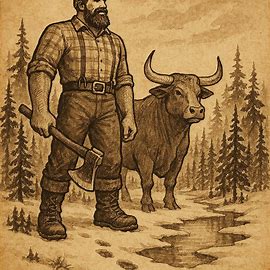
One winter, when the snow lay deep and silent across the land, Paul Bunyan was trekking through a frozen valley. As he looked across the drifts, he spotted something curious, a giant blue shape half-buried in snow. Brushing away the frost, he found a young ox, frozen stiff from the cold.
Paul built a roaring fire beside the creature and waited patiently until the ice began to melt. At last, the ox stirred, shook the snow from its back, and opened its great blue eyes. From that day forward, the animal followed Paul faithfully wherever he went. Paul named him Babe the Blue Ox.
Babe grew to match Paul’s enormous size. The two became inseparable, a team as vast as the wilderness itself. They traveled across America’s forests, cutting timber and shaping the land as they went. Wherever Babe stepped, deep footprints filled with water and became ponds and lakes. Together, they carved rivers, leveled mountains, and cleared paths through the thickest woods.
The Mighty Logging Crew
Paul Bunyan’s logging camp was unlike any other. His lumberjacks were men of legendary size and strength themselves, said to be as tall as pine trees and as hearty as grizzly bears. They could saw trees by the mile and chop down entire forests before breakfast.
At mealtime, the cooks prepared flapjacks on griddles so large that the camp cooks had to strap on skates to slide across the surface and flip them with giant shovels. The aroma of bacon and syrup drifted through the woods for miles. It was said that Paul’s breakfast spoon was so big it took a team of oxen to lift it, and his coffee cup could float a canoe.
No storm was too fierce for Paul’s crew. When snow buried the camp, Babe plowed through the drifts, clearing paths as high as cabins. When rivers froze solid, Paul cracked the ice with his axe and let the water flow again. Under his guidance, the forests of the North yielded endless timber that built America’s early towns and cities.
The Legend Lives On
Years passed, and the forests began to thin. Paul and Babe had done their work well. When the last great timber job was finished, they looked around at the wide-open land they had helped shape. Paul patted Babe’s neck and smiled. “We’ve done all we can here, old friend,” he said.
Together, they wandered north, deeper and deeper into the wilderness, until one day they simply vanished into the Great North Woods. Some say they’re still there, resting in the quiet forests beyond human reach. Others believe they went to carve out new worlds beyond the horizon.
But whenever thunder rolls across the sky, people still whisper that it’s Paul Bunyan’s axe striking against the mountains. And when the northern lights flicker over the snow, they say it’s Babe’s hooves sparking fire as he runs across the frozen heavens.
Discover African American wisdom, Native American spirit stories, and the humor of early pioneers in American Folktales.
Moral Lesson
This American folktale teaches lessons on strength, teamwork, and the enduring power of legend. Paul Bunyan and Babe remind us that greatness isn’t just about might, it’s about partnership, perseverance, and leaving a legacy that inspires generations.
Knowledge Check
1. Who are the main characters in this folktale?
The main characters are Paul Bunyan, the giant lumberjack, and Babe the Blue Ox, his loyal companion.
2. What region of America does this story come from?
The tale originates from Northern lumberjack folklore, especially from Minnesota, Michigan, and Wisconsin.
3. How did Paul Bunyan find Babe the Blue Ox?
He discovered Babe frozen in the snow during a harsh winter and revived him by a campfire.
4. What is one famous trait of Paul Bunyan’s logging crew?
They were so strong and large that they could saw trees by the mile and cook flapjacks on enormous griddles.
5. What natural features are said to have been created by Paul and Babe?
Lakes, rivers, and valleys were believed to have formed where they walked and worked.
6. What is the symbolic meaning of Paul Bunyan and Babe?
They represent human strength, the spirit of adventure, and the American ideal of taming nature through hard work and cooperation.
Source: American folktale, United States. Adapted from Paul Bunyan and His Blue Ox by James MacGillivray (1910).
Cultural Origin: United States (Northern lumberjack folklore — Minnesota, Michigan, Wisconsin)