Long before the doors were locked for the final time, the mall had already begun to hollow out. Stores closed one by one, their signs removed but outlines still visible like faded scars. Escalators slowed, then stopped. Music that once played endlessly above the food court fell silent. What remained was not sudden ruin, but gradual forgetting.
In Rust Belt suburbs across the Midwest, shopping malls had once functioned as modern town squares. Teenagers gathered there after school. Elderly couples walked laps beneath climate controlled ceilings. Jobs, routines, and identities formed around retail schedules and seasonal sales. When manufacturing declined and commerce shifted elsewhere, these spaces lost their purpose faster than they could adapt.
It was after abandonment that the stories began.
Security guards hired temporarily during early closure phases reported seeing movement inside sealed corridors. At first, they assumed squatters. Footsteps echoed where no one should be. Shapes passed storefronts with gates pulled down tight. But when patrols followed, they found no evidence of forced entry. No warmth. No signs of habitation.
Explore the heart of America’s storytelling — from tall tales and tricksters to fireside family legends.
Later, when power was cut entirely, reports continued.
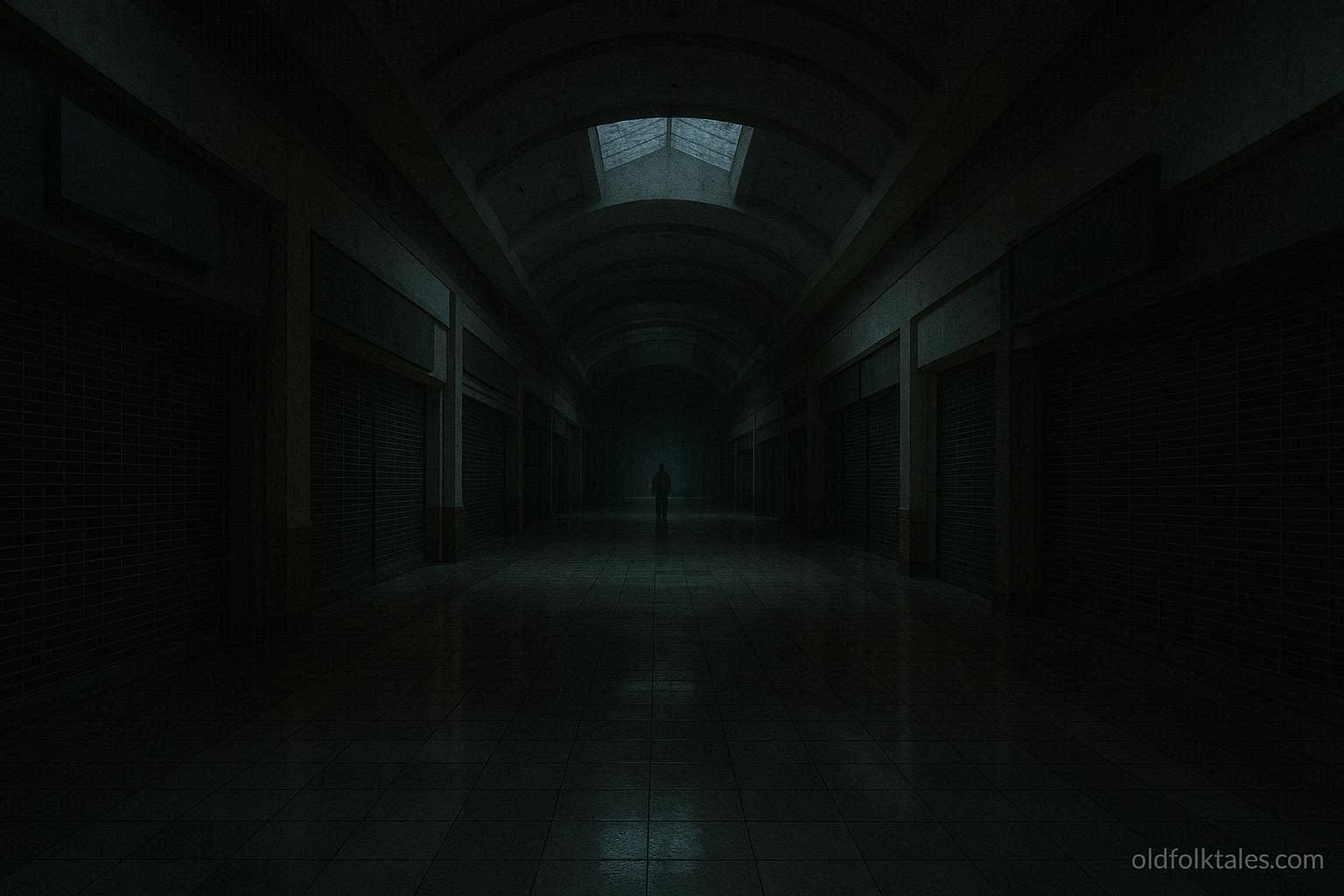
Urban explorers slipping inside through roof access or service hallways described seeing a figure moving at the edge of their vision. Always upright. Always human shaped. It never approached directly. It moved through old anchor stores, vanished into service corridors, and appeared again on upper levels where escalators no longer functioned.
Witnesses rarely described details. They agreed on behavior instead. The figure followed routines.
It passed former clothing stores in predictable order. It paused where registers once stood. It lingered near the food court, standing still beneath dark skylights. It avoided exits.
One explorer recalled hiding behind a kiosk after hearing footsteps that echoed too evenly to belong to an animal. He described the figure walking the main concourse with deliberate pace, stopping at every intersection as if deciding where to go next. When the witness shifted his weight, the figure stopped instantly, though it did not turn.
The Abandoned Mall Stalker is not described as aggressive. It does not chase. It does not block exits. Those who encounter it feel something closer to displacement than fear. A sense of being out of place, as though they were trespassing on something still in use.
Folklorists studying post industrial spaces note a pattern. Locations designed for constant human presence often develop narratives centered on lingering routines. The mall was never meant to be empty. Its architecture assumes flow. Movement. Consumption. When that stopped, something remained misaligned.
The stalker is often interpreted as a manifestation of consumer momentum with nowhere left to go. A shape built from habit rather than intention. It walks because people once walked. It pauses because money once changed hands. It repeats because repetition was the mall’s purpose.
Some accounts suggest the figure reacts to sound. Footsteps attract attention. Dropped objects cause it to stop and listen. Yet it never speaks. Never gestures. It simply continues.
In one documented account from a closed Illinois mall, a photographer captured a series of long exposure shots inside an abandoned department store. Reviewing the images later, he noticed a blurred vertical form appearing consistently near former checkout counters. The shape did not match his own movement. It appeared only in sections associated with high traffic.
The mall stalker does not haunt memories of joy. It haunts systems.
Rust Belt communities experienced malls as promises. Stable jobs. Accessible goods. Social mobility under fluorescent lights. When those promises collapsed, the buildings remained as monuments to interruption. The stalker reflects that pause, that unresolved transition.
People who enter these spaces describe the soundscape as altered. Footsteps seem louder. Air feels thick. Orientation becomes difficult despite familiar layouts. The stalker appears during these moments, when the building’s logic reasserts itself.
Unlike traditional monsters, the stalker does not originate from violence or death. It originates from abandonment. From a system left running without purpose.
Some believe the figure represents workers displaced when stores closed. Others see it as the mall itself, personified, attempting to fulfill a role it no longer understands. Folklore rarely settles such questions.
What remains consistent is behavior. The stalker never leaves the mall. Sightings do not extend beyond parking lots. It belongs entirely to the interior. To corridors designed to channel spending and social life.
Urban decay researchers note that many abandoned malls are eventually demolished. When that happens, reports of the stalker cease. No migration occurs. No relocation. The figure disappears with the structure.
This has led to speculation that the stalker requires architecture. That it is sustained by spatial memory rather than geography. When walls fall, routines dissolve.
Those who encounter the stalker and leave describe an urge to move quickly afterward. To exit the space of repetition. To reenter places still alive with purpose.
The Abandoned Mall Stalker does not guard treasure. It does not punish trespass. It witnesses.
It walks halls built for crowds that never return, carrying the weight of a system that forgot how to stop.
Click to read all American Cryptids & Monsters — creatures of mystery and fear said to inhabit America’s wild landscapes.
Moral Lesson
When systems collapse without closure, their routines linger. Spaces built without plans for ending often remember longer than the people who used them.
Knowledge Check
1. Where is the Abandoned Mall Stalker most often seen?
Inside fully closed and abandoned shopping malls.
2. How does the figure typically behave?
It follows repetitive walking patterns and avoids direct interaction.
3. What emotion do witnesses most commonly report?
Displacement rather than fear.
4. What does the stalker symbolize?
The lingering routines of consumer culture after abandonment.
5. Does the figure leave the mall grounds?
No, sightings are confined to interior spaces.
6. What happens to reports when malls are demolished?
Sightings stop entirely.
Source
Adapted from University of Illinois urban decay folklore archives and post industrial landscape studies.
Cultural Origin
Rust Belt suburban regions of the United States.