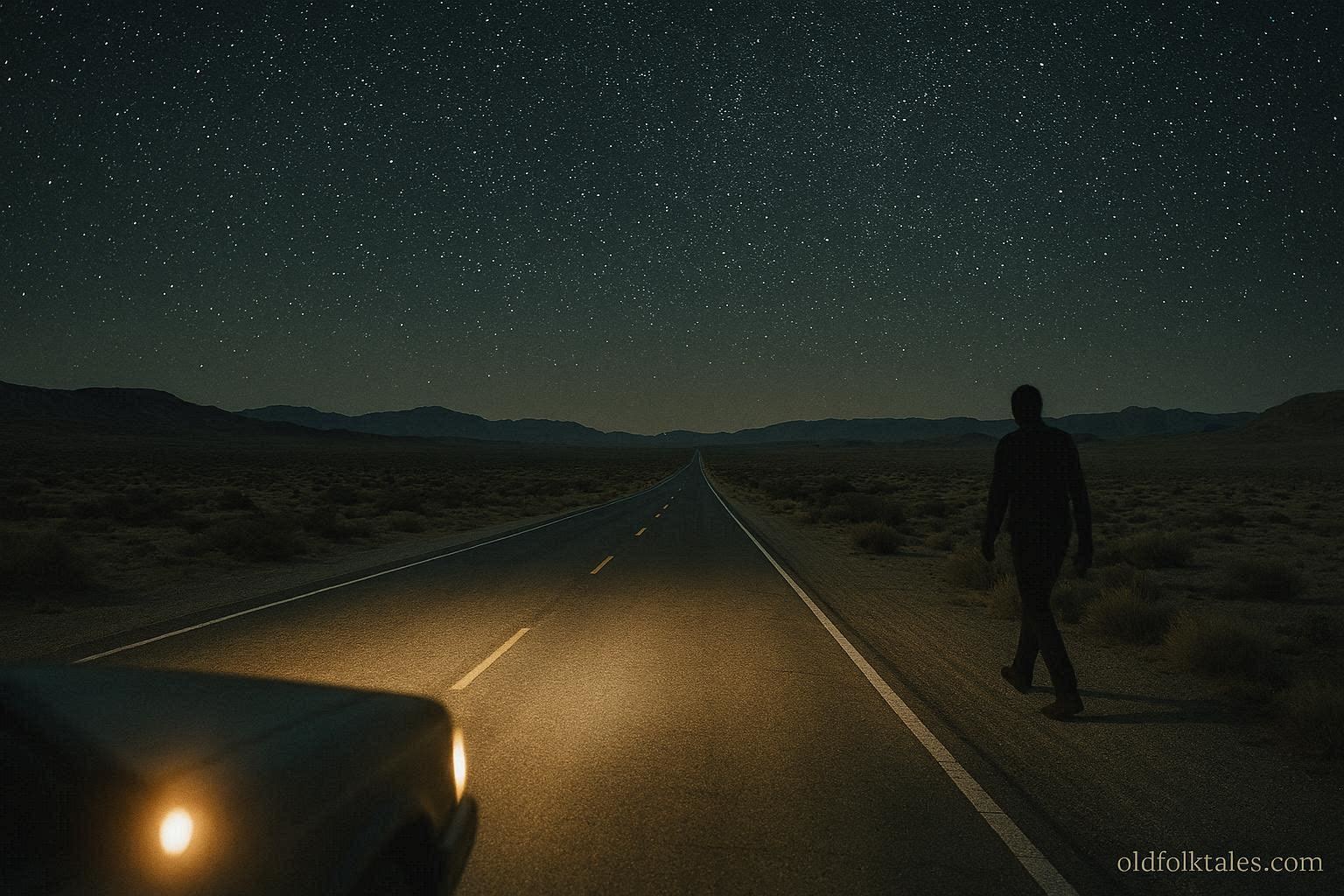
Interstate 8 stretches across the Southwestern desert like a silver ribbon. During the day it shimmers under the sun. At night it becomes a narrow path through darkness, bordered by scrub and mesas. The highway connects cities and towns, but the land between seems endless. Drivers crossing it after midnight often feel as if they are the only people in the world. The desert is vast and indifferent. That is when the Desert Walker appears.
Motorists first see it as an ordinary person standing on the shoulder of the road. At night, the heat of the day has faded. Only headlights illuminate the edges of the asphalt. Travelers think the figure is a stranded hiker or a hitchhiker seeking help. They glance, then focus back on the road. But the Walker does not disappear. It begins moving in tandem with traffic. It does not hurry or lag. It matches the speed of each car, staying perfectly aligned with the highway.
The Desert Walker is human shaped but featureless. Witnesses rarely note clothing or facial details. Its movements are smooth and measured. Its stride is consistent. Its arms swing only slightly. Its head is always forward. It does not cross lanes. It does not step onto the asphalt. It simply walks beside vehicles as if the road itself has chosen to accompany it.
Discover chilling ghost tales and haunted places that echo through America’s towns and countryside.
The phenomenon is frightening not because it is violent, but because it is persistent. Drivers report seeing the Walker for miles. Some spend forty minutes or more on the highway with it pacing beside them. Others describe blinking, looking away, and finding it still there. Its presence seems independent of their speed. Accelerating does not leave it behind. Slowing does not allow it to pass. It exists within the rhythm of the road.
When a vehicle stops, the Walker stops as well. Those who pull over describe an odd sensation. The desert feels larger, as if it has expanded around them. The asphalt seems narrower. Time slows. The Walker does not approach, but its presence presses against perception. Many drivers remain inside their cars, hesitant to step out, unsure if movement will provoke a response. When they resume driving, the Walker resumes walking beside them, maintaining the same exact pace.
Arizona State University researchers have documented multiple independent accounts spanning decades. Truck drivers, commuters, and tourists alike describe similar experiences. The Walker appears along long stretches of desert between towns. Its silhouette is always upright and human, but its lack of detail and flawless alignment defy ordinary explanation. The consistency across accounts has made it one of the most compelling modern highway cryptids.
One trucker recalled seeing the Walker east of Yuma just after midnight. He was transporting goods across the desert. The figure appeared on the shoulder, pale in the glow of his headlights. He maintained speed, checking mirrors constantly. For more than thirty miles, the Walker kept pace. When he finally took an exit to refuel, the Walker paused at the ramp, watching him leave without crossing the road. It remained on the shoulder until he returned to the highway, at which point it resumed its perfect walking rhythm.
Some witnesses describe hearing footsteps. Others report a faint swishing noise that seems to echo in time with their vehicle. The sound does not belong to the car. It comes from the Walker. Those who have left their vehicles to investigate report feeling an oppressive stillness. The desert becomes heavy. The air seems thicker. Even when standing still, the Walker retains a presence. Most return to their cars quickly, preferring observation over confrontation.
Folklorists studying highway cryptids note that modern roads create unique types of monsters. Unlike forests or urban streets, highways are transitional spaces. People move through them quickly. They exist between destinations. Fear arises not from attack but from accompaniment. The Desert Walker is not aggressive. It does not chase. It does not threaten. It simply reflects the tension between motion and stillness, between traveler and landscape.
Some interpretations suggest that the Walker represents persistence without direction. It may be born from the rhythm of the road itself. Highways are arteries of modern life, but they carry travelers who are often alone, tired, and isolated. The Walker mirrors that experience. It embodies motion without purpose, a presence that follows the living without needing to interact.
The Walker does not appear in daylight. Heat and traffic disrupt its rhythm. It is only at night, when roads narrow under headlight beams and the desert becomes silent, that it emerges. Witnesses report that it appears for no longer than the journey allows. When they blink or divert their eyes for a moment, the figure is always still in their peripheral vision. When they finally reach the next town or exit, the Walker is gone. It disappears completely. There is no fading. There is no turning back. Only absence.
Unlike traditional monsters, the Desert Walker has no origin in violence or death. It is a product of environment, movement, and human perception. It occupies a liminal space between reality and narrative, between the functional purpose of the road and the psychological weight of traveling through vast emptiness.
Those who have encountered the Walker often describe lasting effects. They take longer breaks, avoid driving at night, or simply watch more closely while moving through the desert. They report a sense of humility before the land, a recognition that the road is not just a path but a space with memory and presence.
The Walker is confined to the highway. It does not follow into towns or parking areas. It does not appear in gas stations or rest stops. It exists only along the stretch of road between destinations, pacing in quiet companionship with those who travel it. When the road disappears, so does it. When the asphalt ends, the figure vanishes into the desert night.
The Desert Walker of Interstate 8 is not a threat. It is a reflection of movement, solitude, and human presence in empty landscapes. It reminds travelers that even in the midst of progress, there are moments when the environment itself watches, waits, and persists alongside them.
Encounter the strange and the unseen — from Bigfoot to regional monsters hiding in America’s forests.
Moral Lesson
Constant motion without reflection can create the illusion of progress. Sometimes the road reminds you that presence matters more than speed.
Knowledge Check
1. Where is the Desert Walker most commonly seen?
Along Interstate 8 in the Southwestern desert.
2. How does the Walker move in relation to vehicles?
It paces traffic at the same speed without falling behind or advancing.
3. Does the Walker interact with drivers directly?
No, it remains silent and non confrontational.
4. What happens when a driver stops the car?
The Walker stops moving as well.
5. Does the Walker ever leave the highway?
No, sightings are confined strictly to the road.
6. What feeling do most witnesses report?
Dislocation and unease rather than panic.
Source
Adapted from Arizona State University transportation folklore collections and Southwestern highway legend studies.
Cultural Origin
Southwestern desert corridor communities of the United States.