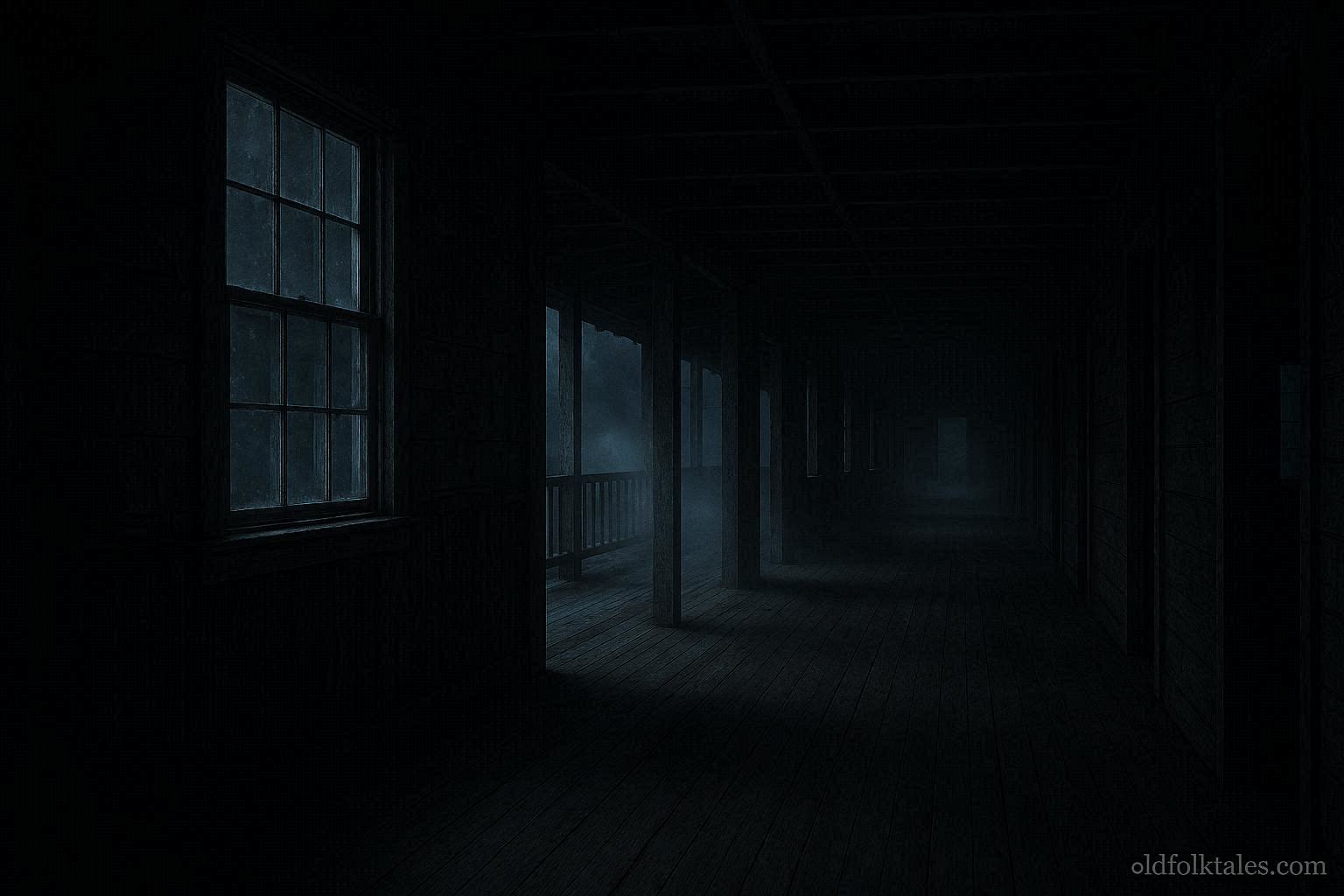
Night carries differently across the waters of San Francisco Bay. Sound travels farther than memory, and light lingers longer than form. On Angel island, silence settles in layers, broken only by wind, water, and the distant pulse of the city. Yet within the closed barracks and abandoned halls, another sound is said to rise. Soft. Hollow. Measured.
A bell.
Not loud enough to alarm. Not sharp enough to demand attention. Just clear enough to be recognized.
Angel Island once served as a threshold between worlds. For countless immigrants arriving on the Pacific Coast, it was not a gateway but a holding place. People waited there for days, weeks, sometimes months. Families were separated. Names were changed. Questions were repeated. Lives were suspended between departure and arrival, belonging and exclusion.
Explore the heart of America’s storytelling — from tall tales and tricksters to fireside family legends.
The boardinghouses and detention barracks were built for control, not comfort. Narrow rooms, shared spaces, rigid schedules. Bells regulated daily life. Bells for meals. Bells for movement. Bells for inspections. Bells for silence.
Waiting became a discipline.
Those who passed through the island carried more than luggage. They carried uncertainty, fear, and the ache of separation. Some were detained alone while relatives were sent onward. Others were rejected and sent back across the ocean, their futures erased by paperwork and policy.
When the detention center closed, the buildings remained. Time weathered them. Paint peeled. Floors warped. Windows clouded. The bells were removed, their metal repurposed or discarded.
But memory did not leave.
The first reports of the ringing came decades later. A maintenance worker doing late checks heard a bell inside a locked building. He assumed vandalism. When he entered, the halls were empty. No devices. No wires. No loose metal. The sound had stopped.
Later, park staff heard it too. Always at night. Always faint. Always from the direction of the old immigration barracks.
Visitors described it differently. Some said it sounded like a boarding bell. Others said it resembled a ship’s call. A few compared it to a school bell, thin and echoing. But the timing remained consistent. Late hours. Quiet conditions. Empty buildings.
The bell never rings in daylight.
Those who study the island’s history began to connect the stories to recorded accounts from former detainees. Many described the bells as the most oppressive part of daily life. Not the rooms. Not the food. The bells. They controlled movement, time, rest, and hope. A bell meant wait. A bell meant stop. A bell meant line up. A bell meant separation.
It was not a symbol of guidance. It was a symbol of power.
The haunting, however, reshaped the meaning.
The bell that rings now does not command. It does not order. It does not regulate. It echoes.
People who hear it describe a feeling rather than fear. A heaviness. A presence. A sense of unresolved waiting.
Some claim the bell sounds most often on anniversaries of mass detentions or deportations. Others say it rises during fog, when the bay blurs boundaries and the island feels suspended between land and water, past and present.
No figure accompanies the sound. No footsteps. No shadows. Just the bell.
One account describes a late night ranger hearing it near the women’s barracks. As he approached, the ringing slowed, stretched, and faded. The building was empty. The doors were locked. The wind had dropped. The bay was calm.
Another tells of a historian working alone inside the museum space. She heard the bell once. Then again. She described it not as frightening, but as intimate, like a sound meant for those who remembered rather than those who heard.
Local belief holds that the bell belongs to enforced waiting itself. That the space remembers the people held there. That the buildings absorbed the rhythm of separation and now release it when silence grows deep enough.
Some say the bell calls no one forward. It simply reminds the living that waiting can wound as deeply as violence.
Unlike other hauntings, there is no danger associated with the sound. No harm follows it. No accidents. No threats. Only remembrance.
Visitors who learn the story often stand still when they hear distant ringing. They do not run. They listen. Some close their eyes. Some whisper names of ancestors who passed through similar gates.
The bell does not seek attention. It does not seek fear. It exists as memory made audible.
Angel Island is now a place of history, education, and reflection. The barracks stand as witnesses. The walls hold inscriptions left by detainees in multiple languages. Poems. Names. Dates. Prayers. Desperation carved into wood.
The bell adds another layer.
It reminds the living that injustice leaves echoes. That displacement lingers. That separation does not end when buildings close.
And at night, when the bay grows still and the city quiets, a soft ringing sometimes drifts through empty halls.
Not a call to gather.
Not a command to move.
Just the sound of waiting that never fully ended.
Click to explore all American Ghost Stories — haunting legends of spirits, lost souls, and mysterious places across the U.S.
Moral Lesson
Injustice does not vanish when systems close. Memory remains, and unresolved suffering continues to speak through the places it shaped.
Knowledge Check
1. Where does the bell ring?
Inside the closed immigration barracks and boardinghouses of Angel Island.
2. When is the bell heard?
At night, when the buildings and island are quiet.
3. What did bells represent during the island’s operation?
Control, waiting, separation, and enforced order.
4. Does anyone appear with the bell?
No, the sound occurs without visible figures.
5. What emotion does the bell evoke rather than fear?
Longing, memory, and unresolved waiting.
6. What does the haunting symbolize?
Displacement, injustice, and the lingering impact of enforced separation.
Source
Adapted from University of California Asian American historical folklore projects and Pacific Coast immigrant narrative archives.
Cultural Origin
Pacific Coast immigrant communities.