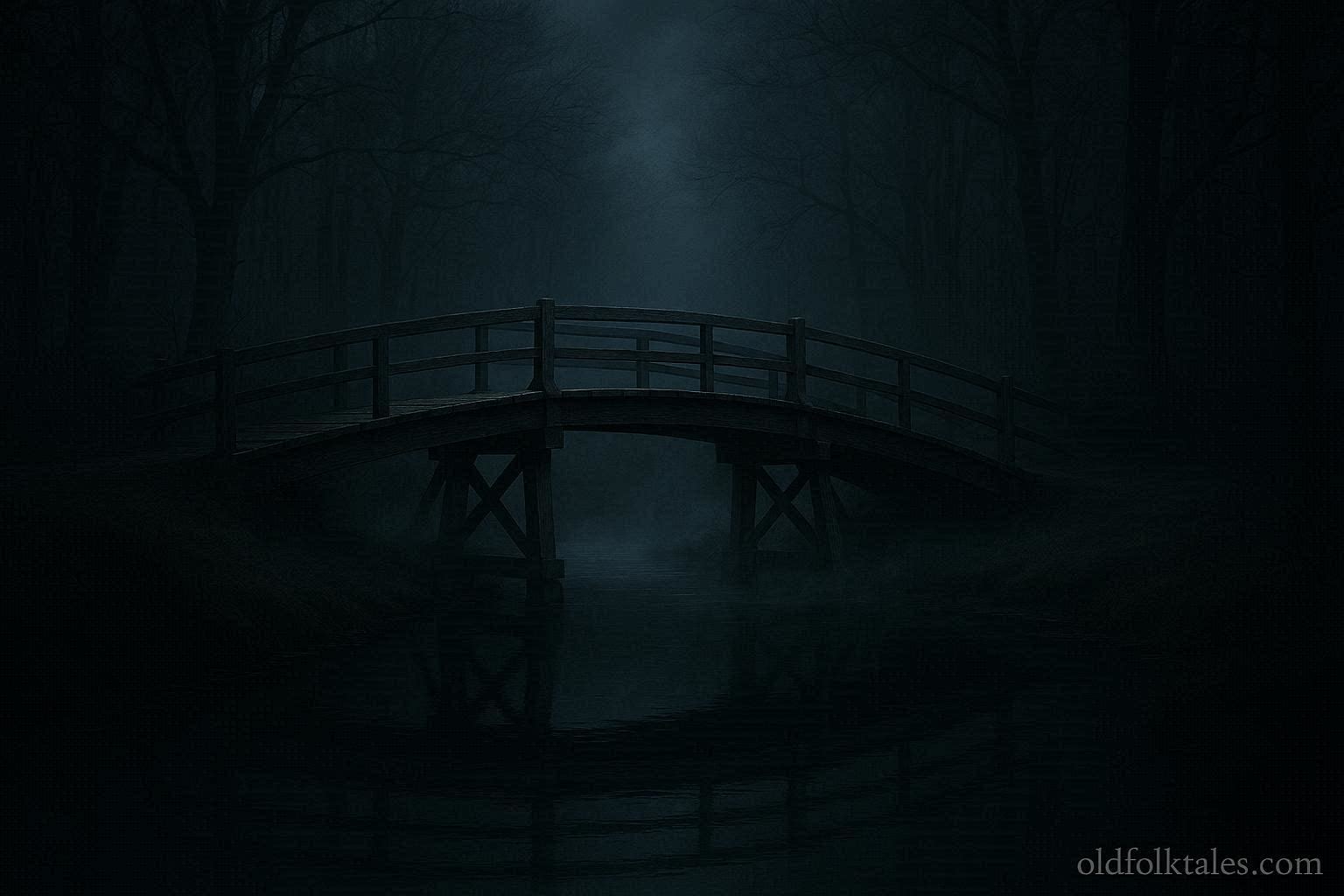
Far from the noise of towns and passing traffic, there stood a narrow wooden bridge that crossed a slow and quiet stream. It connected two stretches of land used mostly by farmers and travelers who knew the area well. During the day, the bridge appeared ordinary.
It was built from aged wood, its surface worn smooth by years of footsteps and wagon wheels. The rails stood firm, though time had left its marks in the form of cracks and faded color. Nothing about it seemed unusual in the light of day.
But when night fell, the bridge became something else entirely.
Especially on nights when the air was still.
There were no winds moving through the trees, no rustling leaves, and no sound of water strong enough to carry across the land. Everything would grow quiet, almost too quiet, as though the world itself had paused.
It was in that silence that the sound would begin.
A low, steady hum.
At first, it was easy to dismiss. Those who heard it for the first time often thought it came from far away, perhaps from distant machinery or movement beyond the hills. But as they stepped closer to the bridge, the truth became clear.
Explore the heart of America’s storytelling — from tall tales and tricksters to fireside family legends.
The sound was coming from beneath it.
It was not loud, but it was deep. It carried a vibration that could be felt as much as heard, moving through the wooden planks and into the ground below. It did not rise or fall like the sound of wind. It remained constant, steady, and unchanging.
Those who stood on the bridge could feel it beneath their feet.
A quiet trembling.
A presence that could not be seen.
People began to speak of it.
At first, only a few shared their experiences. Farmers returning late from their fields mentioned the sound in passing. Travelers spoke of it cautiously, unsure of what they had heard. But as more stories emerged, a pattern formed.
The humming only happened under certain conditions.
It came when the night was still.
It came when the air carried no movement.
And it always came from the same place.
Beneath the bridge.
Elders in the community began to reflect on what this might mean. They had long believed that certain places held more than physical structure. Some locations carried memory, shaped by the events that had taken place there.
They explained that sound was one way such memory could remain.
Not as voices or words, but as something deeper. A resonance. A vibration tied to the past, repeating itself quietly over time.
The bridge, they said, might be one of those places.
One story told of a man who decided to investigate the sound more closely. He had heard the stories but did not believe them. To him, there had to be a simple explanation.
One night, when the air was completely still, he walked to the bridge alone.
As he approached, he heard it.
The hum.
It was exactly as others had described. Low, steady, and impossible to locate beyond the fact that it came from below. He stepped onto the bridge and paused, listening carefully.
The sound did not change.
He moved slowly across the planks, testing each step, trying to find a point where the sound grew stronger or weaker. But it remained the same, as though it existed everywhere beneath him at once.
Curious, he leaned over the side and looked down into the darkness.
The stream below reflected no movement.
There was no visible source.
No shifting water, no animals, nothing that could explain what he was hearing. Yet the sound continued, steady and certain.
For a moment, he felt something unexpected.
Not fear exactly, but awareness.
The kind that comes when something cannot be explained through ordinary understanding. He stepped back from the edge and stood still, allowing the sound to exist without trying to control it.
After some time, he left the bridge.
The moment he stepped away, the hum faded.
It did not follow him. It remained behind, tied to the place where it belonged.
When he shared his experience, his tone had changed. He no longer dismissed the stories. Instead, he spoke with quiet respect, acknowledging that not everything needed to be explained to be understood.
Others who heard the hum came to similar conclusions.
Some avoided the bridge at night, choosing longer paths to reach their destination. Others visited it deliberately, standing in silence to listen, not out of curiosity alone, but out of a desire to understand its meaning.
Over time, the bridge became known not just for its structure, but for its presence.
It was a place where the natural and the unknown seemed to meet. A place where sound existed without cause, where stillness revealed something hidden beneath the surface.
The humming never grew louder.
It never changed its pattern.
It simply continued, appearing on still nights and disappearing with movement in the air. Wind would silence it. Rain would cover it. Only in perfect quiet did it return.
And so the bridge remained.
Standing over the stream as it always had, unchanged in form but different in meaning. Those who crossed it during the day saw only wood and water.
But those who came at night, when the world grew still, understood something more.
They listened.
And in that listening, they were reminded that some places hold echoes not meant to be seen, but to be felt.
Step into shadowy legends of restless spirits and ghostly travelers in American Ghost Stories.
Moral Lesson
Not everything that exists can be seen, and true understanding often begins with quiet observation and respect for the unknown.
Knowledge Check
- When does the bridge begin to hum?
On still nights when there is no wind. - Where does the sound come from?
From beneath the bridge. - How does the sound feel?
It is deep and can be felt as a vibration. - What did the man discover when he investigated?
There was no visible source of the sound. - What did elders believe about the bridge?
It held memory expressed through sound. - What lesson does the story teach?
That some things cannot be explained but should be respected.
Source
Adapted from materials preserved by Pennsylvania State University
Cultural Origin
Pennsylvania rural folklore