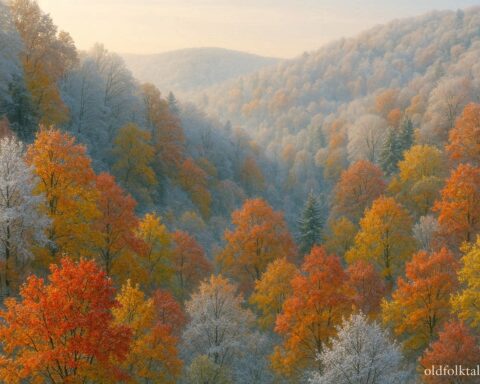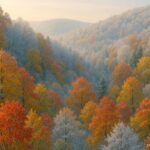
Brown Mountain rises quietly in western North Carolina, its long ridges layered with hardwood forests and mist filled valleys. During the day, it appears unremarkable, one of many peaks stretching across the Appalachian range. At night, however, the mountain becomes a place of uncertainty. For generations, people living nearby have reported glowing lights drifting above its slopes. Alongside these lights, another presence is believed to exist. Shadowy figures that move below the glow, unseen unless watched carefully.
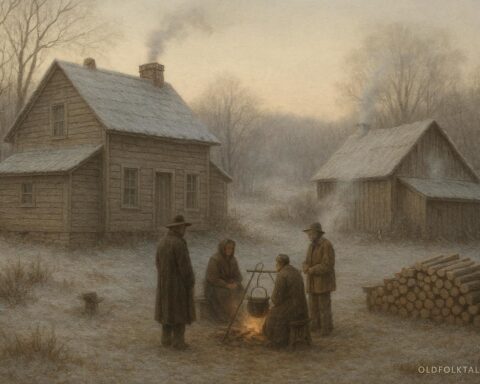
The earliest accounts of the Brown Mountain Lights date back to the nineteenth century. Families living in isolated cabins spoke of small glowing orbs appearing after sunset. These lights moved slowly, rising and falling as though guided by intention rather than wind. At first, people believed they were lanterns carried by travelers. Over time, it became clear that no roads, camps, or settlements existed where the lights appeared.
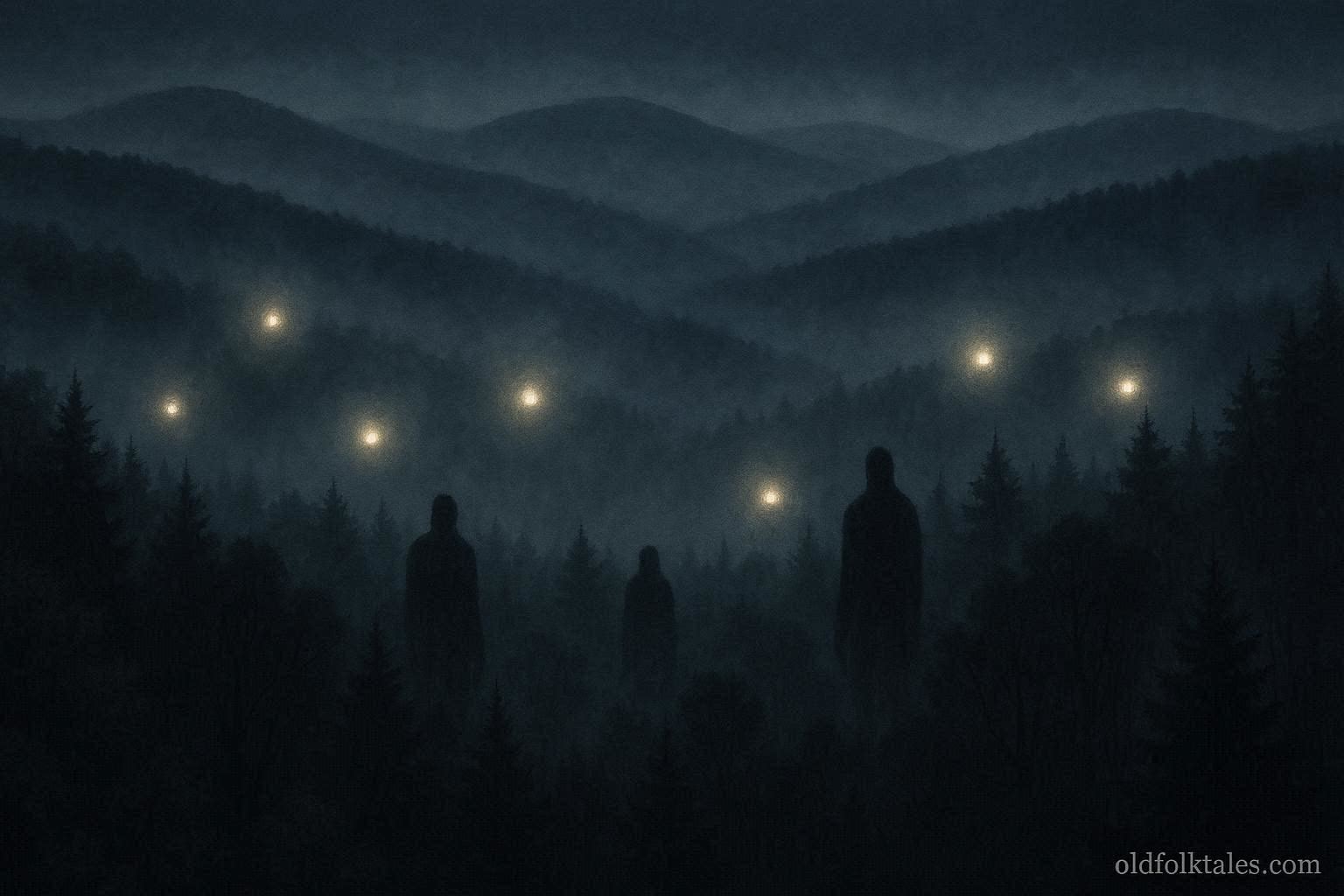
As stories spread, another detail began to emerge. Witnesses claimed that beneath the lights, dark figures could sometimes be seen standing still on ridges or walking through tree lines. These shapes were not animals. They moved upright and deliberate, pausing when the lights paused and advancing when the lights drifted forward. The figures never approached homes, yet their presence felt intentional.
Explore the heart of America’s storytelling — from tall tales and tricksters to fireside family legends.
Hunters were among the most frequent witnesses. Tracking game at dusk, they would see a glow ahead and assume another person was in the forest. As they moved closer, the light would retreat, remaining just out of reach. In the faint illumination, tall silhouettes could be seen between the trees. When the hunter stopped, the figures stopped. When he turned away, the sense of being watched remained.
Descriptions of the creatures were remarkably consistent. They were usually taller than an average human, with narrow frames and indistinct edges. Their bodies appeared darker than the surrounding forest, absorbing light rather than reflecting it. No clear facial features were ever reported. Even when the lights passed close, the figures remained faceless and undefined.
Local elders taught children never to follow the lights. The warning was not framed as fear of danger, but as respect. The mountain, they said, was not empty. The lights belonged to something older than the people who lived nearby. The creatures beneath them were guardians or attendants, not meant to be disturbed.
Some families believed the creatures were spirits of people who had become lost on the mountain long ago. The Appalachian region holds many stories of wanderers who disappeared into the forest and were never found. According to this belief, those who followed the lights too far became bound to them, neither alive nor fully gone.
Other interpretations suggested the creatures were manifestations of the land itself. In this view, the mountain responded to human presence through light and shadow. The figures were not individuals, but expressions of balance, appearing when the boundary between human activity and wilderness was crossed.
Witnesses often reported strange sensations during encounters. Sounds would fade, insects would fall silent, and time seemed distorted. Some claimed hours passed without realizing it. Others felt compelled to turn back without understanding why. The creatures were never said to chase or attack, but their influence was unmistakable.
One widely shared account describes a railroad worker who camped near Brown Mountain in the early twentieth century. Late at night, he observed several lights drifting across the ridge. Beneath them, he saw dark forms moving in parallel. When he stood to approach, the lights dimmed and the figures vanished. The following morning, his compass no longer pointed north while near the site.
Seasonal patterns also emerged in the folklore. Sightings were most common in autumn, when fog rolled heavily through the valleys and nights lengthened. During winter, the lights appeared less frequently, and the creatures were rarely mentioned. Spring brought renewed activity, while summer sightings tended to be brief and distant.
Community members learned to recognize signs associated with the creatures. Dogs refused to bark. Fires burned low despite fresh wood. Windows were shuttered when the lights appeared on the ridge. These practices were not driven by panic, but by tradition passed quietly through families.
Folklorists studying the region noted that people rarely described the creatures directly. Instead, they referred to them indirectly, using phrases like what walks with the lights or those beneath the glow. This avoidance reflected a belief that speaking too clearly about them invited attention.
The creatures were not viewed as evil. They were considered reminders that not all places were meant for constant human presence. The mountain existed on its own terms. The lights and the figures beneath them marked moments when those terms became visible.
Even today, visitors to Brown Mountain report seeing unexplained lights. A few claim they noticed shapes moving beneath the glow, standing motionless at the forest edge. Whether these creatures are spirits, symbols, or something else entirely, they remain part of the mountain’s living folklore.
The Brown Mountain Lights Creatures endure not because they are proven, but because they are remembered. They exist in the shared experience of watching the mountain at night and sensing that something watches back.
Click to read all American Cryptids & Monsters — creatures of mystery and fear said to inhabit America’s wild landscapes.
Moral Lesson
Some mysteries are not meant to be followed or explained. Respect for place and restraint in curiosity protect both the land and those who walk upon it.
Knowledge Check
- What phenomenon are the Brown Mountain Lights Creatures associated with?
They are associated with the unexplained glowing lights seen over Brown Mountain. - How are the creatures most often described by witnesses?
As tall shadowy figures with indistinct features and no visible faces. - Why do locals warn against following the lights?
Because following them is believed to invite disorientation or unwanted encounters. - What role do the creatures play in regional belief?
They act as guardians or attendants connected to the land. - During which season are sightings most common?
Autumn. - Why are the creatures rarely named directly?
Because naming them is believed to draw their attention.
Source
Adapted from Appalachian folklore studies archived at the University of North Carolina and documented regional oral histories.
Cultural Origin
Western North Carolina Appalachian communities.