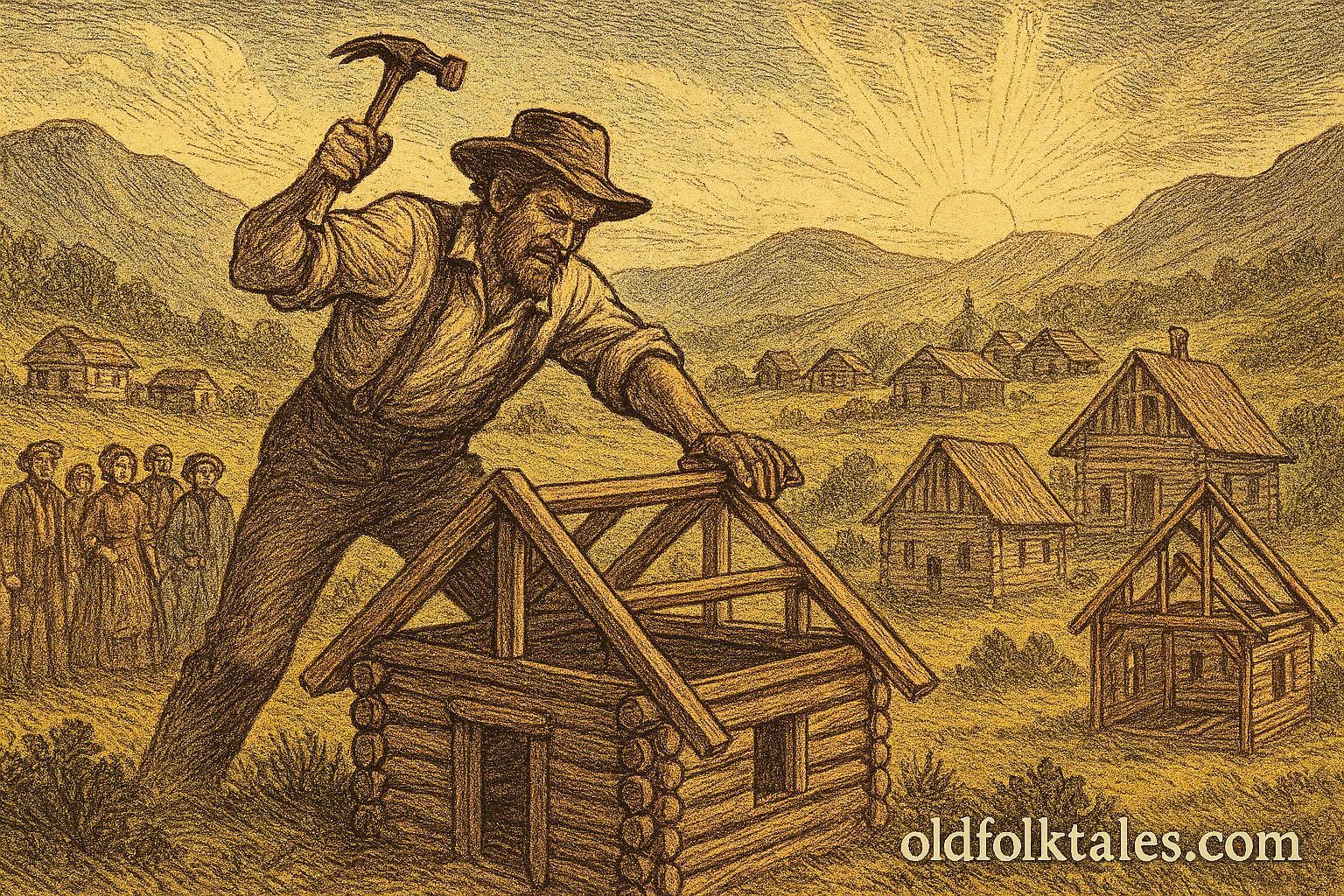
In a small frontier valley, where the rivers met and wild grasses swayed like green waves in the breeze, there lived a carpenter named Jacob Whittle. Jacob was known far and wide not only for his skill but also for his enormous pride. Other craftsmen could take weeks or even months to build a single house, yet Jacob boasted that he could build an entire town in a single day.
The villagers, skeptical yet curious, often watched him work. Some called him foolish, others marveled at his energy. “You cannot raise an entire settlement before the sun sets,” they said, shaking their heads. But Jacob only laughed. “Watch and learn,” he replied, “for I shall prove that skill and speed together can accomplish what most deem impossible.”
On a bright spring morning, with the sun spilling golden light across the valley, Jacob gathered his tools. Hammers, saws, chisels, bundles of timber, and nails were stacked neatly in his cart. He called the villagers to the center of the meadow and announced, “By sundown, you shall witness a town unlike any you have ever seen. Houses, a tavern, a school, and a church, all standing tall, created by these hands alone!”
Explore Native American beings, swamp creatures, and modern cryptid sightingsacross the country.
The villagers murmured amongst themselves, some doubtful, some entertained. Children ran alongside him as he sped through the valley, carrying beams heavier than their own bodies. Every strike of his hammer seemed to echo across the hills like a drum of determination. Boards were cut precisely, walls rose as if by magic, and roofs began to take shape.
By mid-morning, a cluster of homes had already appeared. Windows gleamed in the sunlight, doors stood tall and firm, and smoke curled from the chimneys of the first cottages. Birds perched on the beams, singing as though they too admired his work. Even the old masons, who had spent decades building with care, shook their heads in disbelief. “He moves faster than the river flows,” they whispered.
Yet Jacob’s pride grew with each passing hour. He ignored offers to help. “No one can match my hands,” he thought. “The town must be built by me alone, so my name is remembered forever.” But as the afternoon sun climbed higher, the consequences of his haste began to show. Walls leaned unevenly, roofs sagged under their own weight, and a door frame splintered with a loud crack.
Seeing this, the villagers approached cautiously. “Jacob,” one of the elders said, “even the fastest hands cannot replace patience and careful planning. Perhaps a town built together lasts longer than one built alone.”
Jacob paused. Pride had blinded him to wisdom. He realized that no matter how skilled he was, he could not replace the experience, guidance, and effort of the community. His boastfulness had rushed him into errors that threatened the structures themselves. He looked around at the imperfect buildings and felt a heavy weight in his chest. For the first time, he understood that speed and strength alone were not enough.
With humility, Jacob began to invite others to assist him. Villagers carried beams, mixed mortar, hammered nails, and painted walls. Children gathered stones for foundations, while elders instructed on proper placement and alignment. Slowly, the town began to take its true form, sturdier and more beautiful than anything Jacob could have accomplished alone.
By late afternoon, the sun began its descent. The town was alive with activity, laughter, and teamwork. The houses were complete, the church tower stood proudly, and the schoolhouse gleamed white in the waning light. Jacob looked around, amazed at what had been accomplished through collaboration. The townsfolk cheered, not just for the buildings but for the unity and respect that had made the day a success.
That evening, as the villagers celebrated with food and music, Jacob stood quietly at the edge of the town square. He reflected on the lessons of the day. “Skill is nothing without patience,” he said softly to himself, “and pride is easily broken, but cooperation builds what lasts.” From that day forward, the tale of Jacob Whittle, the carpenter who built a town in a day, was told around campfires and in schoolhouses. It became a story not merely of speed and strength but of humility, community, and the enduring power of working together.
Click to read all American Folktales — timeless oral stories passed through generations across the United States.
Moral lesson
Even great skill requires humility and collaboration. Boasting and rushing can compromise quality and trust, while shared effort strengthens communities. True accomplishment is measured not by speed alone but by the care, cooperation, and respect one brings to their work.
Knowledge check
1 What lesson did Jacob learn about pride and collaboration?
Answer: That even exceptional skill is improved by working with others and being humble.
2 Why did the town initially have structural problems?
Answer: Because Jacob rushed to finish alone and ignored careful planning.
3 How did the villagers contribute to Jacob’s growth?
Answer: They advised him gently, showing that cooperation and patience yield better results.
4 What does the story suggest about speed versus quality?
Answer: That speed is valuable only when balanced with attention to detail and care.
5 Why did the legend of Jacob Whittle endure?
Answer: Because it teaches lessons about pride, skill, and the importance of community.
6 How can the moral lesson be applied today?
Answer: By valuing teamwork, patience, and humility in all personal and professional endeavors.
Source:
Adapted from Library of Congress American trade folklore (1910)
Cultural origin:
Early American settlement folklore