Before the clock was built, the town of Millbrook lived by guesswork.
People rose when the light felt right and slept when darkness settled enough to justify rest. Shopkeepers opened their doors when they believed customers might come. Farmers began their work when the sun cleared the hills, though each man judged that moment differently. Church bells rang when the sexton thought enough time had passed. Court sessions started late or early depending on who arrived first. No one agreed on when a day truly began or ended.
At first, this looseness felt like freedom. Millbrook was young, carved out of forest and field by families who had fled stricter towns and harsher rules. They valued independence. No one liked being told when to wake, work, or pray.
But as the town grew, freedom turned into friction.
Merchants argued over delivery times. A blacksmith accused a farmer of arriving too late to collect an order. Laborers complained that they were paid for fewer hours than they worked. Schoolchildren came and went at different times, leaving lessons half taught. Court cases dissolved into shouting when witnesses claimed they had arrived “on time,” though no two meant the same thing.
Discover celestial myths of the sun, moon, and stars — and the heroes who bridged earth and sky.
Worst of all, resentment spread quietly. People began to suspect one another of cheating time itself.
It was during one such argument that Samuel Pratt spoke up.
Samuel was the town carpenter, a man who measured wood with care and words with restraint. He had traveled before settling in Millbrook and had seen larger towns where a single clock governed the day. When two merchants nearly came to blows over when a contract should have been fulfilled, Samuel raised his hand.
“We don’t share time,” he said. “That’s the trouble.”
The room fell silent.
He explained simply. Every person carried their own sense of time, shaped by habit, hunger, and convenience. Without a common measure, fairness was impossible.
“We share roads,” Samuel continued. “We share wells. We share laws. But time we keep for ourselves. That makes enemies of neighbors.”
The idea unsettled the room. A shared clock sounded dangerously close to control. Who would decide its hours? Who would own it? Who would ring it?
The elders debated for weeks. Some argued that time belonged to God alone. Others feared that a clock would favor merchants over farmers, or officials over laborers. But disputes worsened, and trust thinned.
At last, the town voted to try.
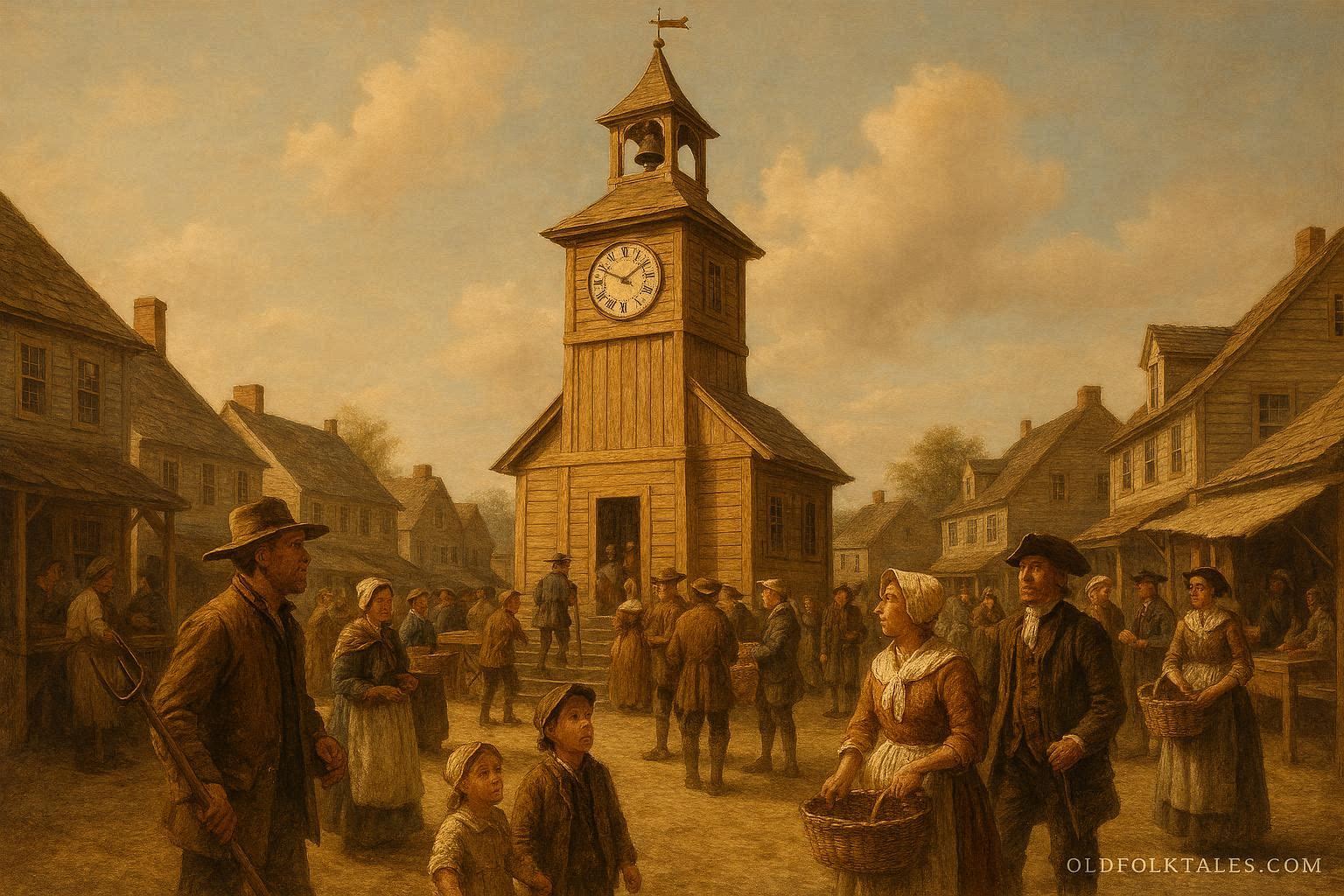
They agreed the clock would not belong to any single family. It would stand in the square, visible to all. Its ringing would mark shared moments only sunrise, midday, and sunset. No one would be fined for ignoring it, but agreements and work would be judged by it.
Samuel was asked to build the tower. An itinerant clockmaker passing through was hired to assemble the mechanism. Children gathered daily to watch gears and weights take shape. For many, it was the first time they had seen time given a body.
When the clock was finished, the town held a small ceremony. There were no speeches, only silence as the clockmaker set the hands and released the weights.
The bell rang once.
It was not loud, but it was clear.
The next morning, something strange happened. People paused when the bell rang at sunrise. Farmers began their work together. Shops opened within minutes of one another. Children arrived at school at the same time, blinking in surprise to see full benches.
Arguments did not vanish, but they changed. When disputes arose, the clock stood between neighbors as a quiet witness. People began to say, “The clock says,” instead of “I thought.”
At first, some resisted. A few merchants opened early anyway. One preacher refused to adjust his sermon time. But gradually, even the stubborn found that cooperation made their days easier.
Something else changed as well.
The clock made waiting visible.
People saw how long they asked others to stand idle. Laborers noticed when employers delayed pay. Town officials learned how meetings stretched beyond fairness. Time became something felt together, not privately endured.
Children learned discipline without fear. They raced the bell and laughed when they lost. Elders rested knowing the day had structure. Travelers trusted Millbrook because appointments were kept.
Years passed. The clock weathered storms and seasons. Once, lightning cracked the tower, stopping the hands for three days. During that pause, old habits crept back arguments, delays, suspicion. When the clock was repaired and rang again, relief spread through the town.
By then, no one questioned its value.
Millbrook grew into a respected town. Contracts signed there carried weight. Markets ran smoothly. Disputes were fewer, not because people changed, but because time was no longer a weapon.
Samuel grew old and walked slowly beneath the tower he built. Children sometimes asked him why the clock mattered so much.
He would smile and answer, “It taught us that fairness needs a rhythm.”
When Samuel died, the bell rang at sunset, though no one had instructed it to do so. The clockmaker’s apprentice, now an old man himself, swore the mechanism had not been touched.
From that day on, the townspeople said the clock did more than measure hours. It reminded them that time, like land and law, must be shared if a community is to endure.
And so Millbrook kept its clock, not as a master, but as a teacher.
Explore the heart of America’s storytelling — from tall tales and tricksters to fireside family legends.
Moral Lesson
Order strengthens community when it is shared. Fairness is possible only when people agree on common measures and accept responsibility for one another’s time.
Knowledge Check
1 Why did conflicts increase in Millbrook before the clock was built?
Answer: Because everyone followed their own sense of time
2 Who proposed the idea of a shared town clock?
Answer: Samuel Pratt, the town carpenter
3 Where was the clock placed and why?
Answer: In the town square so it belonged to everyone
4 What changed most after the clock began ringing?
Answer: Cooperation and fairness in daily activities
5 What happened when the clock stopped after lightning struck?
Answer: Old disputes and confusion returned
6 What did the townspeople believe the clock ultimately taught them?
Answer: That shared time creates fairness and trust
Source
Adapted from American town life folklore, Smithsonian National Museum of American History
Cultural Origin
18th–19th century American towns