Across the farmlands of the American Midwest, where fields stretched wide and harvest seasons shaped the rhythm of life, people learned to rely not only on their labor but on traditions that carried meaning beyond the visible. The land provided food, but it also shaped belief, teaching lessons about patience, survival, and care.
Among these traditions was the use of corn husks.
After the harvest, when ears of corn had been gathered and the fields cleared, the husks remained. Dry, flexible, and often set aside, they might have seemed like leftovers of little use. But within rural communities, they were seen differently.
They were not discarded.
They were transformed.
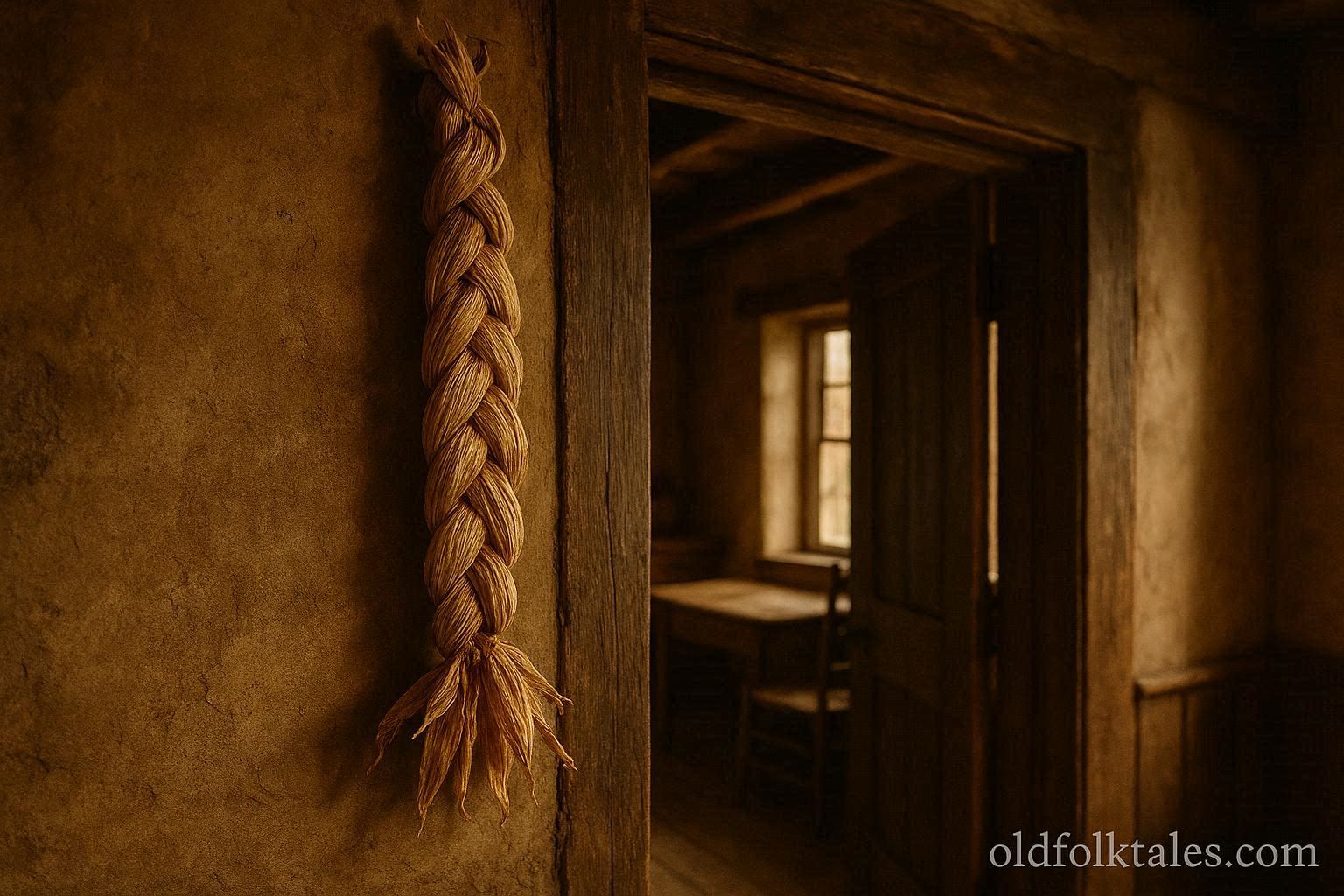
Families would gather the husks and prepare them carefully. Some were braided, others twisted or tied into simple forms. The process was done by hand, often during quiet evenings when work in the fields had ended and the household settled into stillness.
The act of braiding was steady and deliberate.
Each strand crossed over another.
Each movement repeated with care.
It was not only about creating something physical, but about placing intention into the object itself.
Once completed, the braided husks were hung within the home. Sometimes above doorways, sometimes near windows, and sometimes in central areas where the family gathered. Their placement was not random. They were positioned where they could stand as quiet guardians, marking the home as protected.
The belief was simple but deeply held.
That the husks, shaped from a plant that sustained life, carried with them the strength of the harvest.
Discover celestial myths of the sun, moon, and stars — and the heroes who bridged earth and sky.
And that this strength could be extended into protection.
Protection from illness.
From hardship.
From unseen forces that might disturb the balance of the household.
There were stories that supported this belief. One told of a family that, during a season of poor health in the surrounding area, hung newly braided husks throughout their home. While sickness moved through neighboring houses, their own remained stable. Whether by chance or faith, the story became part of the tradition.
Another spoke of a time of hardship, when crops were uncertain and the future unclear. A household, holding onto what they had, created husk charms from the last of their harvest. They hung them with quiet determination, believing that the strength of what had grown would remain with them.
In time, their situation improved.
The story endured.
These accounts were not presented as proof, but as reminders of how belief and action worked together. The husks themselves were simple, but the meaning placed into them gave them purpose.
They represented continuity.
A connection between the work of the land and the life of the home.
The charm also reflected a broader understanding of protection. It was not always about preventing something entirely, but about creating strength within. A sense that the home was prepared, that care had been taken to guard what mattered.
Children growing up in these homes often noticed the husks but did not always question them. They became part of the environment, as natural as the walls or the furniture. Over time, understanding came not through explanation alone, but through observation and repetition.
They saw them being made.
They saw them being placed.
And eventually, they learned to do the same.
As years passed and lifestyles changed, the practice became less common in some places. Modern materials replaced older ones, and the connection to agricultural cycles became less direct. Yet the tradition did not disappear entirely.
In some homes, it remained.
Sometimes as a continuation of belief.
Sometimes as a symbol of heritage.
Sometimes simply as something that had always been done.
Even when the meaning was not spoken in full, the act of creating and hanging the husks carried a quiet respect for what had come before.
The Corn Husk Charm for Protection became more than a rural custom. It became a reflection of how people use what is available to them, turning ordinary materials into symbols of care and resilience.
It also carried a lesson about transformation.
What was once part of the harvest, meant only to protect the crop, became something that protected the home itself. The husk, which had served its purpose in the field, was given a new role within the household.
In this way, nothing was wasted.
Everything had value.
Even now, in places where the land is still worked and the seasons still guide daily life, the practice can be found. Braided husks hang quietly, unchanged by time, holding their place as small but meaningful signs of protection.
They do not draw attention.
They do not demand recognition.
Yet they remain.
A reminder that strength can come from what is simple.
That protection can be created through intention.
And that traditions, even the quietest ones, carry the power to shape how people live, care, and endure.
Click to read all American Traditions & Beliefs — the living folklore of daily life, customs, and superstitions.
Moral Lesson
Simple resources, when used with intention and respect, can become powerful symbols of protection and resilience.
Knowledge Check
- What material is used to make the charm?
Dried corn husks from the harvest. - How are the husks prepared?
They are braided or tied into forms by hand. - Where are the charms placed?
Inside homes, often near doors or windows. - What do the husks symbolize?
Strength from the harvest and protection for the home. - Why is the tradition important?
It connects daily life to the land and promotes care and resilience. - What lesson does the story teach?
That simple materials can hold deep meaning when used with intention.
Source
Adapted from materials preserved by Cornell University
Cultural Origin
Midwestern agricultural folklore