In the earliest days, before words were formed and before voices carried meaning, the world was filled with sound but not understanding. The wind moved through the trees, water flowed across the land, and animals called to one another in ways that were clear to them. But humans, though present, did not yet share a common way to express their thoughts.
In the lands of the Huron-Wendat, where forests, rivers, and open clearings shaped daily life, people lived closely with nature and with each other. They could gesture, point, and make simple sounds, but something was missing.
They could not share ideas clearly.
They could not name the world around them.
They could not fully understand one another.
This lack of language created confusion.
When danger appeared, warnings were not always understood. When food was found, it could not easily be shared through explanation. When feelings arose, they remained locked within, unable to be expressed in a way others could truly know.
The people lived, but not in harmony.
They gathered often, trying to find a way to communicate more clearly. They watched the animals, noticing how birds called to each other and how wolves moved together as if guided by shared signals. They listened to the rhythm of the world, hoping to learn from it.
Explore the heart of America’s storytelling — from tall tales and tricksters to fireside family legends.
But still, they remained without words.
Among them was an elder who observed these struggles closely. The elder believed that the ability to speak was not simply a skill to be learned, but something that needed to be given.
A gift.
Something that would connect people not only to each other, but to the world itself.
The elder began to listen more carefully than anyone else.
Not just to the sounds, but to the patterns within them.
The wind did not move randomly. It carried rhythm.
Water did not flow silently. It carried tone.
Even the smallest sounds held structure.
The elder believed that within these patterns lay the beginning of language.
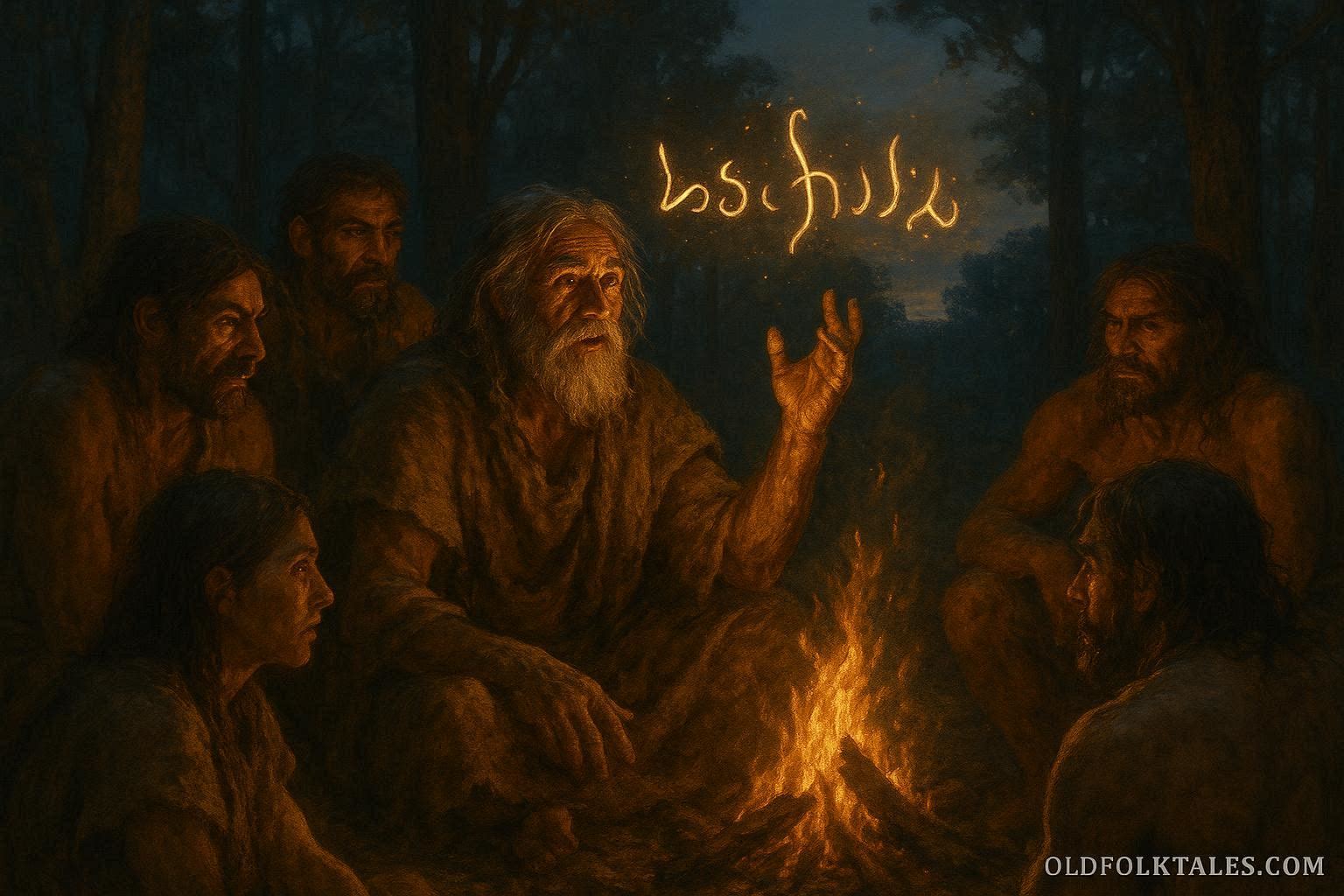
One night, as the people gathered in quiet reflection, the elder spoke in a way no one had heard before. The sounds were different.
Shaped.
Intentional.
They were not random noises, but something new.
The people listened.
Though they did not yet understand the meaning, they felt something change.
The sounds seemed to carry intention.
They held form.
The elder repeated the sounds, slowly, carefully, as if shaping them in the air. Others began to imitate, uncertain at first, but curious. The sounds spread among the group, each person trying to follow the pattern.
At first, the sounds were simple.
Short.
Unclear.
But over time, they began to take shape.
A sound for water.
A sound for fire.
A sound for the sky.
Each word formed slowly, growing from repetition and shared understanding. As the people practiced, the sounds became more consistent. They began to recognize them, to connect them with meaning.
Something new had begun.
The ability to name.
With names came recognition.
With recognition came understanding.
The world around them became clearer.
They could now call to one another with purpose. They could warn of danger, share discoveries, and express their thoughts in ways that others could understand. What had once been confusion began to transform into connection.
But language did not stop at naming.
As time passed, the people began to shape sounds into more complex forms. They combined words, creating new meanings. They told simple stories, describing what they had seen and what they had experienced.
These stories grew.
They carried memory.
They carried knowledge.
They carried identity.
The people began to understand that language was more than sound.
It was a way of holding the world.
A way of sharing it.
A way of remembering it.
In some tellings, it is said that this gift was not created by humans alone, but guided by a greater presence. That the elder, in listening so carefully to the world, had learned to hear what was already there.
That language existed within the rhythms of nature.
Waiting to be understood.
The animals continued to speak in their own ways, the wind continued to move, and the water continued to flow. But now, humans could join this world of sound with their own voices, adding meaning and intention.
The first conversations were simple.
Then they became richer.
People spoke of the land, of their experiences, of their connections to one another. They began to teach the younger ones, passing down words along with their meanings. Language became part of daily life, woven into every action and interaction.
With language came identity.
Each group shaped their own way of speaking, their own patterns and expressions. These differences became part of who they were, reflecting their environment, their history, and their understanding of the world.
In the traditions of the Huron-Wendat, language is more than communication. It is connection. It ties people to their ancestors, to their land, and to each other.
The story of how language began serves as a reminder of its importance.
It is not something to be taken for granted.
It is something to be valued.
Something to be preserved.
Even now, every word spoken carries a trace of that first moment when sound became meaning. Every conversation reflects the beginning of understanding, when humans first learned not only to speak, but to listen.
The world is still filled with sound.
But through language, it has also become a place of shared meaning.
Moral Lesson
Communication is a powerful gift that helps build understanding, connection, and identity.
Knowledge Check
- What problem did early humans face?
They could not clearly communicate or understand one another - Who helped introduce language?
An elder who studied the patterns of sound - What inspired the creation of words?
The rhythms and sounds of nature - What changed once people began using language?
They could share ideas, warnings, and stories - What did language eventually help create?
Identity and connection among people - What is the main idea of the story?
That language is essential for understanding and unity
Source
Adapted from materials preserved by Yale University
Cultural Origin
Huron-Wendat