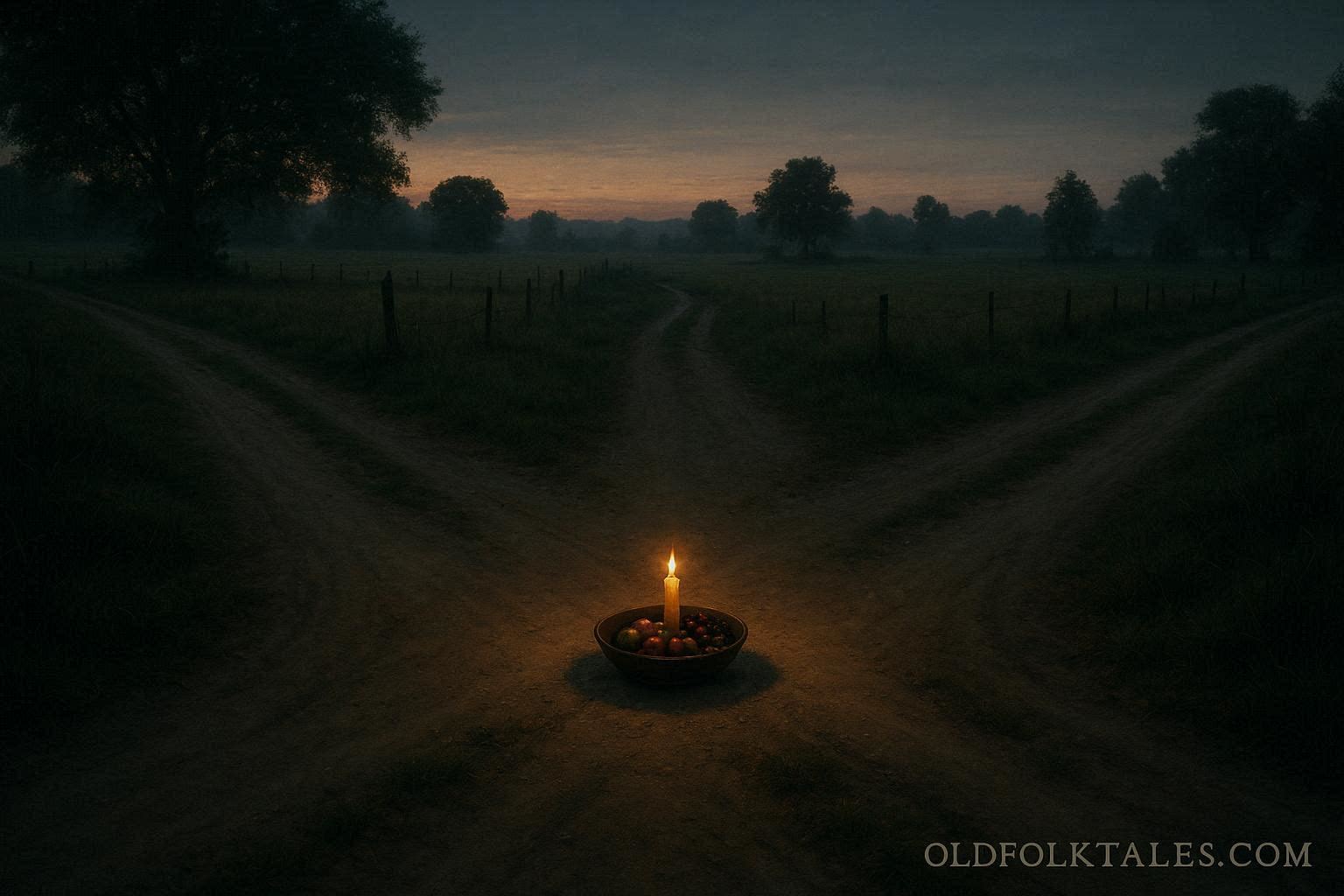
In many African American Hoodoo traditions, the crossroads was never seen as an ordinary place. It was where two paths met, where directions crossed, and where movement from one place to another became possible. Because of this, it was understood as a point of transition.
A place where things could change.
A place where what was carried could be left behind.
For those seeking healing, especially when illness lingered without clear relief, the crossroads became a place of quiet action. Not crowded, not loud, but chosen carefully. It was often a simple intersection of rural roads, where the land stretched open and the air moved freely.
The timing mattered.
The approach mattered.
And most importantly, the intention mattered.
The ritual began long before the offering was placed. The person, or sometimes someone acting on their behalf, would prepare an item to carry to the crossroads. This offering was not random. It could be something small like food, herbs, or an object that had been kept close during the time of illness.
What mattered was that it represented what needed to be released.
It carried the weight of discomfort.
Of weakness.
Of imbalance.
Once prepared, the journey to the crossroads was taken with focus. There was no rushing, no distraction. Each step was part of the act, moving from the place of illness toward the place of release.
Encounter the strange and the unseen — from Bigfoot to regional monsters hiding in America’s forests.
When the crossroads came into view, there was often a pause.
A moment of stillness.
The space itself felt different, not because of what could be seen, but because of what it represented. Four directions stretching outward, each one leading somewhere unknown.
The offering was then placed at the center, or at the point where the paths met. It was not thrown or dropped carelessly. It was set down with intention, as though acknowledging the purpose it served.
In that moment, the act was complete.
But one part remained.
The leaving.
After placing the offering, the person would turn and walk away without looking back. This was important. To look back was to hold onto what had just been released. To walk forward without turning was to trust that the act had been done, that what needed to leave would not follow.
Stories told of how this practice brought relief. One spoke of a man who had been troubled by a persistent illness, one that left him weak and restless. After preparing an offering and placing it at the crossroads, he returned home quietly.
In the days that followed, his strength began to return. Slowly at first, then more steadily, until he was once again able to work and move without strain.
Another story told of a woman who carried her offering at dawn, placing it where two paths met at the edge of her community. She did not speak as she walked, and she did not look back. That night, she slept without disturbance for the first time in many days.
These stories were not always explained in the same way. Some believed the crossroads allowed illness to be carried away, dispersed in different directions so that it no longer remained with the individual. Others believed the act itself, the decision to release and walk forward, created a shift that allowed healing to begin.
There were also deeper understandings of the crossroads as a place of exchange. Not a place where something simply disappeared, but where it was transformed, moved from one state to another.
What was heavy became light.
What was held became released.
The ritual was never meant to be performed without thought. It required awareness, respect, and a clear sense of purpose. Those who practiced it understood that the act was not about forcing change, but about allowing it.
Allowing what no longer belonged to be left behind.
Allowing the body and mind to return to balance.
Over time, as new explanations of illness and healing emerged, the practice came to be viewed in different ways. Some saw it as symbolic, a powerful way of marking the end of a difficult period. Others understood it as a form of focus, helping the mind let go of what it had been holding.
Yet even as interpretations changed, the ritual itself remained.
In quiet places, along simple roads, offerings were still placed.
Not always seen.
Not always spoken of.
But still present.
The Crossroads Offering for Healing became more than a single act. It became a reflection of how people understand release. That healing is not always about adding something new, but sometimes about letting something go.
It also carried a lesson about movement. The crossroads is not a place where one stays. It is a place one passes through. In the same way, illness and hardship are not meant to remain forever.
They are to be faced.
Released.
Left behind.
Even now, the idea of the crossroads continues to hold meaning. Not always in the same form, but in the understanding that there are moments in life where a decision must be made.
To carry forward.
Or to let go.
And in that choice, healing begins.
Explore how American superstitions and rituals still influence modern life and local traditions.
Moral Lesson
Healing often requires letting go of what burdens us and trusting in the process of release and renewal.
Knowledge Check
- What is the purpose of the crossroads offering?
To transfer or release illness away from a person. - Why is the crossroads considered important?
It is seen as a place of transition and change. - What must a person do after placing the offering?
Walk away without looking back. - What does the offering represent?
The illness or burden that needs to be released. - How did people believe the ritual worked?
It allowed illness to be carried away or transformed. - What lesson does the story teach?
That letting go can be an important part of healing.
Source
Adapted from materials preserved by Smithsonian Institution
Cultural Origin
African American Hoodoo traditions