Central California is a region of quiet suburbs, orchards, and winding streets that stretch into the hills. Residents of Fresno and its surrounding neighborhoods often describe peaceful evenings, with streetlights casting long shadows across lawns and sidewalks. Yet, over the last two decades, a strange phenomenon has captured the imagination of locals and cryptid enthusiasts alike: the Fresno Nightcrawler.
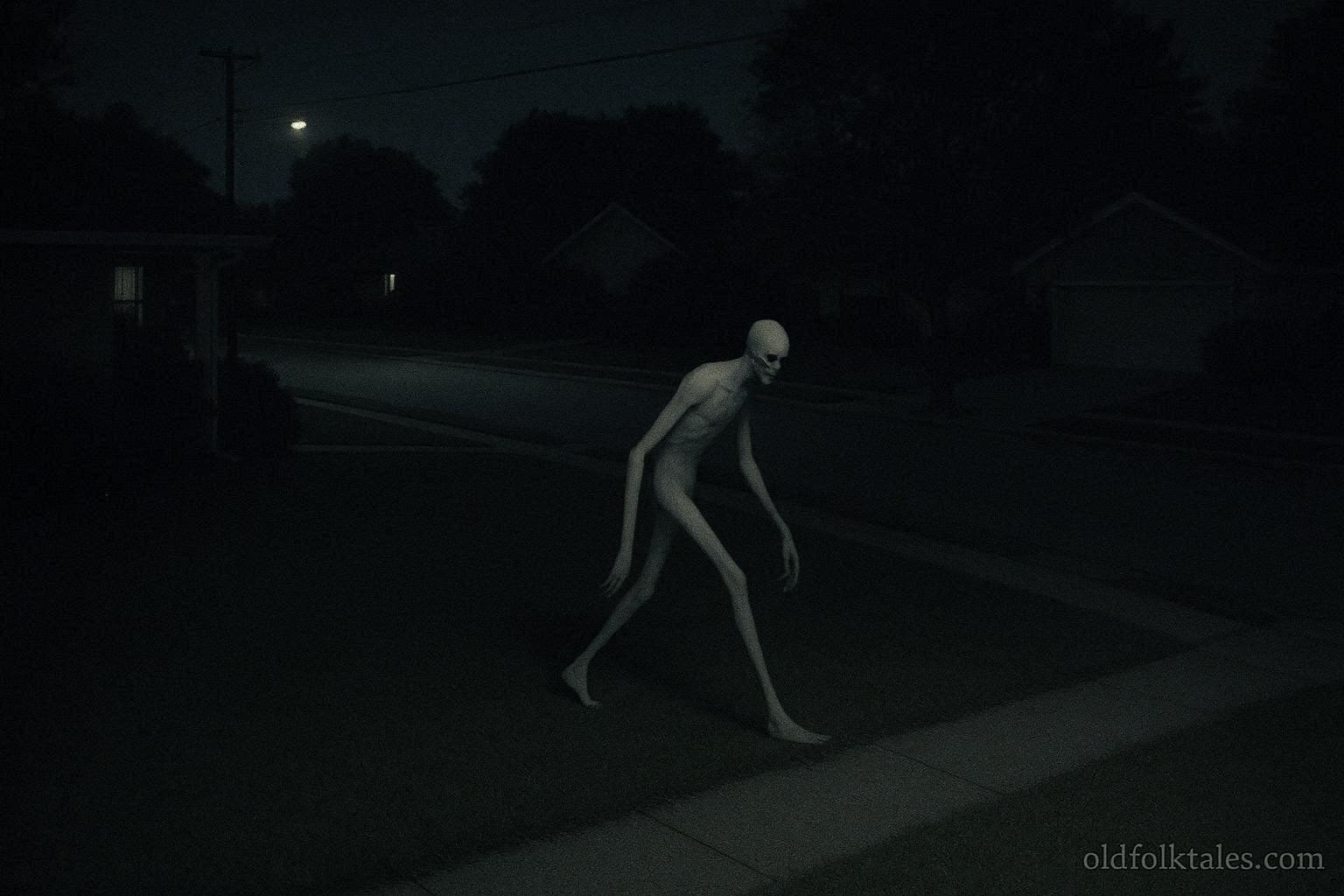
These creatures are unlike traditional monsters in folklore. They are tall, pale, and thin, with long, seemingly fragile legs. They glide silently across lawns, driveways, and streets, moving in a manner that defies ordinary human or animal movement. What sets them apart is that most sightings have been captured on home security cameras or video footage, giving the story a modern, almost digital twist.
The first widely publicized footage emerged in the early 2000s, sparking curiosity and debate. Neighbors, police officers, and videographers who reviewed the recordings described the figures as eerily humanoid yet impossible. The legs moved with an unusual fluidity, appearing to float above the ground. No other body parts were clearly visible, though some claimed to perceive faint torsos or heads.
Explore the heart of America’s storytelling — from tall tales and tricksters to fireside family legends.
Residents often report seeing the Nightcrawlers at night, usually in quiet, suburban areas where few people are walking. The figures are most frequently observed gliding across lawns or alleyways, their long legs carrying them silently from one side of the street to another. Some believe the creatures are harmless, merely curious observers of human activity, while others are unnerved by their sudden, unexplained presence.
Folklorists and media anthropologists at California State University note that the Fresno Nightcrawler represents a unique intersection of folklore and technology. Unlike older stories passed orally, these cryptids are often experienced through digital media. Security cameras, dashcams, and cell phone recordings allow viewers to witness the impossible from a safe distance, blending skepticism and wonder.
The legend has grown in part because the creatures are difficult to study. They move silently, appear only briefly, and leave no trace. No footprints, broken grass, or other evidence has been reliably documented. The combination of sighting scarcity and digital evidence has fueled debate, speculation, and repeated sharing online, giving the Nightcrawlers a distinctly 21st-century folklore presence.
Eyewitness accounts are consistent across multiple neighborhoods. Observers describe the figures moving in the same gliding pattern, with long legs and minimal other visible features. The figures seem unconcerned by humans, sometimes stopping momentarily as though observing, then continuing on. No physical interaction or aggression has ever been reported, yet the unusual movement and pale appearance evoke a sense of unease.
The Fresno Nightcrawler also reflects deeper cultural themes. Suburban areas often feel controlled and predictable, yet these sightings remind residents that the world contains unknowns. The figure’s presence in well-lit, populated areas challenges assumptions about safety and control, blending fear, curiosity, and the thrill of the unknown.
Children, teenagers, and adults alike recount experiences with the Nightcrawlers. Stories are shared during community events, online forums, and casual neighborhood conversations. The narrative has become a marker of regional identity, a shared mystery that locals and enthusiasts discuss with fascination. The digital nature of sightings ensures that the legend is preserved, not in books or manuscripts, but in home security archives and online collections.
Some theories suggest the Nightcrawlers are extraterrestrial, interdimensional, or simply optical illusions amplified by video quality. Regardless of explanation, the story has persisted and grown precisely because of its modern framing. Unlike traditional cryptids in remote forests or mountains, the Nightcrawlers appear in spaces familiar to humans: their streets, yards, and neighborhoods.
Observers are often left with more questions than answers. How did the creatures get there? Why do they glide in such a unique manner? Do they follow any pattern or routine? Every question adds to the legend, making the Nightcrawlers both a puzzle and a modern myth. Their presence reminds communities that mystery can exist even amid the ordinary routines of suburban life.
The Fresno Nightcrawler is now firmly part of Central California folklore. It combines modern technology with the timeless human fascination with the unknown. Its legend teaches that even in places thought to be fully known and safe, the world retains secrets that demand attention, observation, and respect.
Click to read all American Cryptids & Monsters — creatures of mystery and fear said to inhabit America’s wild landscapes.
Moral Lesson
Even in familiar and controlled environments, the unknown can appear. Awareness, curiosity, and respect for unseen forces are important lessons for navigating life.
Knowledge Check
1. Where are the Fresno Nightcrawlers most often reported?
In suburban neighborhoods of Fresno and surrounding Central California communities.
2. What do the Nightcrawlers look like?
Tall, pale, thin figures with long legs, minimal visible torso or head.
3. Are they aggressive toward humans?
No, they move silently and appear uninterested in physical interaction.
4. How are most sightings documented?
Through home security cameras, dashcams, and other digital recordings.
5. What modern cultural themes do the Nightcrawlers reflect?
Mystery in familiar spaces, blending fear, curiosity, and the thrill of the unknown.
6. Why has the legend persisted?
Because digital evidence allows sharing across generations and online communities, keeping the story alive.
Source
Adapted from California State University urban folklore and media anthropology archives.
Cultural Origin
Central California communities.