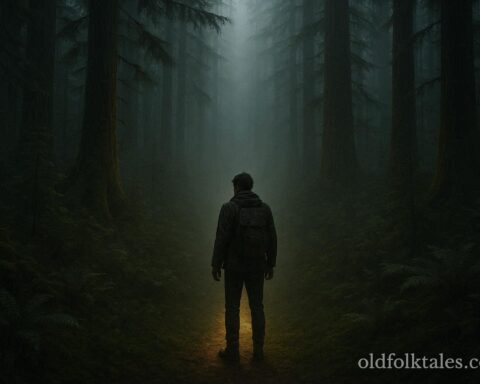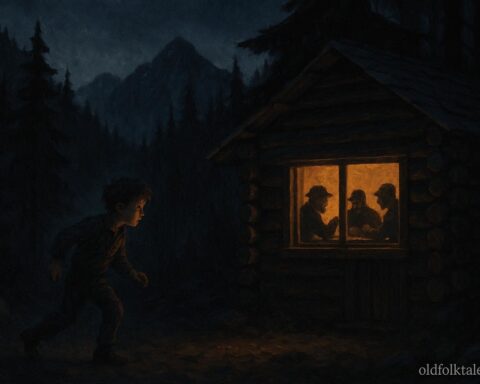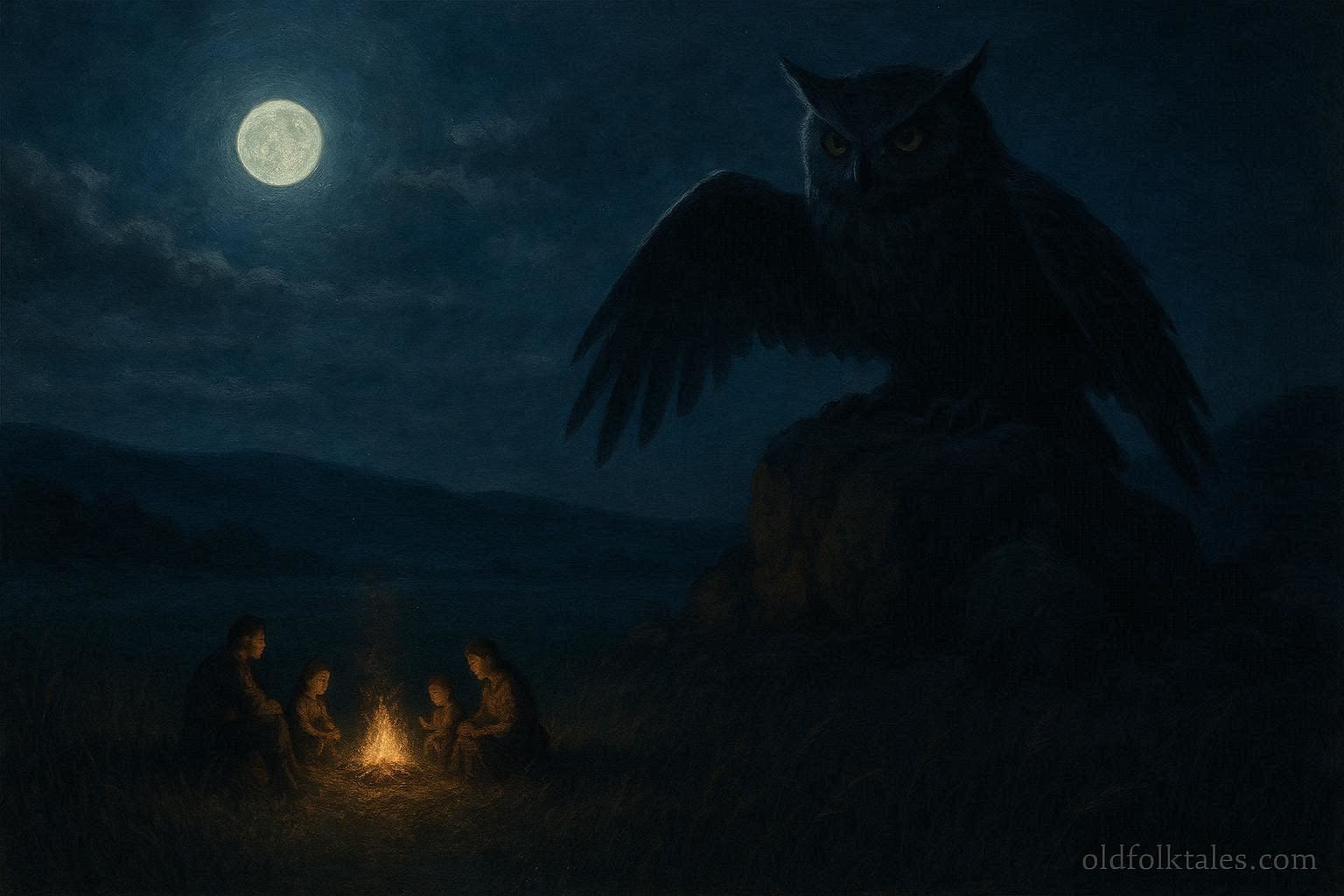
Night settles differently on the Plains. The sky opens wide, stars stretch across the darkness, and the land grows quiet enough for every sound to travel far. It is during these hours that elders warned children to stay close, listen carefully, and never wander alone. Their caution was not abstract. It was rooted in stories of a great owl like being whose shadow moved across the grasslands after sunset.
The Giant Owl is described as far larger than any ordinary bird. Its wingspan is said to blot out moonlight when it passes overhead. Feathers blend with darkness, making its shape difficult to track against the night sky. When it lands, the ground feels heavier, as if the air itself presses downward.
Unlike ordinary owls, this being does not merely hunt animals. It watches human movement, especially that of children who stray from firelight or camp boundaries. The Giant Owl does not cry out loudly. Instead, it emits a deep hollow sound that seems to come from everywhere at once. Elders say this sound unsettles the mind and pulls attention away from safety.
Explore ancient Native American creation myths and the symbolic tales that shaped America’s belief systems.
Children were taught that the owl appears when vigilance fades. It does not strike suddenly. It observes. It waits. The longer a child lingers alone, the closer the presence draws. In this way, the legend served as a lesson woven into nightly routines.
Adults described encounters differently. Hunters returning late spoke of enormous shapes passing silently overhead. Others reported finding massive feather impressions pressed into soft ground near campsites. These signs vanished by morning, leaving only memory and unease.
The Giant Owl is believed to possess intelligence equal to humans. It understands patterns, recognizes weakness, and chooses moments when protection lapses. For this reason, elders emphasized collective responsibility. Children were not guarded by individuals alone but by the community as a whole.
In stories, the owl does not always succeed. Watchful parents, alert dogs, and protective songs drive it away. Firelight is especially important. The being avoids open flames and strong communal presence. Camps that remained lively and attentive were rarely visited.
The owl is not described as purely evil. It is a force that exists within the natural order, enforcing awareness. Its role is to remind people that night carries risks and that survival depends on attention and cooperation.
Some elders explain that the Giant Owl originated during a time of imbalance, when children wandered freely and suffered harm from unseen dangers. The being emerged as a personification of those dangers, giving shape to fear so it could be understood and managed.
The owl’s eyes are said to glow faintly, reflecting light rather than emitting it. Those who meet its gaze feel frozen, unsure whether to move or hide. Elders taught children never to look directly at glowing eyes in the dark, as curiosity weakens caution.
Animals react strongly to the Giant Owl. Horses grow restless. Dogs whine and refuse to leave camp. Birds fall silent. These signs were interpreted as early warnings, prompting adults to gather children closer.
Songs and stories were used as protective tools. Certain rhythms were believed to confuse the owl or signal alertness to others. The act of singing together reinforced unity and discouraged isolation.
The Giant Owl is most active during periods of transition, early nightfall, seasonal change, and times when camps move locations. These moments disrupt routine and increase vulnerability. The legend teaches that extra care is needed during change.
Importantly, the owl is rarely seen directly. Most encounters involve shadow, sound, or sensation. This ambiguity strengthens the lesson. Danger is not always visible. Awareness must extend beyond what the eyes can confirm.
As settlements grew and modern lighting spread, sightings became less common. However, elders say the owl has not vanished. It has retreated to places where darkness still dominates and vigilance still matters.
The story continues to be told not to frighten but to prepare. Children learn boundaries through narrative rather than force. Fear is balanced with instruction, emphasizing safety over terror.
The Giant Owl that steals children is a reminder that protection is active, not passive. It requires watching, listening, and staying connected. The legend endures because it speaks to a universal truth. When attention fades, danger grows.
Click to read all American Cryptids & Monsters — creatures of mystery and fear said to inhabit America’s wild landscapes.
Moral Lesson
Vigilance, community responsibility, and protection of the vulnerable are essential for safety and survival.
Knowledge Check
- When does the Giant Owl most often appear?
After sunset during the night. - Who is the Giant Owl said to watch most closely?
Children who wander alone. - What discourages the Giant Owl from approaching camps?
Firelight and strong communal presence. - How do animals react to the Giant Owl?
They show signs of distress or silence. - Is the Giant Owl described as purely evil?
No, it represents danger and awareness. - What lesson does the legend teach communities?
The importance of vigilance and collective protection.
Source
Adapted from Plains Indigenous folklore collections archived by the Smithsonian
Cultural Origin
Plains Indigenous communities