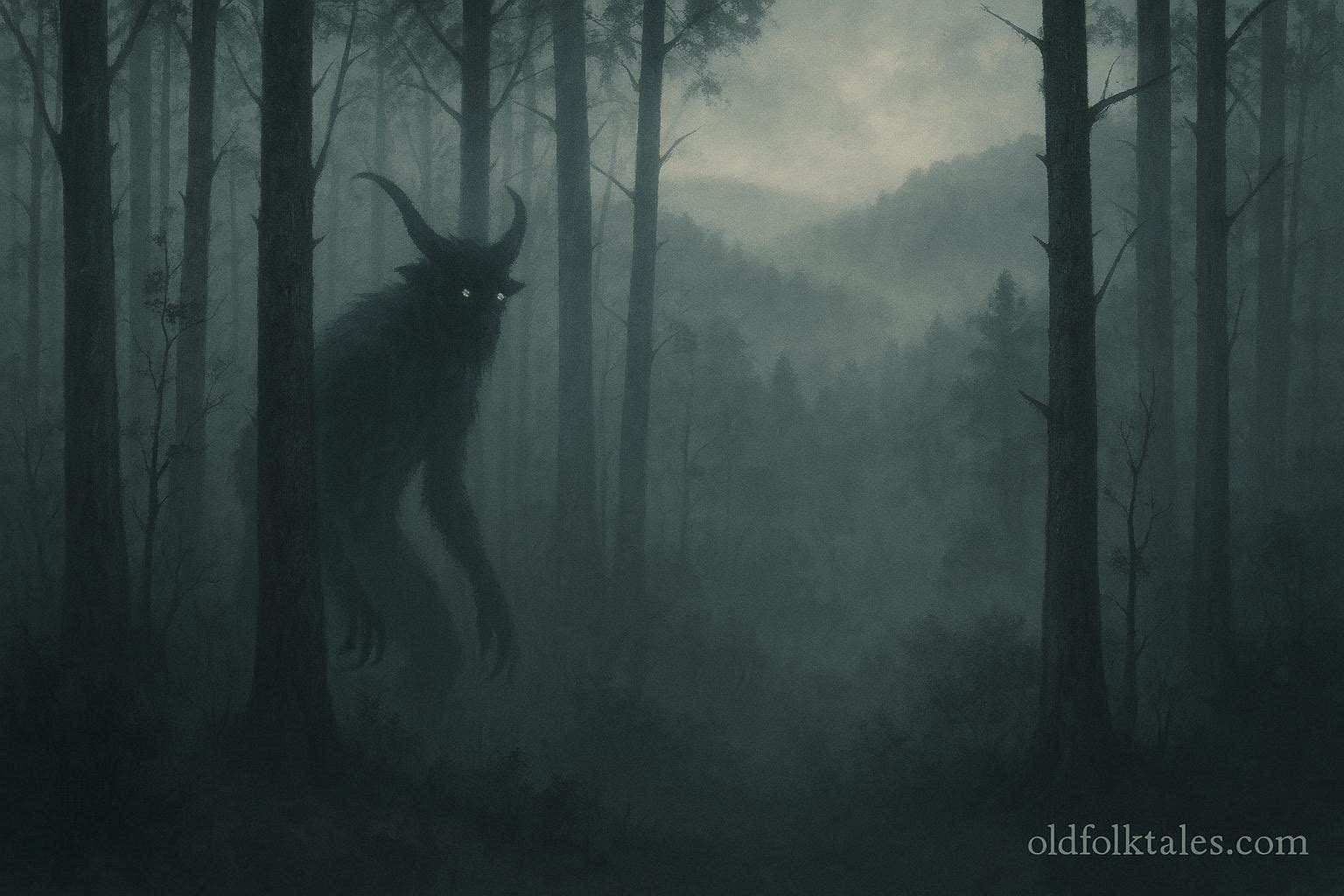
The dense, rolling hills of the Ozarks have long been home to mysteries whispered around campfires and recounted in the quiet of mountain cabins. Among these legends, none is more feared or more enigmatic than the Lougarou. Local farmers and travelers have told tales for generations of a creature that walks on two legs yet bears the features of a goat, with leathery skin, glowing eyes, and curved horns that pierce the shadowed forests. Unlike ordinary wildlife, the Lougarou seems to vanish and reappear at will, often accompanied by a chilling silence or the faint rustle of unseen movement in the underbrush.
Historically, the Lougarou was first documented in early 19th‑century settler journals. Farmers leaving their cabins at dawn occasionally reported seeing hoof‑like footprints in muddy paths where no animal should tread. Livestock were found mysteriously disturbed, though never harmed in a conventional way, adding to the cryptid’s fearsome reputation. Indigenous oral traditions also hinted at a spirit guardian or a trickster figure of the mountains, though the Lougarou’s hybrid form is unique to Ozark folklore. Scholars studying Appalachian and Ozark legends note that such creatures often serve as a narrative bridge between moral caution and unexplained natural phenomena.
Sightings of the Lougarou often share remarkable consistency. Witnesses describe a humanoid torso, covered with sparse, coarse hair, ending in goat-like legs and hooves. Its eyes are said to emit an unnatural reflection, especially at dusk or in the light of the full moon. Some accounts tell of a low, guttural growl, while others report eerie silence that blankets the woods whenever it is near. The creature is rarely seen for long; observers often lose it among the twisted trees and steep valleys, giving the impression that it can traverse terrain with impossible agility.
Explore how American legends shaped the nation — from frontier heroes to Revolutionary War tales.
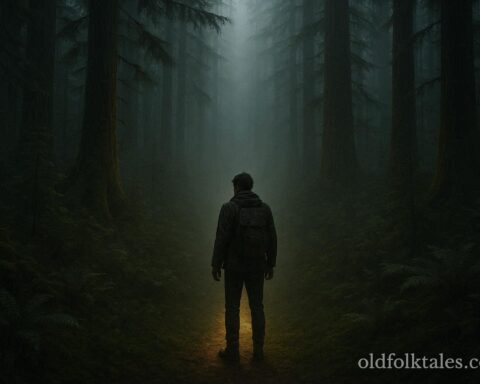
Local residents recount that the Lougarou is most active during autumn and winter months, when darkness arrives early and fog hugs the hills. Hunters and hikers describe a sudden, unsettling presence behind them, only to find nothing when they look back. These encounters have inspired superstitions about the Lougarou as both a guardian and a harbinger. Some families claim that those who disrespect the forests or the animals within risk attracting its attention, while others interpret its sightings as warnings of misfortune or upcoming hardship.
Modern researchers have attempted to explain the phenomenon with naturalistic theories. Some suggest that misidentified deer, mountain goats, or escaped livestock could account for sightings, particularly under poor lighting. Others consider the Lougarou a product of collective imagination, a cultural construct shaped by the isolation of mountain life and oral storytelling traditions. However, the enduring consistency of eyewitness reports, spanning generations and geographical distance within the Ozarks, lends the Lougarou a place among America’s most enigmatic cryptids.
The Lougarou has also inspired folklore beyond personal encounters. Local storytellers have incorporated it into cautionary tales for children, warning of wandering alone in the mountains or ignoring family and community guidance. These narratives often emphasize respect for the land, attentiveness to the natural world, and the importance of remaining vigilant in unfamiliar terrain. Over time, the creature has come to symbolize the unpredictable, untamed spirit of the Ozark wilderness, blending fear, mystery, and cultural identity into a single legend.
In contemporary times, the Lougarou continues to capture attention. Cryptid enthusiasts and paranormal investigators travel to the Ozarks hoping to catch a glimpse or gather evidence. Some set trail cameras, while others spend nights listening for the telltale hoof‑like steps and guttural sounds reported by previous generations. Local festivals sometimes reference the creature, celebrating the lore while warning visitors to respect both the legend and the rugged landscape it inhabits. The Lougarou remains a living part of regional storytelling, a bridge between history, myth, and the natural world.
Encounter the strange and the unseen — from Bigfoot to regional monsters hiding in America’s forests.
Moral Lesson
Respect the land, its creatures, and the wisdom of local traditions; caution and vigilance can safeguard us from unseen dangers and teach the value of harmony with nature.
Knowledge Check
- What is the Lougarou said to look like?
A goat‑like humanoid with horns, hooves, and glowing eyes - Where is the Lougarou mainly reported?
The Missouri and Arkansas mountains of the Ozarks - During which seasons is the Lougarou most active?
Autumn and winter - What type of moral lesson is often associated with Lougarou stories?
Respect for the land and vigilance in nature - Which types of evidence have researchers relied on?
Eyewitness reports, footprints, and anecdotal stories - How is the Lougarou used in local culture today?
As a folkloric figure in cautionary tales, festivals, and cryptid research
Source:
Adapted from Ozark folklore compilations and state historical archives
Cultural Origin:
Ozarks regional folklore