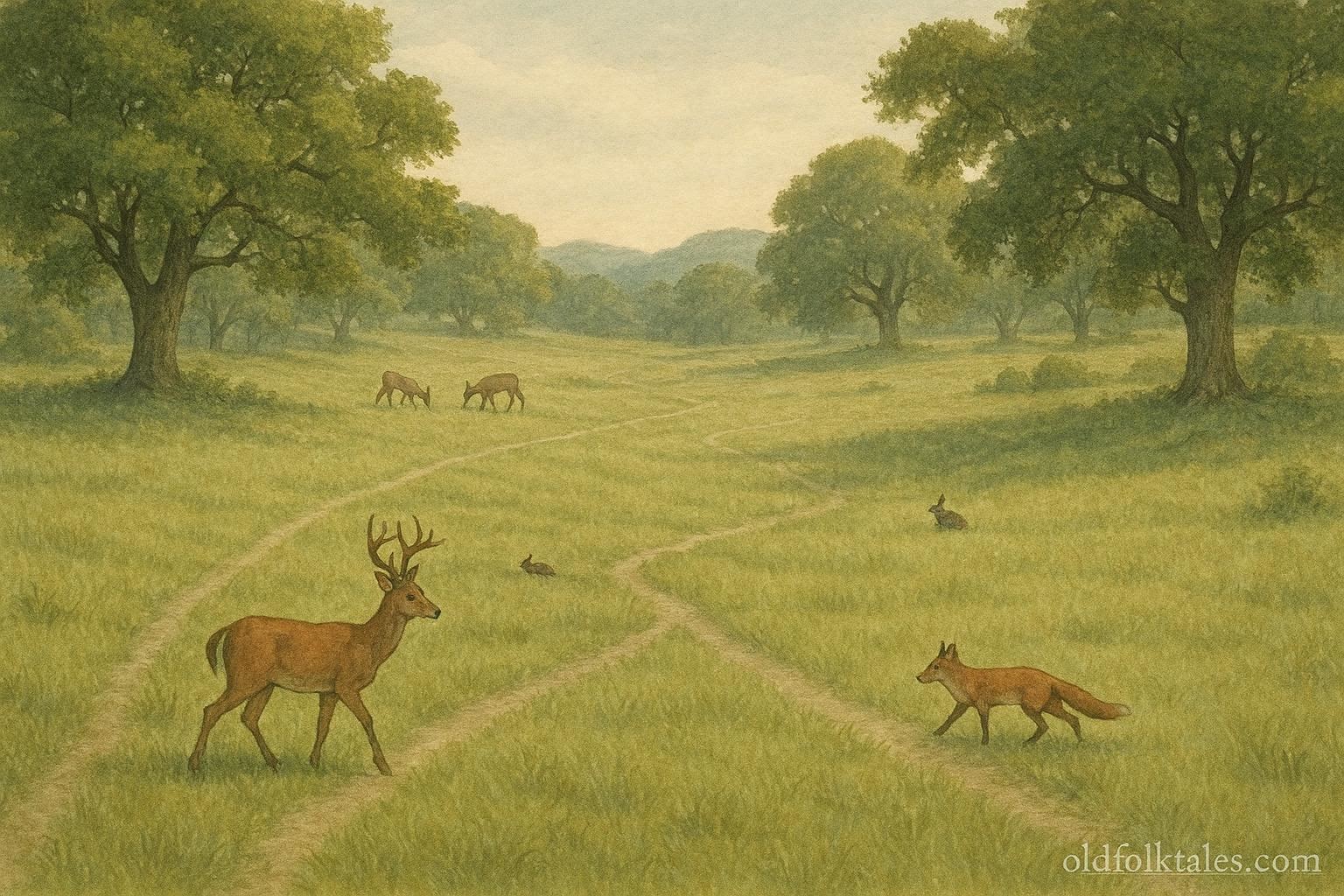
Ash Trail Meadow appeared ordinary to anyone passing through for the first time. Its rolling grasses, scattered oaks, and gentle hills gave the impression of quiet stillness beneath a wide, open sky. Yet the Miwok knew differently. Beneath this calm exterior lay traces of history and care. Pale ribbons of ash traced across the grass told the story of generations who had tended the land with deliberate attention, preserving pathways of animals and maintaining balance between fire, plants, and life itself.
Long ago, the Miwok observed the movement of deer, elk, and other creatures across the meadow. The animals traveled the same routes year after year, guided by instinct, water sources, and the cycles of the seasons. Over time, these routes became ingrained in the land. People noticed that by watching these movements, they could predict where animals would appear, where fresh water collected, and where grass would be strongest. The land, animals, and people were bound together in a living system of memory and guidance.
Fire became a tool for reinforcing this natural order. Elders instructed small, deliberate burns along the animal paths at precise times of the year. The fires were never left uncontrolled; they were planned with care, using knowledge of wind, moisture, and season. When the fires died down, pale ash covered the ground, tracing the animal trails and reinforcing the paths that had been worn for generations. These burns not only refreshed the grass and cleared old growth but also served as a living map of the meadow’s history.
Discover chilling ghost tales and haunted places that echo through America’s towns and countryside.
The children of the Miwok learned early to read these signs. Elders guided them along the ash trails, pointing out where the soil was rich, where water collected, and where plants grew fastest. The burns were taught not simply as a method of survival but as a language the land could understand. Observing the ash trails and the returning animals instilled awareness, patience, and respect. Every flame and every step carried meaning, connecting the young learners to a centuries-old cycle of care.
Stories tell that there were times when the people failed to tend the fires. The meadow became tangled and overgrown. Water pooled in unusual places, grass choked the soil, and animals avoided the area. Without careful stewardship, the land lost its harmony. The Miwok understood that neglect of the meadow affected both people and animals alike. When controlled burns returned, however, the meadow revived. Fresh shoots appeared, the old animal paths reemerged, and balance was restored. Ash lines acted as markers, reminding the people of where care had been taken and where attention was still needed.
The meadow also became a place for communal reflection and learning. After each controlled burn, elders would bring families together to walk the trails. They would point out subtle changes in plant growth, note animal signs, and share stories of ancestors who had tended the land before them. Memory was encoded not only in oral tradition but in the land itself. The ash lines and animal tracks were living records of the past, ensuring knowledge would not be lost and that future generations could continue the cycle of care.
Patience and discipline were essential lessons of Ash Trail Meadow. Fires that were too large or poorly timed could destroy the soil, kill beneficial plants, or endanger wildlife. Too small or inconsistent, and invasive grasses could take over, disrupting the ecosystem. Elders emphasized that the land responded honestly to human care: respect and attention brought renewal, negligence led to stagnation. Observing and understanding these rhythms taught responsibility, humility, and the importance of living in harmony with the natural world.
The animals themselves became teachers. Deer and elk appeared when the land was ready, moving along the ash-lined paths, grazing where grass was strongest, and resting where water and shelter were abundant. Smaller creatures followed, spreading seeds, aerating the soil, and completing cycles of life. By paying attention to their behavior, the Miwok learned about seasons, weather, and the subtle signals that guided life in the meadow.
Ash Trail Meadow was more than a place; it was a living story. Every fire, every ash line, every returning animal was part of a narrative that spanned generations. Elders reminded the people that the land itself remembered: the earth held the knowledge of all who had walked upon it, and it required care and attention to keep that memory alive. To disrespect the land was to risk losing not only resources but the guidance embedded in its patterns.
Even today, Ash Trail Meadow continues to embody these lessons. The careful balance of fire, the return of animals, and the pale lines of ash across the grass all preserve memory, renewal, and stewardship. Visitors can still feel the pulse of history beneath their feet, a quiet reminder that survival and abundance depend not on domination, but on attentive care and respect for the interconnected rhythms of life.
Explore ancient Native American creation myths and the symbolic tales that shaped America’s belief systems.
Moral Lesson
Stewardship requires patience, observation, and respect. True care ensures continuity, balance, and renewal for humans, animals, and the land itself.
Knowledge Check
- Why were ash lines important in Ash Trail Meadow?
They marked animal migration paths and preserved memory across generations. - How did controlled burns help the meadow?
They encouraged new growth, maintained open paths, and supported wildlife movement. - Why was fire considered a language of the land?
Because careful burns communicated renewal and balance to both people and animals. - What happened when fire was neglected?
The meadow became overgrown, water stagnated, and animals moved away. - Why was patience important in tending the meadow?
Because too much or too little fire disrupted the balance and harmed the land. - How did Ash Trail Meadow teach responsibility?
It showed that humans must observe, care for, and maintain harmony with the environment.
Source
Adapted from University of California Indigenous land-management folklore research
Cultural Origin
Miwok communities