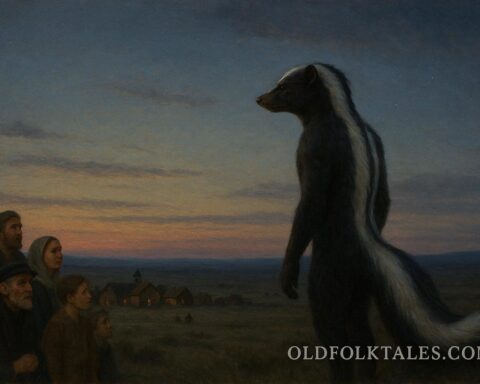
Some legends begin in castles or battlefields. Others are born on quiet country roads where fog settles low over the fields and headlights cut through darkness. In central Vermont, one such legend took shape along isolated stretches of forest-lined pavement. It is the story of the Northfield Pigman, a half-man, half-pig figure said to wander rural backroads long after sunset.
Northfield is a small New England town surrounded by wooded hills, farms, and winding roads. In the daytime, it appears peaceful and unremarkable. But like many rural communities, it carries stories passed between generations tales told at bonfires, sleepovers, and long winter evenings.
The Pigman legend is often described as a transformation story. According to one version, a local farmer who kept pigs in remote pastures gradually withdrew from town life. Rumors spread that he had become obsessed with his livestock. When neighbors stopped seeing him at church or market, whispers replaced facts.
Discover chilling ghost tales and haunted places that echo through America’s towns and countryside.
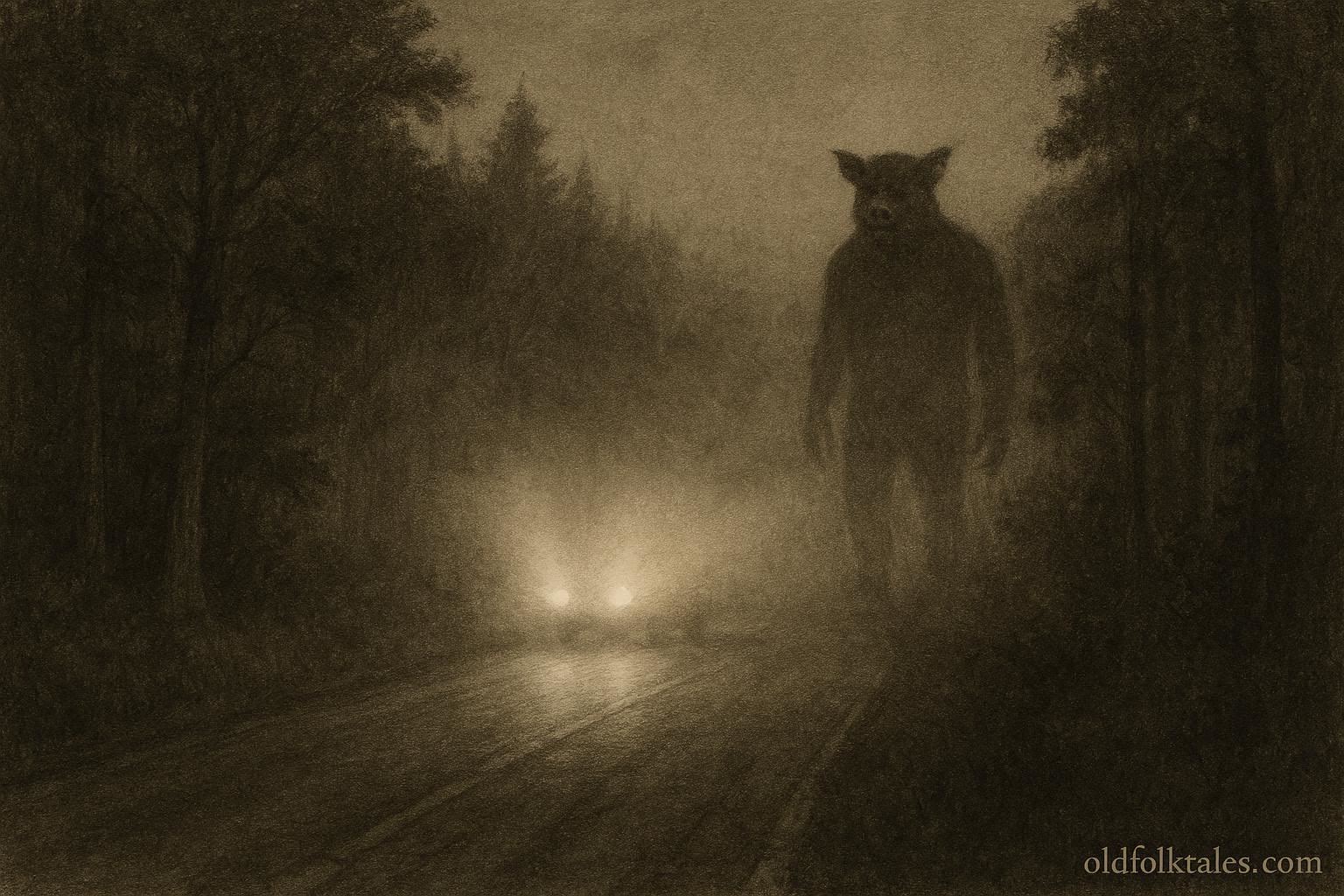
Eventually, stories claimed the farmer had somehow taken on the features of his animals. He was said to walk upright like a man but possessed the face or snout of a pig. Some accounts describe glowing eyes reflecting in headlights. Others claim he emitted strange grunting sounds from the woods.
Another variation suggests that the Pigman was never fully human to begin with. In this telling, he is a creature of the forest, drawn to farms and roads only at night. He is described as large, shadowy, and capable of disappearing quickly between trees.
Like many road legends, the Pigman story is tied to caution. Teenagers are warned not to drive recklessly on dark backroads. Children are advised not to wander alone into the forest. The creature becomes a symbolic guardian of boundaries, a reminder that isolation can be dangerous.
Transformation myths are deeply rooted in global folklore. Stories of humans turning into animals appear in cultures around the world. In New England, where rural life historically revolved around farming and livestock, it is not surprising that pig, a familiar but sometimes unsettling animal became central to such a legend.
Agricultural communities often balance practicality with superstition. Animals are essential for survival, yet they are also powerful symbols. Pigs in particular have long carried mixed meanings associated with abundance in some traditions and impurity in others. This dual symbolism may have influenced the shape of the Pigman tale.
Rural isolation strengthens legends. Long stretches of road without streetlights can make ordinary shadows seem threatening. Wind moving through trees can resemble whispers or movement. In winter, snow absorbs sound, creating an eerie silence that heightens imagination.
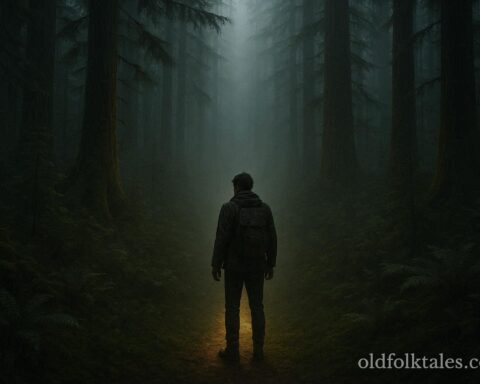
Reports of Pigman sightings tend to follow a familiar pattern. A driver traveling at night notices a figure near the edge of the road. For a brief moment, the headlights illuminate something unusual, perhaps an oddly shaped silhouette. When the driver slows down or turns around, the figure is gone.
Psychologists who study urban legends suggest that such experiences are often shaped by expectation. Once a story becomes known within a community, people interpret ambiguous sights or sounds through its framework. A deer crossing the road at an unusual angle may briefly appear humanoid. Shadows cast by tree branches may resemble upright forms.
The Northfield Pigman legend has no verified physical evidence. No official records confirm encounters with a half-human creature. Yet its persistence reveals something important about storytelling.
Legends thrive not because they are proven, but because they resonate. The Pigman reflects anxieties about isolation, about losing connection to community, and about crossing unseen boundaries. In small towns, where reputation matters and rumors spread quickly, transformation becomes a metaphor for social withdrawal.
The setting plays a crucial role. Vermont’s forests are dense and ancient. Many roads curve sharply and disappear into darkness. Fog can roll in suddenly, distorting shapes and distance. In such conditions, imagination fills gaps that visibility cannot.
Modern retellings sometimes shift the story toward horror, exaggerating physical details for dramatic effect. However, earlier versions emphasize mystery more than violence. The Pigman is usually described as elusive rather than aggressive. He appears, watches, and vanishes.
This watchful quality aligns with a broader New England tradition of road legends. Across the region, stories warn travelers about spectral hitchhikers, haunted bridges, and silent figures standing just beyond headlights. These tales share a common structure: brief encounter, moment of fear, sudden disappearance.
Historians examining Vermont folklore note that many rural legends gained traction in the mid-to-late twentieth century. As small towns modernized, older oral storytelling traditions adapted to new settings. Campfire tales replaced front-porch storytelling, but the function remained the same reinforcing shared identity and caution.
The Pigman may also reflect tension between human control and the natural world. Farming represents order, planning, and cultivation. The forest represents unpredictability and wildness. A half-man, half-animal creature straddles both realms, embodying the fragile boundary between civilization and wilderness.
Even today, some Northfield residents smile knowingly when the legend is mentioned. For many, it is less a literal belief and more a cultural artifact, a story that belongs to the landscape.
Driving through rural Vermont at night still carries a certain atmosphere. Without city lights, the sky appears vast and stars shine intensely. The road narrows, trees lean inward, and the world feels older than modern life. In such moments, it is easy to understand how a fleeting shadow might become something more.
The Northfield Pigman endures because it captures a universal experience: the uneasy feeling of being watched in the dark. Whether born from rumor, imagination, or symbolic storytelling, the legend remains woven into Vermont’s rural identity.
Click to read all American Cryptids & Monsters — creatures of mystery and fear said to inhabit America’s wild landscapes.
Moral Lesson
Isolation and rumor can transform ordinary circumstances into powerful legends. Stories often reveal more about human fears than about monsters themselves.
Knowledge Check
- Where is the Northfield Pigman legend said to originate?
Northfield, Vermont. - What type of creature is the Pigman described as?
A half-man, half-pig figure. - What common setting is associated with Pigman sightings?
Dark rural roads and forested areas. - What theme does the Pigman legend strongly reflect?
Transformation and rural isolation. - Why do road legends often develop in rural areas?
Limited visibility and isolation heighten imagination and storytelling. - Does historical documentation confirm the Pigman’s existence?
No, the legend persists through oral storytelling rather than verified records.
Source
Adapted from Vermont Historical Society archives and University of Vermont Special Collections
Cultural Origin
Vermont rural folklore