History often remembers wars by their loudest generals and most famous victories, yet some of the most decisive acts occur quietly, carried out by those whose names rarely appear in textbooks. During the American Revolution, while muskets thundered and declarations were signed, the Oneida Nation made a choice that would alter the fate of the conflict and forever change their own destiny.
The Oneida people were part of the Haudenosaunee Confederacy, a powerful alliance of Indigenous nations whose political systems influenced democratic thinking long before colonial settlement. When war broke out between the British Crown and the American colonies, the Confederacy faced intense pressure. Neutrality was discussed, debated, and desired. But neutrality proved impossible in a war that cut directly through Indigenous homelands.
British agents sought Indigenous allies aggressively, offering protection and continuity. At the same time, American representatives approached the Oneida with appeals to shared values and mutual survival. After long council deliberations, the Oneida chose an alliance that history would later acknowledge as pivotal but costly.
Explore the heart of America’s storytelling — from tall tales and tricksters to fireside family legends.
Their decision was not unanimous. Families were divided. Villages faced tension. Choosing sides meant choosing consequences. Still, the Oneida believed that aligning with the Americans offered the best chance to protect their people from total domination by imperial power.
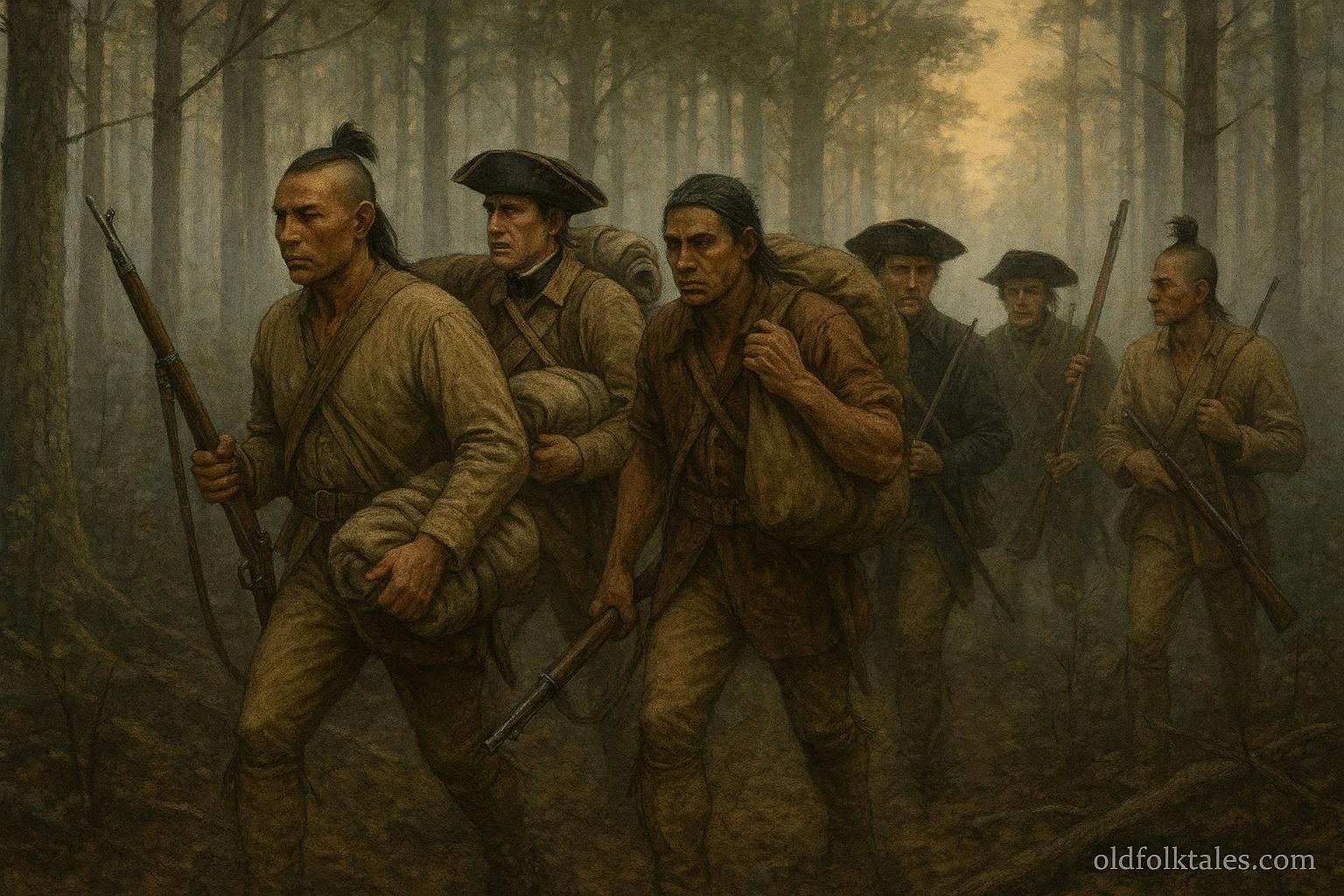
Once committed, the Oneida did not merely pledge symbolic support. They became indispensable contributors to the revolutionary cause. Oneida scouts moved silently through forests unfamiliar to colonial soldiers, gathering intelligence on British troop movements. Their knowledge of terrain, seasonal travel routes, and enemy habits allowed American commanders to avoid ambushes and reposition forces with precision.
Food aid proved just as critical as battlefield action. During harsh winters when Continental Army supplies dwindled, Oneida communities shared corn, beans, and preserved foods from their own stores. This generosity came at great personal cost, as Oneida families themselves faced scarcity. Their aid helped keep American soldiers alive during moments when morale and survival were dangerously fragile.
The Oneida also served as guides and messengers, navigating dangerous paths between encampments. Communication during wartime was slow and perilous, yet Oneida runners carried information across hostile territory, often under threat of capture or death. These efforts helped maintain coordination between scattered American forces.
On the battlefield, Oneida warriors fought beside colonial troops, notably at the Battle of Oriskany. There, Indigenous fighters faced Indigenous opponents, as other Haudenosaunee nations allied with the British. The battle was brutal, chaotic, and deeply painful, forcing the Oneida to confront the reality that the war was tearing Indigenous nations apart.
Despite their sacrifices, victory did not bring reward. When the war ended and independence was secured, treaties were written and broken with alarming speed. Promised protections vanished. Lands were seized. Settlers moved westward, often onto territories once safeguarded by Oneida alliance.
The very nation the Oneida helped create expanded at their expense. Displacement followed. Some Oneida were forced west to Wisconsin, while others struggled to remain in New York on diminished lands. Their wartime loyalty did not shield them from betrayal.
Yet memory persisted. Stories passed down within Oneida communities preserved the truth of their role. Oral histories spoke of nights spent guiding soldiers, of empty storehouses shared with strangers, of courage given without guarantee of return. These stories resisted erasure.
Today, historians increasingly recognize that American independence was not achieved alone. It was shaped by Indigenous intelligence, sacrifice, and diplomacy. The Oneida warriors did not merely participate in history. They altered its course.
Their story challenges simplified narratives of revolution. It reminds us that freedom for some was built upon the loss of others. And it demands recognition that heroism does not always result in justice.
Moral Lesson
True heroism is not measured by reward or recognition but by the courage to act according to conscience, even when the outcome brings personal loss. The Oneida warriors demonstrated that moral choices can shape history, even when history fails to honor those choices in return.
Knowledge Check
1. Who were the Oneida warriors allied with during the American Revolution?
They allied with the American colonial forces.
2. Why was the Oneida alliance a risky decision?
It exposed their communities to retaliation and internal division.
3. What type of support did the Oneida provide?
They provided intelligence gathering, food aid, guidance, and battlefield assistance.
4. How did Oneida aid affect American troops?
It improved survival, morale, and military strategy.
5. What consequences did the Oneida face after the war?
They suffered land loss, broken treaties, and displacement.
6. Why is Oneida heroism often overlooked in history?
Their contributions were informal and minimized in traditional historical records.
Source
Adapted from Smithsonian National Museum of the American Indian historical folklore collections
Cultural Origin
Oneida Nation communities, Northeastern United States