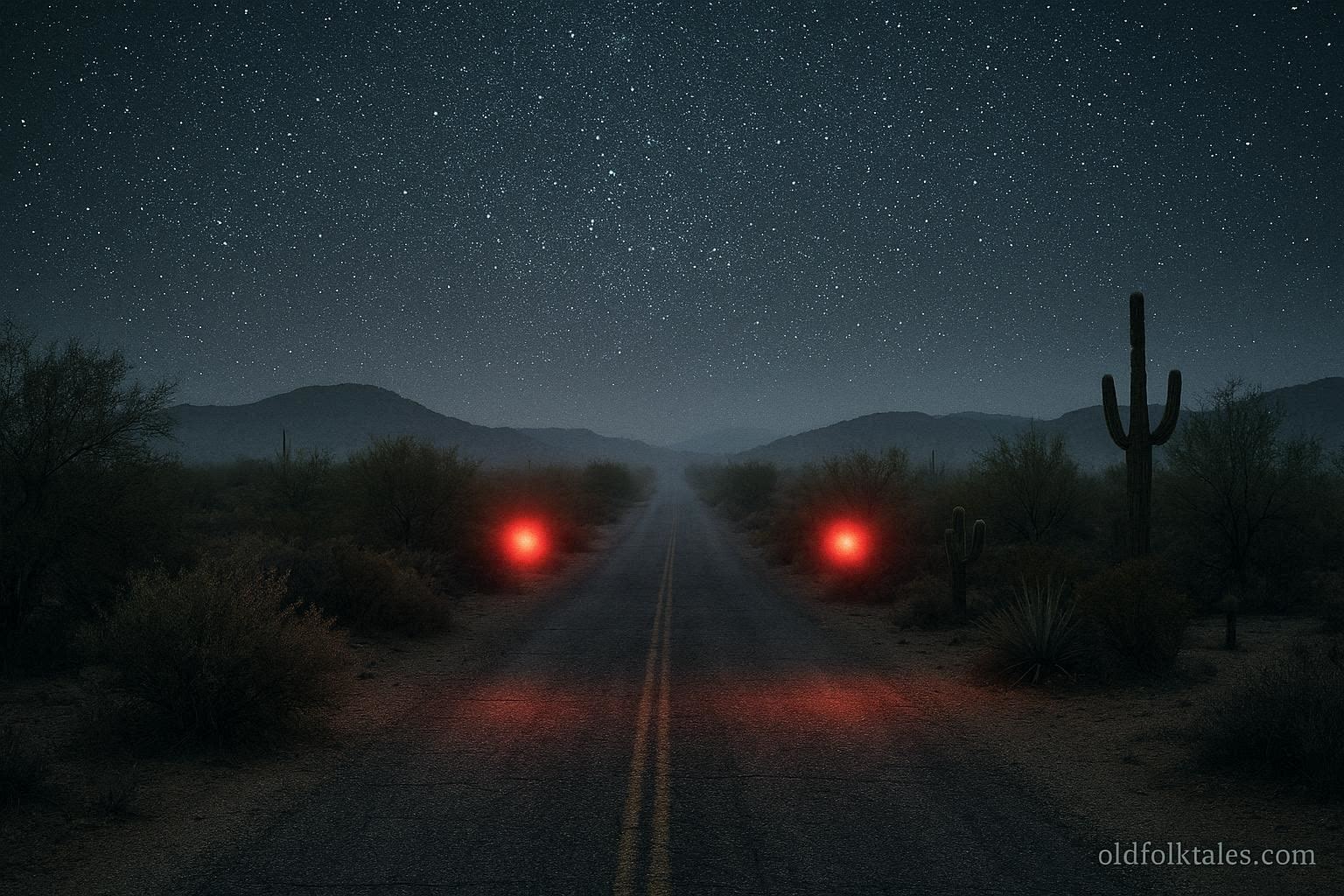
The borderlands of Texas, New Mexico, and Arizona are vast stretches of desert, scrub, and isolated roads. At night, the emptiness feels absolute. Few travelers venture far after dark, and those who do often report seeing something that cannot be explained. Along certain stretches of remote roads, pairs of red lights appear at roughly human height. They hover or move slightly, never advancing or retreating. Witnesses call them the Red Eyes of the Borderlands.
People first noticed the lights decades ago. Drivers describe pulling their cars to the side when the lights appear. The lights seem aware of their presence, holding a steady position as if watching. At the same time, the lights never follow, strike, or respond in an aggressive way. They simply exist in the night, silent and unyielding. This behavior has led to stories that blend fear and curiosity.
Local communities pass down these stories quietly. The lights are often described as mysterious guardians or watchers, tied to the harshness and isolation of the desert. Some claim the eyes mark borders, watching those who travel too far into unpopulated areas. Others link them to supernatural surveillance, a warning to respect boundaries. Over time, the legend has become part of the folklore of Southwestern borderlands.
Step into shadowy legends of restless spirits and ghostly travelers in American Ghost Stories.
Researchers from the University of Texas have documented numerous accounts of the phenomenon. People consistently report the same features: paired red lights, human height, stationary movement, and sudden disappearance. Witnesses come from diverse backgrounds, drivers, ranchers, hikers but their stories share key details. The repetition suggests a legend rooted in both observation and cultural imagination.
The appearance of the red lights is unpredictable. Sometimes they appear along lonely stretches of highway. Other times, they are seen near desert outposts or abandoned border stations. Travelers report feelings of unease, a sense of being watched or evaluated. The lights themselves never emit sound, nor do they produce heat or other physical effects, yet their presence commands attention.
Folklorists argue that the Red Eyes of the Borderlands illustrate the human need to explain uncertainty. In sparsely populated regions, where silence dominates and natural hazards abound, stories of mysterious watchers provide a framework for understanding danger and maintaining respect for the environment. The lights mark liminal spaces, those places between safety and unknown terrain.
Some researchers suggest the lights may have technological explanations, distant vehicle lights, reflective markers, or rare optical phenomena. However, consistent descriptions across decades, including accounts before modern highways and electronic devices, indicate that the phenomenon is also a cultural story. It blends observation, imagination, and the psychological effects of traveling alone in the desert night.
The legend continues to evolve. Local storytellers share it around campfires, roadside inns, and during community gatherings. New witnesses add to the body of accounts, maintaining the sense that the lights are real and present. The Red Eyes are not just an isolated phenomenon; they are woven into the identity of the borderlands, reflecting both the danger and wonder of the desert landscape.
Travelers and residents treat the lights with a combination of caution and respect. The legend teaches awareness: move carefully, observe surroundings, and respect boundaries. Like many folktales, the Red Eyes serve a dual purpose: entertaining through mystery and instructing through implied warnings.
Even though the lights have never caused direct harm, they remain a potent symbol. They represent liminality, the tension between human territory and untamed land, and the persistence of unknown forces along border roads. To those who witness them, the lights are a reminder that some parts of the world are not fully under human control.
The Red Eyes of the Borderlands continue to appear to those who travel after dark. They endure because the landscape remains vast and isolated, because the stories are passed down carefully, and because human imagination continues to search for meaning in the shadows.
Click to read all American Cryptids & Monsters — creatures of mystery and fear said to inhabit America’s wild landscapes.
Moral Lesson
Boundaries exist for a reason. Respect the unknown, pay attention to your surroundings, and do not overestimate human control over the land.
Knowledge Check
1. Where are the Red Eyes of the Borderlands most often reported?
Along remote roads in the Texas, New Mexico, and Arizona borderlands.
2. How are the lights described?
Paired, red, roughly human height, stationary, and silent.
3. Do the Red Eyes approach or attack humans?
No, they remain stationary and do not exhibit aggression.
4. What cultural purpose does the legend serve?
It warns travelers to respect boundaries and pay attention to the unknown.
5. Who has reported seeing the Red Eyes?
Drivers, ranchers, hikers, and other remote-area travelers.
6. Why does the phenomenon persist in folklore?
Because the desert remains isolated, the stories are passed down, and human imagination fills the gaps of uncertainty.
Source
Adapted from University of Texas border studies folklore documentation and oral tradition archives.
Cultural Origin
Southwestern border communities of Texas, New Mexico, and Arizona.