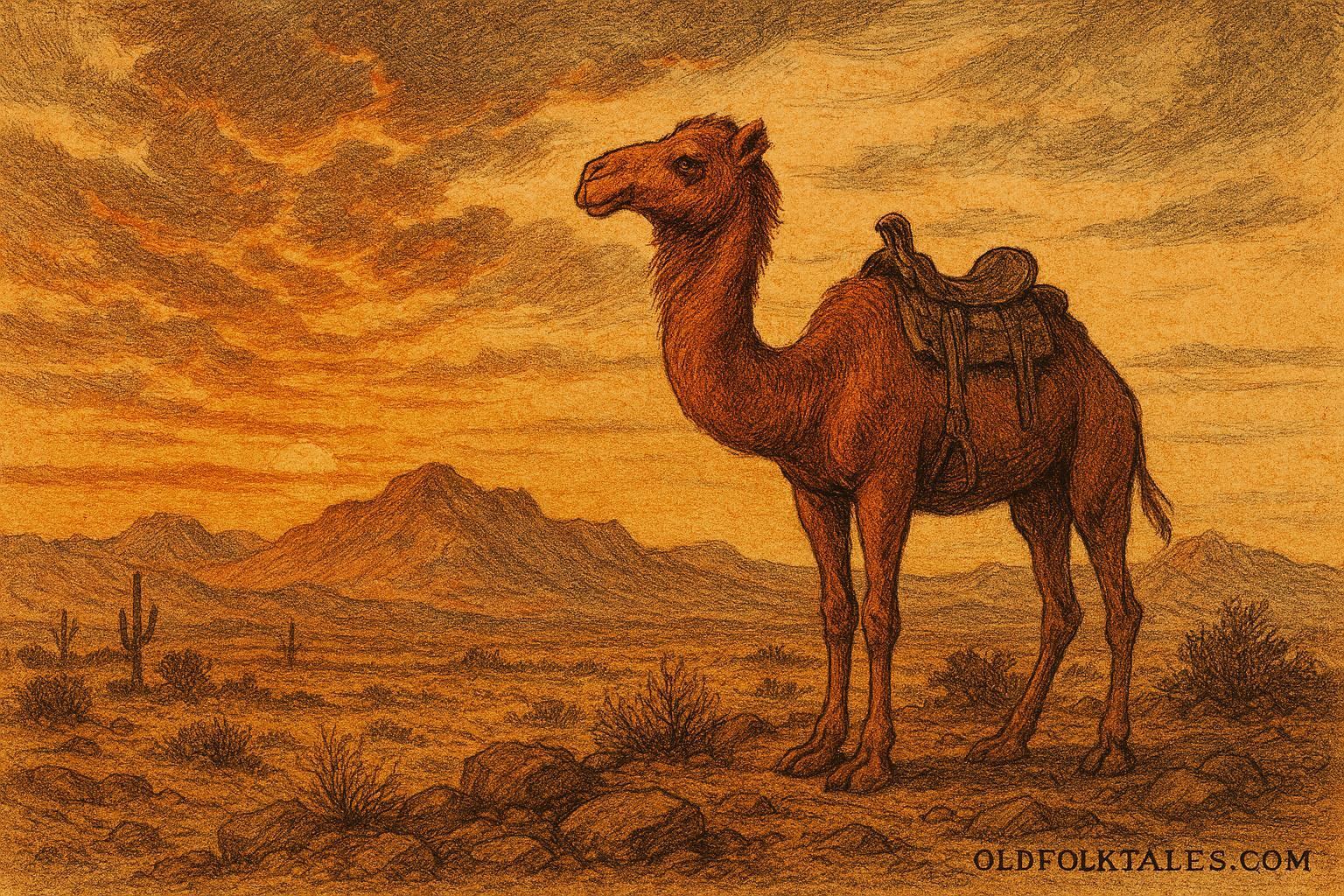
Long before highways crossed Arizona’s deserts, stories traveled faster than wagons. Among the strangest tales whispered across the frontier was that of a red-haired camel wandering alone beneath the blazing sun. Ranchers claimed to see it at dusk. Prospectors swore it moved silently across the horizon. Some insisted it carried something terrifying strapped to its back.
The legend of the Red Ghost Camel emerged in the late nineteenth century, during a time when the American Southwest was still being mapped, settled, and militarized. Arizona was harsh country. Water was scarce, distances were vast, and traditional pack animals struggled in extreme heat.
In the 1850s, the United States Army launched an unusual experiment known as the Camel Corps. The goal was practical rather than mythical. Military leaders believed camels, already adapted to desert environments in the Middle East and North Africa, could thrive in the arid terrain of the American Southwest.
Explore the heart of America’s storytelling — from tall tales and tricksters to fireside family legends.
In 1855, dozens of camels were imported and transported to Texas and the Arizona Territory. Soldiers tested them for carrying supplies across deserts. Reports indicated that camels could travel longer distances with less water than horses or mules. From a logistical standpoint, the experiment showed promise.
However, the animals frightened horses unfamiliar with their scent and behavior. They were difficult to manage using traditional cavalry methods. When the Civil War began, funding and attention shifted away from experimental programs. The Camel Corps was quietly abandoned.
Some camels were sold at auction. Others were released or escaped into the wild. Over time, scattered reports began to surface of large, strange animals roaming desert regions. To settlers unfamiliar with camels, the sightings seemed unnatural.
The Red Ghost legend gained momentum after a particularly disturbing report. In the 1880s, ranchers claimed to have encountered a red-haired camel with what appeared to be a human skeleton strapped to its back. According to the story, the bones were tied securely, suggesting the rider had died long before the animal was seen again.
Whether the skeleton detail was factual, exaggerated, or symbolic remains debated. Some historians speculate that a former handler may have died while riding one of the animals, his remains never recovered. Others argue that the skeleton element evolved later as part of frontier storytelling tradition.
Multiple sightings were reported across Arizona’s desert regions. Witnesses described the animal as unusually tall, reddish in color, and swift despite its size. It reportedly avoided capture and disappeared into rugged terrain whenever approached.
Eventually, a rancher is said to have shot and killed a wild camel matching the Red Ghost description. When examined, no skeleton was reportedly found. This discrepancy only fueled the mystery. If the skeleton story was false, why had so many people repeated it?
The Red Ghost Camel sits at the intersection of documented history and folklore. Unlike purely mythical creatures, camels truly did roam parts of the Southwest after the Camel Corps experiment ended. Historical records confirm their presence. Newspapers from the late nineteenth century mention wild camels sighted in Texas, Arizona, and California.
This factual foundation strengthens the legend. The idea of a phantom camel is not entirely imaginary. It is rooted in a real government program that briefly altered the ecology of the desert. When the experiment failed, the abandoned animals became living anomalies.
Frontier communities often transformed unusual events into storytelling traditions. In isolated environments, unexplained sightings were discussed repeatedly, gaining detail with each retelling. A solitary camel crossing a sunset horizon could easily become a ghostly figure in collective memory.
The desert itself contributes to the legend’s power. Heat waves distort vision. Distance plays tricks on perception. A lone animal appearing through shimmering air can seem larger or stranger than it truly is. The Red Ghost may have been an ordinary escaped camel magnified by environment and imagination.
Yet the skeleton detail persists in folklore collections. It symbolizes the danger and unpredictability of frontier life. The desert claimed lives without warning. Travelers vanished. Expeditions failed. The image of a camel carrying the remains of a lost rider captures that harsh reality in a single haunting image.
Modern historians emphasize that the Camel Corps experiment was innovative but poorly timed. Political instability and war interrupted its progress. Had it continued, camels might have become common in the American Southwest. Instead, they became relics of a forgotten military curiosity.
The Red Ghost legend serves as a reminder of how quickly history can shift from documented fact to mythic narrative. A government project intended to improve transportation became the seed of one of Arizona’s strangest cryptid tales.
Even today, stories of ghostly desert animals resurface in books and documentaries. Though no confirmed wild camels roam Arizona now, the image of a red-haired phantom crossing the sand remains part of regional identity.
The Red Ghost Camel represents more than a mysterious animal. It reflects experimentation, abandonment, and the unpredictable consequences of frontier ambition. In the vast silence of the desert, where history leaves few visible traces, legends endure long after footprints fade.
Click to read all American Cryptids & Monsters — creatures of mystery and fear said to inhabit America’s wild landscapes.
Moral Lesson
Human experiments and ambitions can leave unexpected legacies. History often becomes legend when facts are forgotten but stories remain.
Knowledge Check
- What was the purpose of the United States Camel Corps?
To test camels as pack animals for desert transportation in the American Southwest. - In which decade were camels imported into the United States for this experiment?
The 1850s. - Why were camels considered suitable for Arizona’s desert environment?
They could travel long distances and survive with limited water. - What unusual detail made the Red Ghost legend especially famous?
Reports that the camel carried a human skeleton strapped to its back. - Why was the Camel Corps experiment discontinued?
The outbreak of the Civil War shifted military priorities and funding. - What makes the Red Ghost Camel different from purely mythical cryptids?
It is based on a documented historical military experiment that released real camels into the Southwest.
Source
Adapted from Arizona State Library archives and U.S. Army historical records
Cultural Origin
Arizona frontier folklore