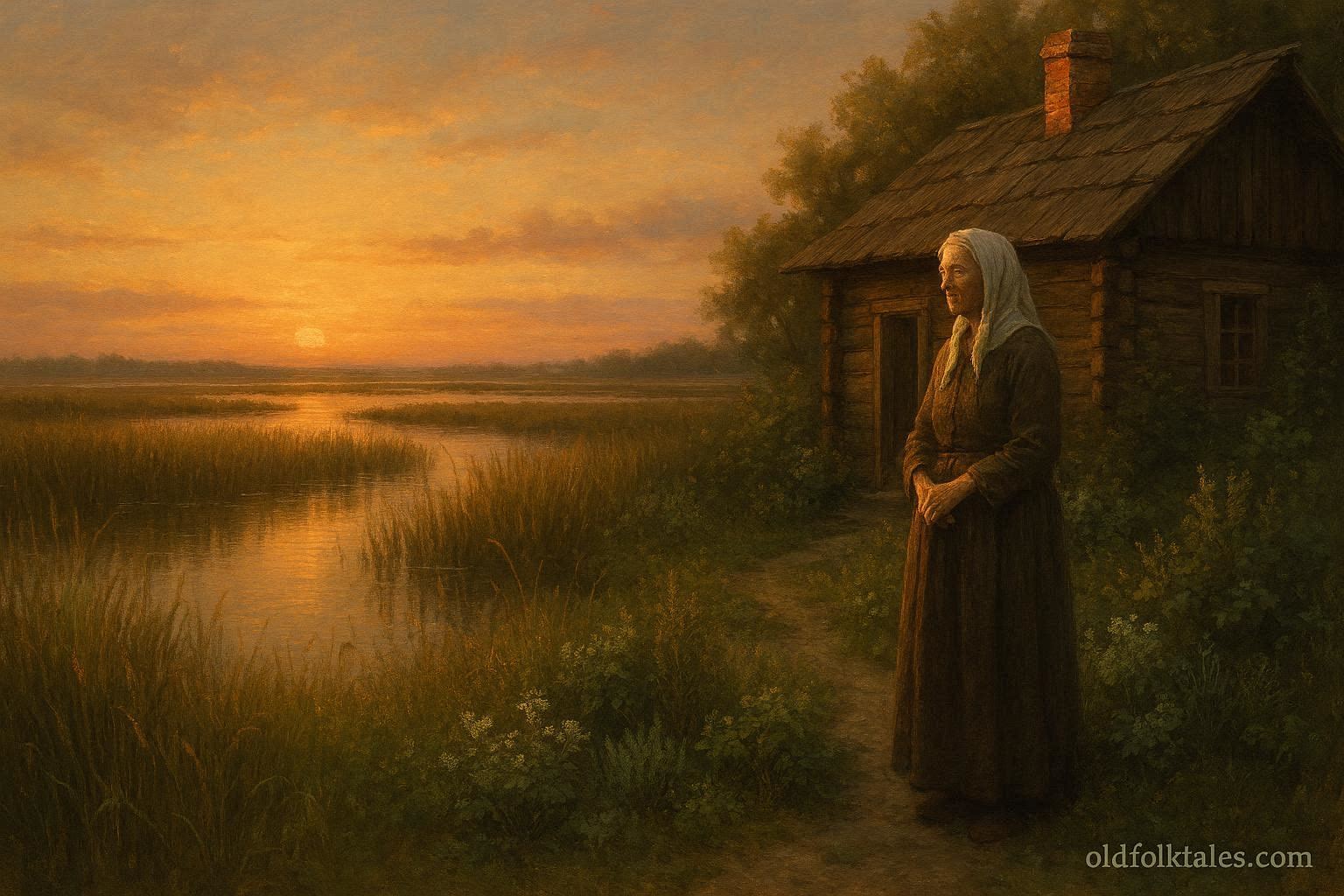
Savannah Marsh stretched wide beneath an open sky, its tall grasses moving gently with the breeze and its waters reflecting the shifting light of day and night. To many, it was simply a place of quiet beauty, but to those who lived nearby, it was something more.
It was a place of knowledge.
Hidden within the marsh, beyond the well-worn paths, lived a woman known to the community as the root woman. She was not often seen in the village, but her presence was always felt. People spoke her name with respect, knowing that her work went beyond what could easily be understood.
She was a healer.
Those who came to her did so with purpose. Some arrived with illnesses that had not responded to ordinary remedies. Others came with problems they could not explain, troubles that seemed to follow them without reason. No matter the case, the root woman listened carefully before offering help.
Her home stood at the edge of the marsh, surrounded by plants that she had gathered and nurtured over many seasons. Each root, leaf, and herb had its place and its purpose. She understood them in ways that others did not, knowing which could heal, which could protect, and which must be handled with care.
Step into America’s cultural roots — from folk healing and weather lore to seasonal celebrations.
Her work was guided by knowledge passed down through generations.
She did not rush her actions. Instead, she observed, listened, and considered what was needed. Sometimes she prepared mixtures using herbs from the marsh, combining them in ways that seemed simple but carried deep meaning. Other times, she created small bundles, carefully tied and given to those who needed protection.
But her role was not limited to healing the body.
She also worked to protect the spirit.
There were moments when people came to her not because of illness, but because something felt wrong. They spoke of unease in their homes, of shadows that seemed to linger, or of a heaviness they could not explain. In these cases, the root woman’s work became more focused.
She would travel to their homes, moving slowly and observing everything around her. She paid attention to details others might overlook, as though reading signs hidden in plain sight. Once she understood the situation, she would begin her work.
Her rituals were quiet but deliberate.
She spoke in low tones, her words steady and measured. Sometimes she worked during the day, but often her most important rituals took place at night, when the world was still and distractions were few. Those who witnessed these moments said that the atmosphere would change, becoming calm and balanced by the time she finished.
One evening, a fisherman came to her with a serious concern.
He explained that his home had become unsettled. Objects seemed to shift slightly, and there were moments when the air felt heavy, as though something unseen was present. His family had grown uneasy, and he feared that whatever it was would not leave on its own.
The root woman listened without interruption.
After a moment of thought, she agreed to visit his home. When she arrived, she walked through each room slowly, taking in her surroundings. She paused at certain points, as though sensing something others could not.
That night, she began her work.
She prepared a mixture of herbs and roots, placing them carefully around the home. She spoke quietly, her voice blending with the soft sounds of the night. The air felt tense at first, but as her work continued, that tension began to fade.
By the time she finished, the space felt different.
Lighter.
The fisherman and his family noticed the change immediately. The unease that had once filled their home was gone, replaced by a sense of calm they had not felt in days. They thanked her, understanding that what she had done went beyond simple explanation.
Stories like this spread throughout the community.
People came to see the root woman not only as a healer but as a protector. She stood between the known and the unknown, using her knowledge to maintain balance where it had been disturbed.
Despite her importance, she remained humble.
She never claimed more than her role required, and she always reminded those she helped to respect the land and the traditions that made her work possible. She believed that true healing did not come from her alone, but from the connection between people, nature, and the wisdom of those who came before.
As time passed, the marsh remained, and so did the stories.
Even when the root woman was no longer seen as often, her presence was still felt. The knowledge she carried did not disappear. It continued through those who remembered, through traditions that were carefully preserved and respected.
The marsh itself seemed to hold her legacy.
Those who walked its edges spoke of a quiet sense of protection, as though something still watched over the land and the people connected to it. The plants continued to grow, the waters continued to flow, and the balance she had worked to maintain remained.
The story of the root woman became more than just a memory.
It became a reminder.
That healing is not only about curing illness, but about maintaining harmony. That protection requires understanding, respect, and connection to something greater than oneself.
And that some knowledge, once learned and honored, never truly fades.
Discover African American wisdom, Native American spirit stories, and the humor of early pioneers in American Folktales.
Moral Lesson
True protection and healing come from respecting tradition, nature, and the wisdom passed down through generations.
Knowledge Check
- Where did the root woman live?
At the edge of Savannah Marsh. - What did people seek from her?
Healing and protection. - What did she use in her work?
Herbs, roots, and rituals. - What type of problems did she help solve?
Illness and spiritual disturbances. - How did people feel after her help?
They felt calm and protected. - What does the story teach about tradition?
It should be respected and preserved for future generations.
Source
Adapted from materials preserved by Georgia Southern University
Cultural Origin
Gullah Geechee traditions