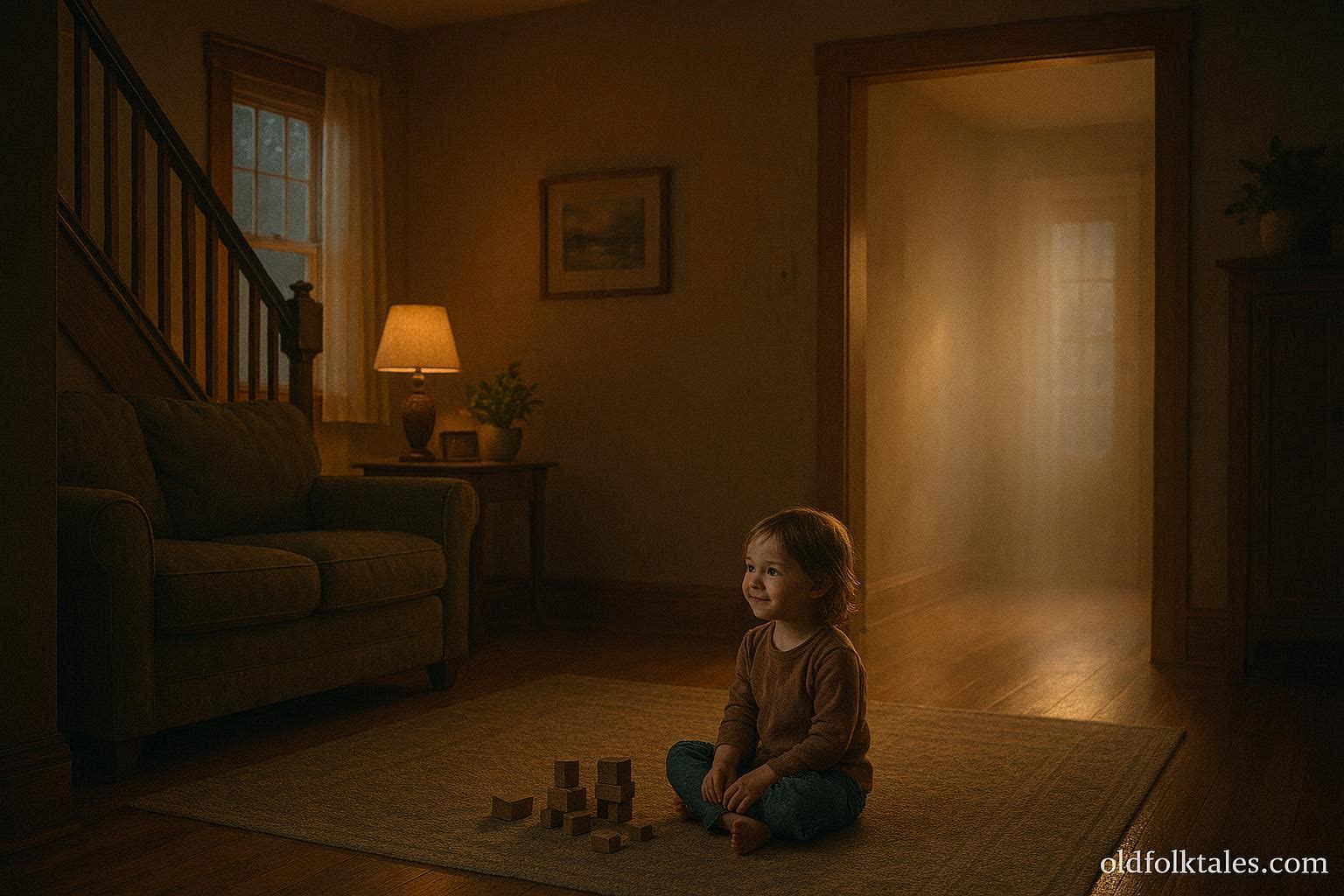
In many Midwestern communities, stories of spirits are not always told through fear or spectacle. Some are shared quietly, often in kitchens or during long evenings, when adults recall things their children once said and then forgot. Among these accounts is a persistent legend of a silent human-shaped presence that only children seemed able to see.
Parents noticed it first through behavior rather than stories. A child would pause mid-play, turn toward an empty space, and smile or nod as if acknowledging someone familiar. At other times, children spoke softly to corners of rooms or waved goodbye to nothing at all. When asked who they were speaking to, the answers were never dramatic. Children described the presence as calm, quiet, and always watching.
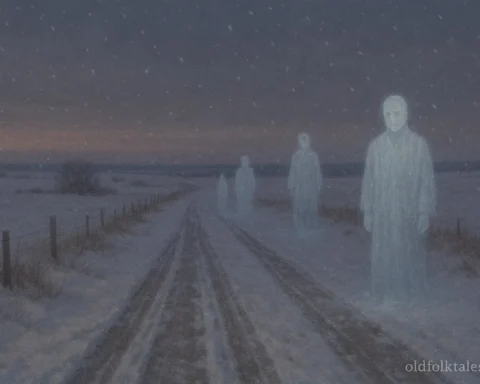
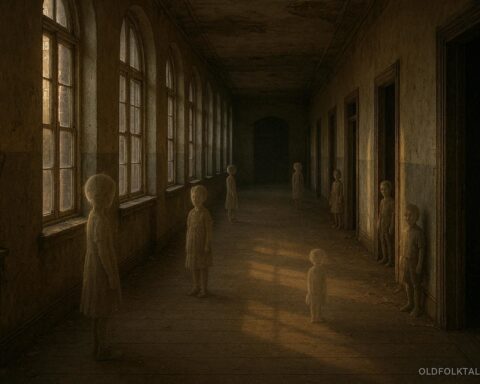
Descriptions were strikingly similar across families. The figure was never frightening. It did not touch objects, speak aloud, or move suddenly. It simply stood or sat nearby, often close to doorways, beds, or windows. Children rarely gave it a name, referring to it instead with phrases like “the quiet one” or “the watcher.”
Explore the heart of America’s storytelling — from tall tales and tricksters to fireside family legends.
Elders believed this consistency mattered. In Midwestern folklore, children were thought to possess a wider range of perception, one that narrowed with age. Before learning what could and could not be seen, children were believed to notice presences that existed alongside the living world without fully belonging to it.
The silent figure was often associated with ancestors. Not necessarily a specific grandparent or relative, but a family-connected presence tied to memory and protection. In some traditions, the figure was believed to appear during moments of vulnerability after a death in the household, during illness, or when a child was very young.
What strengthened belief in the legend was the effect the presence seemed to have. Children who were anxious often became calmer. Those afraid of sleeping alone rested more easily. Parents observed changes without seeing a cause, and elders advised them not to interfere.
Adults were discouraged from directly acknowledging the presence. Speaking to it, calling attention to it, or demanding explanations was believed to disturb a balance. The figure was thought to remain only while it was unnoticed by adults, its purpose tied to quiet observation rather than interaction.
Stories tell of children leaving space for the figure setting out an extra pillow, adjusting blankets, or whispering goodnight before sleep. These actions were not taught. They emerged naturally, reinforcing the belief that the connection belonged entirely to the child.
As children grew older, the sightings faded. There was no sudden disappearance, only a gradual forgetting. A child might mention one day that the figure had “gone away” or simply stop referring to it at all. Elders interpreted this as a natural transition, marking the closing of a perceptual window.
Adults who once saw the figure as children often retained only fragments of memory, a sense of being watched over, a feeling of safety during difficult times. These recollections were rarely spoken aloud, but when shared, they followed the same patterns across generations.
In this way, the silent figure remained part of community memory without becoming a tale of fear. It was not a restless ghost or a warning spirit. It was a presence defined by restraint, appearing only when needed and leaving without ceremony.
The legend endures because it resists proof. It asks for no belief, demands no recognition, and leaves behind only the suggestion that childhood perception may once have been wider than adulthood allows.
Click to explore all American Ghost Stories — haunting legends of spirits, lost souls, and mysterious places across the U.S.
Moral Lesson
Not all guardians are meant to be seen forever. Some forms of protection exist only during moments of innocence and pass quietly when their work is done.
Knowledge Check
- Who was believed to see the silent figure?
Children, particularly during early childhood. - How was the figure described by those who saw it?
As calm, human-shaped, silent, and non-threatening. - What role did elders believe the figure played?
A protective presence connected to family or ancestral memory. - Why were adults discouraged from acknowledging the figure?
Because attention from adults was believed to disrupt its purpose. - When did sightings usually stop?
As children grew older and their perception changed. - What remained after the figure was no longer seen?
A lasting sense of comfort and protection remembered into adulthood.
Source
Adapted from University of Illinois child folklore and belief studies
Cultural Origin
Midwestern communities