The mountains of the Southwest appear silent and unmoving, yet Pueblo oral tradition teaches that stillness does not mean emptiness. Beneath stone and soil, life continues in forms rarely seen. Long before villages were built on the mesas, elders spoke of beings who lived inside the earth itself. These were the Underground Stone People, small in size but immense in power, bound to the balance of the land.
The Stone People are said to dwell deep beneath mountains, mesas, and rocky cliffs. Their homes are not caves that humans can enter, but chambers formed naturally within the earth. These spaces are alive with warmth and energy, shaped by time rather than tools. The beings move easily through stone as if it were water, leaving no tunnels or marks behind.
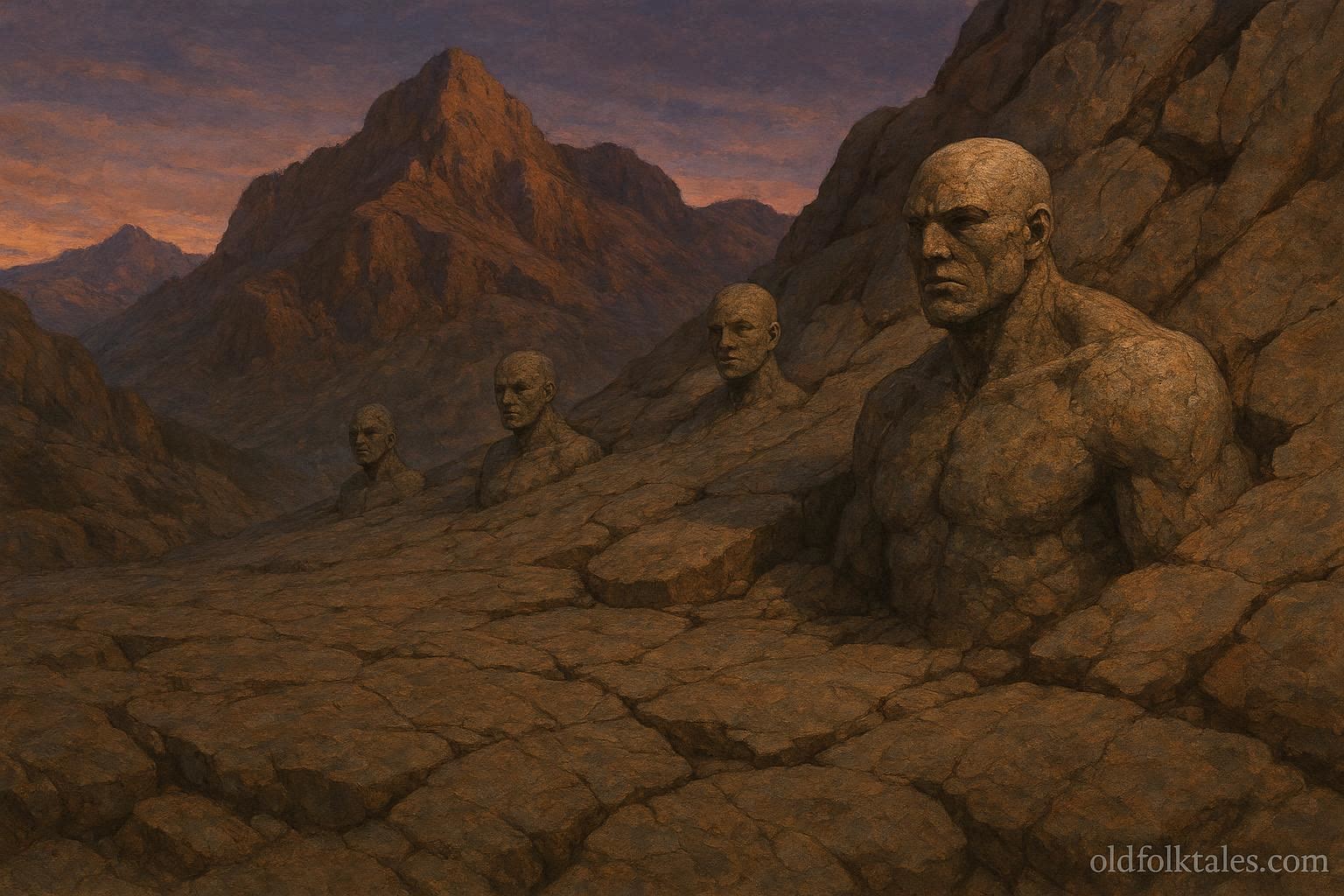
Witnesses describe the Stone People as short, broad figures with bodies resembling rock. Their skin is said to be gray, brown, or reddish, blending with the stone around them. Their faces appear rigid and expressionless, yet their eyes are alert and aware. Despite their small size, they carry great strength and authority.
Explore the heart of America’s storytelling — from tall tales and tricksters to fireside family legends.
The Stone People rarely emerge. When they do, it is not without reason. Elders teach that their appearance signals imbalance. This imbalance may come from disrespect toward the land, greed, or careless behavior that disrupts harmony. The Stone People do not punish directly. They warn.
Stories describe moments when cracks appear in rock faces and small figures step briefly into the open. They do not wander far from the mountain. Often, they stand silently, watching nearby villages or travelers before retreating underground. These encounters are brief but unforgettable.
Children are sometimes the first to notice signs of the Stone People. They speak of hearing tapping sounds from beneath the ground or feeling vibrations through bare feet. Elders believe children are more sensitive to changes in the land and can sense disturbances before adults recognize them.
Adults report different experiences. Some feel sudden unease while traveling near certain mountains. Others describe hearing low rumbling sounds that do not resemble earthquakes. These sensations are interpreted as the Stone People moving below, responding to imbalance above.
Animals react strongly when the Stone People are near the surface. Snakes retreat into hiding. Birds leave rocky ledges. Livestock refuse to graze near certain slopes. These reactions are considered warnings to humans to pay attention and reconsider their actions.
The Stone People are not enemies of humans. They are caretakers of the earth’s inner strength. Elders explain that mountains hold memory and power. The Stone People ensure this power remains undisturbed. When humans take more than they should, the Stone People remind them of limits.
In some stories, the Stone People emerge after acts of disrespect, such as digging without permission or ignoring ceremonial responsibilities. Their presence brings a sense of pressure and heaviness rather than fear. People feel compelled to stop what they are doing and leave the area.
There are also stories of the Stone People aiding humans indirectly. Travelers who lost their way in rocky terrain sometimes found themselves guided back to safety without understanding how. Later, elders explained that the Stone People had intervened to restore balance rather than allow harm.
The Stone People communicate without words. Their messages come through sensation, environment, and timing. A sudden rockfall, a blocked path, or a change in weather may all serve as warnings. Those who understand these signs know when to pause and reflect.
Elders emphasize that the Stone People do not appear for entertainment or proof. Seeking them out is considered disrespectful. Their power comes from secrecy. When humans demand access to hidden places, imbalance grows.
As time passed and modern development expanded, stories of the Stone People became less frequent. Yet elders say this does not mean the beings have vanished. It means people have stopped listening. The Stone People remain beneath the mountains, waiting.
Ceremonial teachings reinforce respect for the earth’s interior. Mountains are approached with caution. Stones are not moved without purpose. These practices honor the presence of the Stone People and maintain harmony.
The legend teaches that the earth is layered with responsibility. What lies beneath supports what lives above. The Stone People embody this truth. They are reminders that strength does not always appear large or loud.
When imbalance grows, the Stone People rise briefly into awareness. When harmony is restored, they return underground. Their cycle mirrors the relationship between humans and the land.
The Underground Stone People continue to exist not as monsters, but as guardians of depth and stability. Their story endures because it teaches restraint, awareness, and respect for unseen forces that sustain life.
Encounter the strange and the unseen — from Bigfoot to regional monsters hiding in America’s forests.
Moral Lesson
Respect for the earth and recognition of natural limits are essential to maintaining balance and harmony.
Knowledge Check
- Where do the Underground Stone People live?
They live beneath mountains and rocky formations. - When do the Stone People emerge?
They emerge during times of imbalance. - How are the Stone People physically described?
They are small, strong, and stone like in appearance. - Do the Stone People communicate with words?
No, they communicate through signs and environmental changes. - How do animals respond to the Stone People?
They show signs of avoidance or distress. - What lesson do the Stone People represent?
They represent respect for the earth and balance.
Source
Adapted from Bureau of American Ethnology Pueblo folklore records
Cultural Origin
Hopi and Zuni communities