When the sun begins to sink behind the wide horizon of the American Southwest, Route 66 takes on an almost dreamlike glow. The old road stretches endlessly across plains and deserts, its cracked asphalt shimmering in the heat by day and glowing softly under moonlight by night. For travelers, the road holds a thousand stories, but few are as haunting or enduring as that of the Vanishing Hitchhiker.
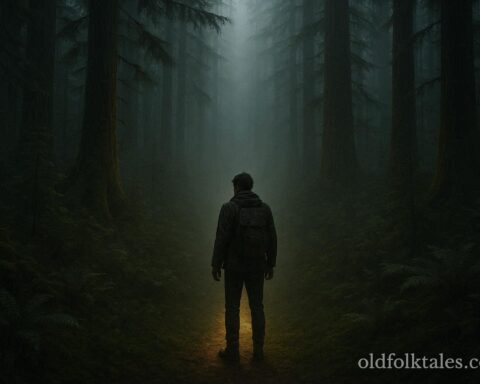
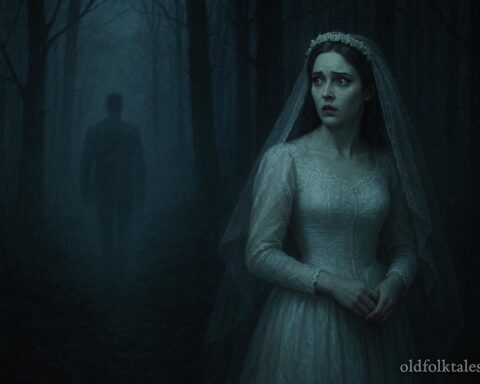
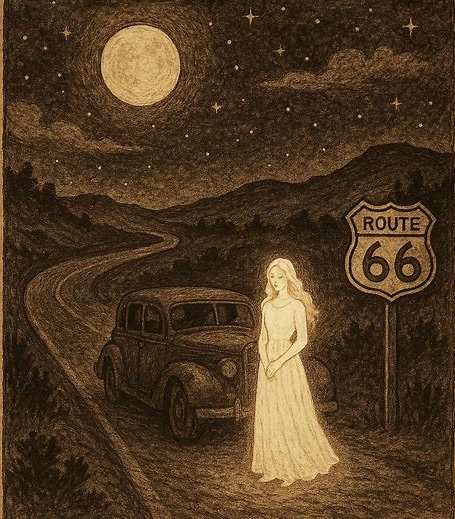
For generations, people journeying along this historic highway have told the same mysterious tale. It begins on a quiet night, when the road is nearly empty and the hum of the engine is the only sound. Up ahead, a solitary figure appears in the headlights, a young woman standing by the roadside, her white dress fluttering in the desert wind. Her presence feels both out of place and strangely familiar, as if she has been waiting for this moment forever.
Drivers who stop describe her as soft-spoken and gentle. She thanks them politely, her voice faint and calm. Some notice that her clothes seem from another time, perhaps the 1930s or 1940s. She often says she is trying to reach her family or get home after a dance, sometimes naming a nearby town or giving a specific address. The road hums quietly as she sits beside them, her gaze fixed on the window, the reflection of passing lights flickering in her pale eyes.
Explore ancient Native American creation myths and the symbolic tales that shaped America’s belief systems.
As the car nears her destination, the driver often turns to ask another question and that is when the impossible happens. The seat beside them is empty. The door never opened, no sound was heard, yet the girl is gone.
In confusion and fear, some drivers turn back, retracing the road, but she is nowhere to be found. Others, unsettled but curious, continue on to the address she mentioned. Each time, the story ends in the same chilling way. The person who answers the door listens quietly, then sighs and explains that their daughter or sister died many years ago on that very stretch of Route 66. She never made it home.
No one knows exactly when the story began, but it became part of Route 66 folklore as early as the mid-twentieth century. Folklorists who collected versions of the tale found that it appeared all along the great American highway from Illinois and Oklahoma to Arizona and New Mexico. Each retelling kept the same details, even across thousands of miles and decades of change.
Some versions place the spirit near old dance halls or roadside diners, where travelers once gathered for music and laughter before heading back into the night. Others describe the girl appearing near sharp curves or bridges where accidents once claimed lives. A few say she leaves behind the faint scent of lavender, her favorite perfume, lingering in the car long after she vanishes.
Skeptics have tried to explain the legend as the product of imagination, exhaustion, or the loneliness of long-distance travel. Yet too many witnesses tell the same story, with the same calm conviction, to dismiss it entirely. For those who have encountered her, the experience feels deeply real not a nightmare, but a meeting with something ancient and sorrowful.
Route 66 has always been more than a road. It is a ribbon that binds together the American spirit of movement and discovery. It carried families west during the Dust Bowl, soldiers during wartime, and dreamers chasing freedom in the open desert. It is no wonder that a ghost would choose such a place to wander. For the Vanishing Hitchhiker, the road itself seems to be both her prison and her home a place she cannot leave until her final journey is complete.
Locals along the highway sometimes speak of her kindly. They say she appears only to those with a good heart, to remind them of compassion in the face of the unknown. Some believe she represents the countless travelers who met their end on the open road, their stories lost to history. Others see her as a guardian of Route 66, forever reminding people to drive carefully and to honor the lives that once passed that way.
One driver, years ago, told a story that captured the essence of the legend. He was traveling late one summer night through Oklahoma when he saw a girl waving by the side of the road. She wore a simple white dress, her hair gleaming under the headlights. She asked for a ride home to a nearby town and thanked him softly when he agreed. They spoke little during the drive. When they reached the address she gave, he stopped the car and turned to tell her they had arrived. She was gone.
Confused and shaken, he knocked on the door. An elderly woman answered. When he described the girl, tears filled her eyes. She whispered that her daughter had died twenty years earlier in a car accident coming home from a dance. The driver never forgot that night, and from then on, he said a silent prayer whenever he passed that stretch of road.
Today, Route 66 still holds that same sense of wonder and melancholy. Travelers continue to share stories of strange encounters lights that move without cars, radios that switch on by themselves, and, every so often, the soft glow of a young woman walking along the roadside, her eyes fixed on the distance, waiting for a ride she will never finish.
Her story endures because it touches something universal. The Vanishing Hitchhiker is not just a ghost story; she is a symbol of longing, memory, and the fragile line between the living and the departed. Her spirit belongs to the open road, to the quiet hours before dawn, and to every traveler who has ever felt the presence of someone unseen keeping them company through the night.
Step into shadowy legends of restless spirits and ghostly travelers in American Ghost Stories.
Moral Lesson
The story of the Vanishing Hitchhiker reminds us to show kindness even when we do not understand, to treat every stranger with compassion, and to remember that the road we travel may carry the memories of those who came before.
Knowledge Check
1. Where does the story of the Vanishing Hitchhiker take place?
Along Route 66, the historic highway crossing the American Midwest and Southwest.
2. What does the mysterious hitchhiker usually ask for?
A ride home to see her family or return from a dance.
3. What happens before the car reaches her destination?
The hitchhiker vanishes without a sound, leaving the driver alone.
4. What do residents say when drivers visit the address she gave?
That a young woman matching her description died long ago on that same road.
5. What symbolic meaning does the legend hold?
It represents kindness, memory, and the spirit of travelers who never made it home.
6. Why is Route 66 a fitting setting for this ghost story?
Because it is a road of dreams, journeys, and countless untold stories of those who traveled it.
Source:
Adapted from The Vanishing Hitchhiker American Urban Legends and Their Meanings by Jan Harold Brunvand 1981
Cultural Origin:
United States (Midwestern and Southwestern urban legend folklore)