Water determined survival in early American farming communities. Crops could fail, livestock could perish, and families could be forced to abandon land if a well ran dry. Yet beneath many homesteads flowed unseen streams and aquifers, hidden by soil and stone. Finding them required patience, experience, and sometimes a kind of knowledge that could not be explained in ordinary terms.
This was where the water witch entered the story.
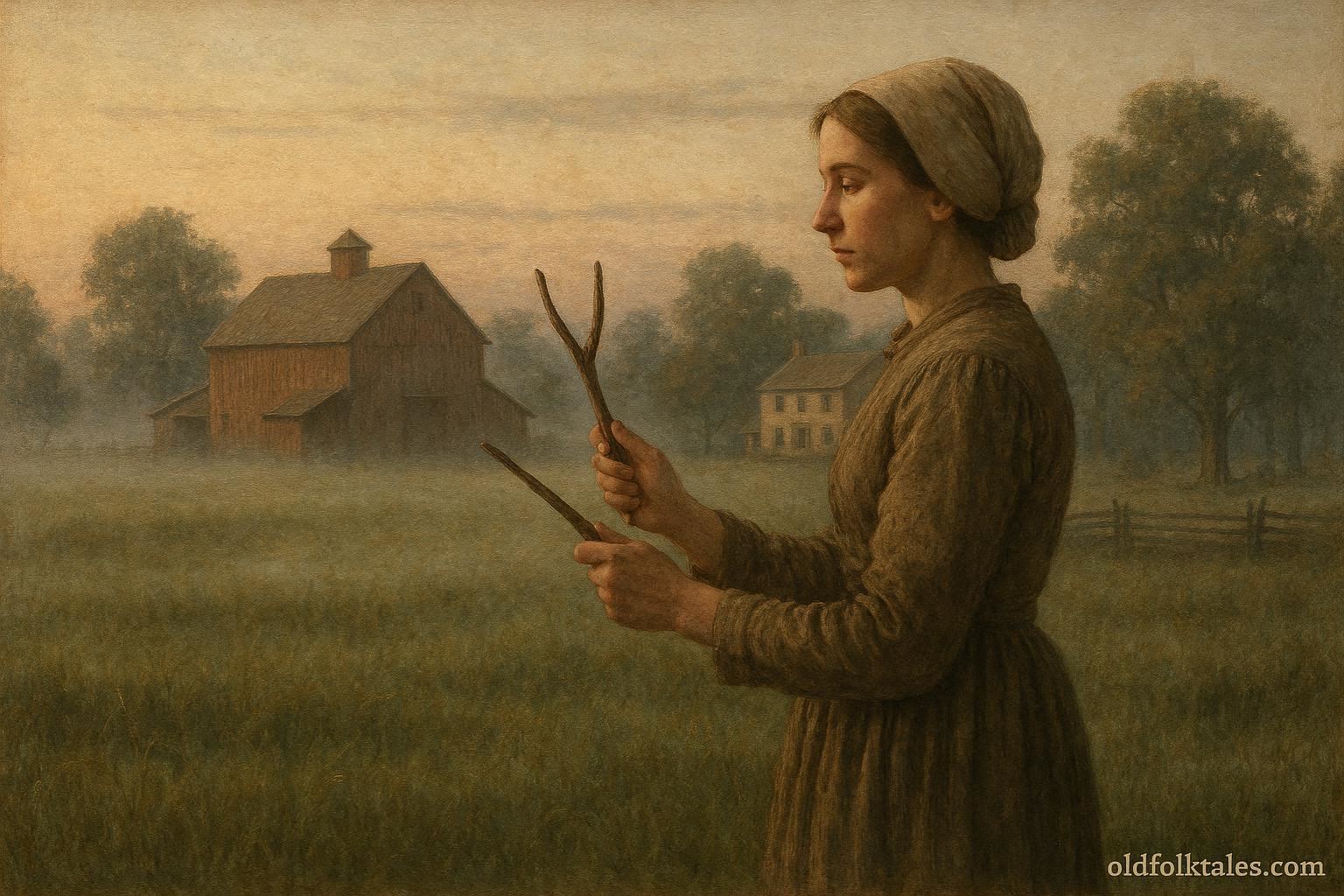
She was called many names. Some referred to her as a dowser, others as a water finder, and a few spoke the word witch quietly, with uncertainty rather than accusation. She carried no instruments beyond a forked branch cut from a living tree, usually willow or peach. To those who watched, her method appeared simple. To those who relied on her, it was essential.
The water witch did not advertise her services. Her name passed from farm to farm by word of mouth. When wells failed or new land was cleared, a messenger would arrive at her door. She listened, asked questions, and agreed only when she believed the land was ready to be tested.
Explore Native American beings, swamp creatures, and modern cryptid sightingsacross the country.
Her practice had been inherited. She learned it as a child, watching her grandmother walk fields slowly, barefoot when possible, holding the branch loosely in both hands. The elder woman explained that the branch did not find water. The body did. The wood only revealed what the dowser already sensed.
According to tradition, water moved with intention. It responded to pressure, to stone, and to the memory of the land. The water witch believed that people could learn to feel its presence if they quieted themselves enough.
When she arrived at a farm, she never began immediately. She observed the slope of the land, the vegetation, and the behavior of animals. She noted where grasses grew darker and where insects gathered. These signs mattered as much as the ritual itself.
Only after this observation did she cut a fresh branch. It had to be taken with permission, spoken aloud. The branch was shaped like a Y, held with palms facing upward, elbows relaxed. She walked slowly, letting the wood move as it wished.
When the branch dipped suddenly toward the ground, she stopped.
The first time this happened for a family watching, disbelief often followed. They whispered. They laughed nervously. Some accused the branch of trickery or chance. The water witch ignored them. She marked the spot and continued walking. When the branch dipped again in the same place, her expression changed.
“This is where it runs,” she said. “Deep, but steady.”
Digging a well was costly labor. To follow the water witch’s guidance required trust. Some families hesitated. Others committed fully, staking weeks of work on her word.
Most of the time, water was found.
Not always immediately. Sometimes the digging went deeper than expected. Sometimes rock delayed progress. The water witch warned of this. She spoke of layers, of veins, of obstacles beneath the soil. When the well finally broke through, relief followed, along with gratitude.
Her reputation grew not because she never failed, but because she never promised certainty. She reminded families that the land decided the outcome. She merely listened.
In times of drought, her presence was especially valued. Crops withered, animals weakened, and desperation spread. The water witch moved from homestead to homestead, often refusing payment beyond food or shelter. She believed the practice required humility. Greed, she said, dulled intuition.
Some clergy viewed her work with suspicion. They questioned whether her methods conflicted with religious doctrine. She responded calmly, stating that water was a gift placed by the Creator and that seeking it harmed no one. Over time, opposition softened, especially when wells she identified sustained entire communities.
Children followed her movements with fascination. She allowed them to observe but discouraged imitation without patience and discipline. “Feeling comes before doing,” she told them. “And listening comes before feeling.”
As she aged, her pace slowed. Others attempted to learn her method, but few matched her consistency. She insisted that inheritance alone was not enough. One had to respect the land, observe its patterns, and approach the practice without ego.
When she could no longer walk fields, she taught by instruction rather than demonstration. She explained how seasons affected water flow. How heavy rains shifted underground paths. How human activity altered natural balance.
After her death, stories grew. Some claimed she could hear water singing beneath the soil. Others said the branch moved on its own. She would have dismissed such claims. To her, the work was never magical. It was relational.
The wells she found continued to serve families long after her passing. They marked her legacy more clearly than any tale. Even as technology advanced, some farmers still sought dowsers, believing that intuition and observation could complement tools.
The water witch’s story endured because it represented something deeper than water finding. It reflected trust between humans and land, between knowledge passed quietly and needs spoken openly.
In a world increasingly driven by instruments and measurements, her legacy reminded communities that survival sometimes depended on listening to what could not be easily measured.
Click to read all American Traditions & Beliefs — the living folklore of daily life, customs, and superstitions.
Moral Lesson
Survival is strengthened when intuition, observation, and humility guide how people interact with the natural world.
Knowledge Check
1. What object did the water witch use to locate water?
A freshly cut forked branch, usually willow or peach.
2. What skill was believed to guide the branch’s movement?
The dowser’s inherited intuition and bodily sensitivity.
3. Why did the water witch observe the land before beginning?
To read natural signs that indicated underground water.
4. Did the water witch guarantee success?
No, she emphasized that the land ultimately decided the outcome.
5. Why did she avoid greed in her practice?
She believed greed interfered with intuition and respect for the land.
6. What lasting impact did her work have on communities?
Reliable water sources that sustained farms and settlements.
Source
Adapted from Library of Congress American rural technology folklore collections
Cultural Origin
Early American farming communities