In the northern lands where winter defines the rhythm of life, snowfall is more than a change in weather. It reshapes the land, alters sound, and challenges those who move through it. When storms grow heavy, familiar paths disappear beneath fresh layers of white, and the horizon fades until sky and ground become indistinguishable. In such moments, survival depends not only on strength, but on careful judgment and restraint.
Among Subarctic Indigenous communities, elders taught that winter carried memory. Snow did not simply fall; it listened. Sound behaved differently during storms, stretching farther while losing direction. A voice could travel across open space and seem close, or come from ahead while belonging to no visible source. Because of this, travelers were warned never to trust sound alone when snow thickened.
One of the most widely known winter warnings concerned a presence called the Whispering Snow Figure.
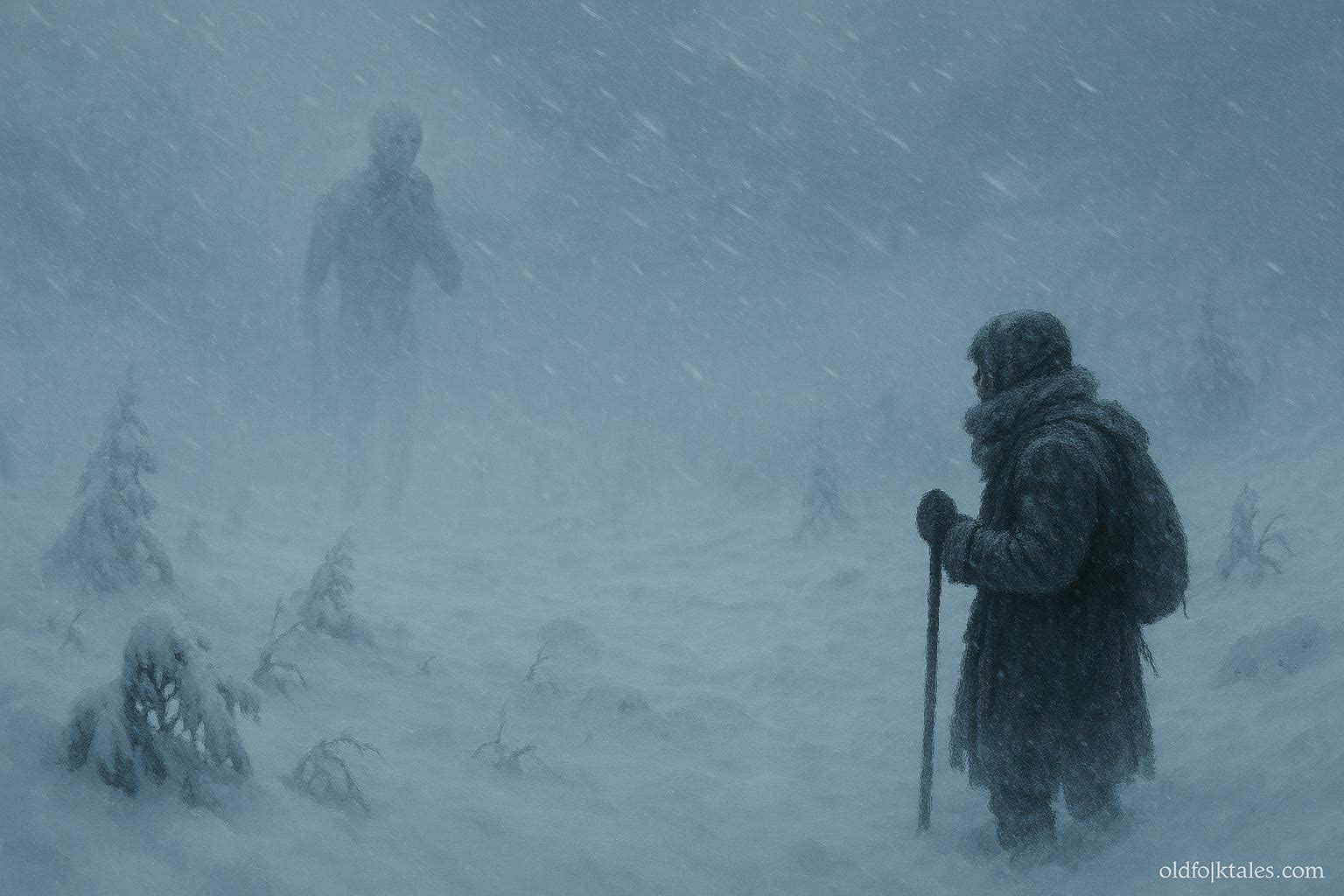
The Whispering Snow Figure was said to appear only during severe snowfall, when wind erased tracks almost as soon as they were made. It did not visit villages or approach fires. It remained where storms ruled and decisions carried consequence. Those who encountered it rarely saw it at first. They heard it before they understood what they were hearing.
Explore the heart of America’s storytelling — from tall tales and tricksters to fireside family legends.
The voice arrived as a whisper carried on the wind, calm and measured. It often spoke the traveler’s name, or offered a direction that seemed reasonable. The tone was not aggressive, nor was it comforting. It was steady, patient, and strangely familiar, as though it already knew the listener’s thoughts.
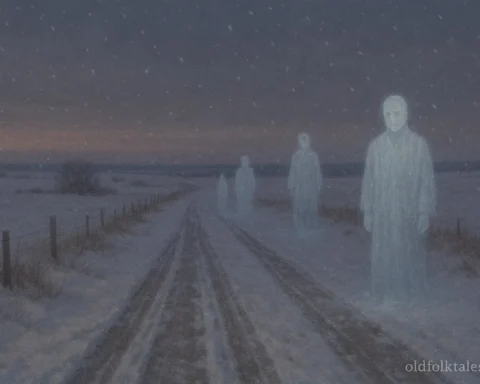
When the figure revealed itself, it emerged gradually from the snowfall. Its shape was humanlike, tall and slender, formed from pale light and shadow. Its features were blurred, as though unfinished, and its surface reflected the falling snow rather than resisting it. Those who tried to focus on its face found that it would not remain clear.
The figure never approached directly. It remained at a distance, always just beyond reach. Travelers who attempted to walk toward it discovered that the space between them did not close. The Whispering Snow Figure existed within the storm itself, not fully bound to the ground.
Stories told by survivors spoke of different outcomes. Some followed the whisper cautiously, using the voice as a suggestion rather than a command. These individuals were guided toward familiar landmarks hidden by snow, such as ridgelines, tree stands, or frozen waterways that marked known routes. When safety was reached, the voice faded quietly, leaving no trace behind.
Other stories ended in silence. Travelers who followed the whisper without question were led away from known paths and into unfamiliar terrain. They trusted the calmness of the voice and ignored their own awareness. When these individuals disappeared, no tracks were found once the storm cleared. Spring revealed no remains, no signs of struggle, and no explanation beyond the memory of sound carried on snow.
Because of this, the Whispering Snow Figure was never described as evil or kind. Elders explained that it was a test rather than a threat. Winter itself was the judge. Those who refused all guidance risked freezing where they stood. Those who surrendered judgment risked being taken by the storm.
One well known story tells of a young hunter named Taqtu who set out during the early hours of a rising storm. Confident in his experience, he believed he could complete his journey before the snowfall worsened. Within a short time, wind erased his tracks and blurred the trees around him, leaving him unsure of his direction.
It was then that the whisper began.
The voice spoke softly, suggesting a turn that felt logical. Taqtu hesitated, remembering his grandmother’s teachings. He asked aloud who was speaking, hoping to anchor the sound to something real. The whisper fell silent for a long moment, then returned with a different direction, as if adjusting to his doubt.
Taqtu recognized that the voice did not answer questions or explain itself. It only redirected. Choosing not to follow blindly, he knelt and placed his hand against the snow, feeling the subtle slope of the land beneath it. He recognized the shape of a nearby ridge and oriented himself using memory rather than sound.
As he walked away from the whisper, it followed at a distance, growing softer with each step. It did not pursue or protest. When the storm thinned, the voice dissolved into the wind. Taqtu reached shelter exhausted but alive, carrying the lesson forward.
Elders explained that the Whispering Snow Figure was formed from those who had perished alone in winter storms. Unable to return home, their spirits became bound to snowfall itself. They were not driven by cruelty or mercy, but by repetition. Each traveler represented a chance to guide or mislead, to resolve or repeat the moment of loss.
The figure never crossed into places of warmth or light. It belonged to the storm and to the choices made within it. Children were warned never to answer voices during heavy snowfall and never to call names into the wind. Winter demanded humility above confidence.
Even today, those who travel during storms in the far north move carefully. They trust landmarks over sound and memory over impulse. When a whisper seems to rise from the snowfall, they slow their steps and choose deliberately, knowing that survival depends on discernment as much as direction.
Encounter the strange and the unseen — from Bigfoot to regional monsters hiding in America’s forests.
Moral Lesson
The story of the Whispering Snow Figure teaches that guidance without discernment can be as dangerous as no guidance at all. In moments of fear or uncertainty, calm voices may still lead astray if judgment is surrendered completely. Survival depends on balance: listening without obedience, trusting experience without arrogance, and remembering that not every helper intends safety. Winter rewards those who move with humility, awareness, and self control.
Knowledge Check
- Why does the Whispering Snow Figure appear only during heavy snowfall?
Answer: Because storms create conditions where sound is distorted and travelers are most vulnerable. - How do travelers usually first become aware of the figure?
Answer: By hearing a calm whisper carried through the snow. - Does the Whispering Snow Figure physically approach travelers?
Answer: No, it remains at a distance and cannot be fully reached. - Why do elders warn against following the whisper blindly?
Answer: Because unquestioned obedience can lead travelers away from safety. - What choice helps some travelers survive encounters with the figure?
Answer: Using memory, landmarks, and judgment instead of relying only on the voice. - What is the figure believed to represent spiritually?
Answer: Spirits of those lost to winter storms bound to snowfall and repetition.
Source
Adapted from University of Alaska Indigenous winter travel folklore and oral history documentation.
Cultural Origin
Subarctic Indigenous communities