In the vast grasslands of the Northern Plains, where the winds whisper across endless fields and the sky stretches like an ocean of blue, the Lakota Sioux people carried an ancient understanding of thunder. To them, it was not simply a sound, it was a spirit, alive and powerful, the voice of something far greater than humankind.
Long ago, before the rivers carved their deep paths and before the buffalo roamed in countless herds, the Great Spirit, known as Wakan Tanka, placed the world under divine guardianship. Among His most fearsome and awe-inspiring creations were the Thunder Beings, mighty spirits who ruled over the storms and the sacred waters of the earth.
Click to read all American Cryptids & Monsters — creatures of mystery and fear said to inhabit America’s wild landscapes.
These Thunder Beings dwelled in the western mountains, where the clouds rested upon the peaks and lightning played like serpents of fire across the sky. Their eyes flashed with light, and their voices rolled in the thunder that followed them. When they galloped across the heavens on their celestial steeds, the air trembled, and the hearts of both man and beast stirred with reverence.
The people knew that when the Thunder Beings came riding, rain would follow, a sign of renewal, life, and balance. They were both feared and loved, for their power could destroy as easily as it could bless.
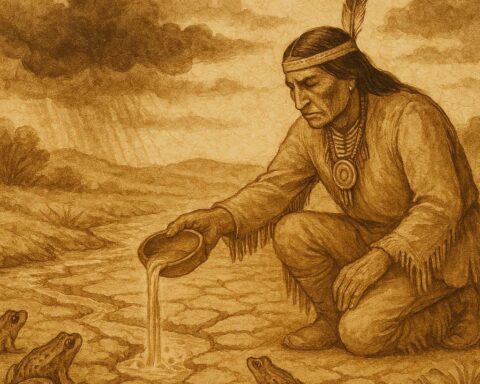
One spring, however, the rains did not come. The earth cracked under the burning sun, and the once-lush grasses turned brittle and brown. Rivers thinned to shallow streams, and the buffalo moved farther away in search of water. The people grew weary, and their prayers rose day after day toward the dry heavens.
At last, the elders gathered the tribe in council. “We must call to the Thunder Beings,” they said, “for only they can awaken the clouds and bring the life-giving rain.” But no one dared approach the western mountains, for they were sacred and perilous, home to spirits no mortal could command.
Then one brave man, known for his strength and devotion, stepped forward. His name has been lost to time, but his courage is remembered still. “I will go,” he said. “I will climb the mountain and sing the song of our ancestors, that the Thunder Beings may hear our plea.”
He set out alone at dawn, his heart steady as the morning star. The wind carried the scent of dust and the faint promise of rain. As he climbed, the mountain grew dark with gathering clouds. Lightning flickered in the distance like the gaze of watching eyes.
At the summit, he raised his hands toward the swirling sky and began to sing, a song of courage, faith, and respect for the spirits. His voice rose strong against the wind, and though thunder cracked around him, he did not falter.
Then, with a great flash of light, lightning struck the ground beside him, splitting stone and shaking the earth. Yet the man stood firm, his song unwavering. In that moment, the Thunder Beings appeared, immense forms cloaked in mist and flame, their hooves beating like war drums in the clouds.
“Who dares call to us?” they thundered.
The man bowed low. “I come for my people. The earth is thirsty, the rivers sleep, and the hearts of the children are afraid.”
The Thunder Beings regarded him in silence. Then one spoke, its voice echoing like rain on stone. “You have faced us with courage, not fear. You have sung not for yourself, but for all life. For this, we will send our gift.”
With that, the heavens opened. Rain poured down, gentle at first, then steady and strong. It soaked into the thirsty earth, filled the riverbeds, and brought the scent of life back to the plains. The people rejoiced below, dancing in the downpour, their cries of gratitude rising to the sky.
As the storm began to fade, the Thunder Beings spoke one final time to the brave man:
“When you hear our drums in the sky, know that life returns again. Fear us not, for thunder is the heartbeat of the world.”
When the man returned to his people, they welcomed him with reverence. The elders taught that from that day forward, thunder should never be feared. It was not an omen of destruction but a reminder that the world breathes, grows, and renews through the will of the Great Spirit and His messengers, the Thunder Beings.
And so, whenever lightning flashed and thunder rolled across the plains, the Lakota would pause in respect. Parents told their children to listen, not with fear, but with awe, for they were hearing the voice of creation itself.
Click to read all American Traditions & Beliefs — the living folklore of daily life, customs, and superstitions.
Moral Lesson
The story teaches that courage and reverence for nature open the path to renewal. By facing the forces of the world with respect rather than fear, we live in harmony with creation and receive its blessings.
Knowledge Check
1. Who are the Thunder Beings in Lakota Sioux tradition?
They are powerful spirits who control storms and bring rain and renewal to the earth.
2. Where do the Thunder Beings dwell according to the tale?
They live in the western mountains, where the clouds gather and lightning is born.
3. What act of bravery does the man perform in the story?
He climbs the sacred mountain and sings a song to call upon the Thunder Beings for rain.
4. What do the Thunder Beings symbolize in Lakota belief?
They represent nature’s balance, both the power to destroy and the power to restore life.
5. What message did the Thunder Beings leave for the people?
“When you hear our drums in the sky, know that life returns again.”
6. What is the main moral of the story?
Respect for nature and spiritual courage invite renewal and harmony between humans and the natural world.
Source: Adapted from the Lakota Sioux legend “Thunder Beings and Weather,” collected on Native-Languages.org.
Cultural Origin: Lakota Sioux, Northern Plains, United States (Native American folklore).