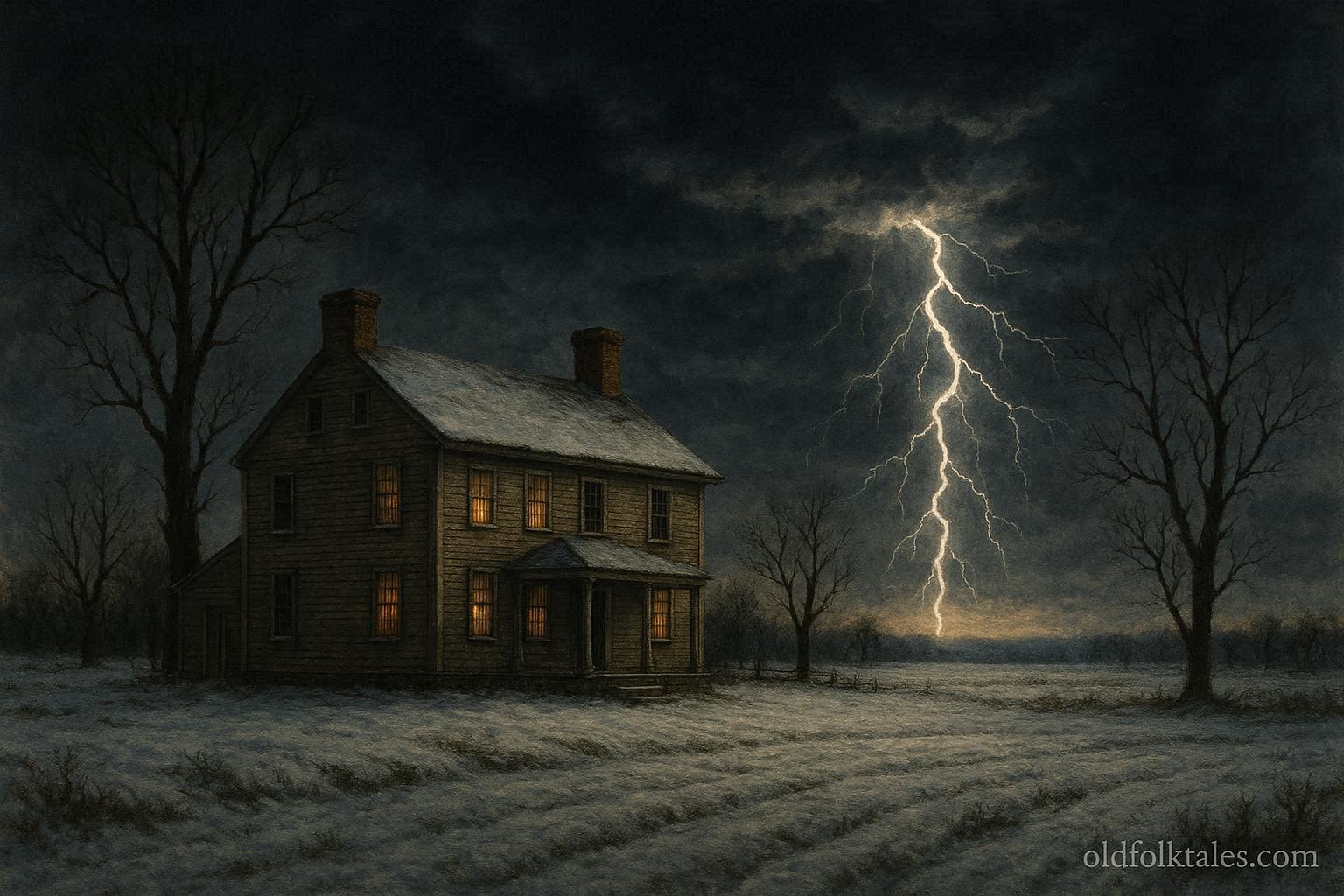
The winter sky over colonial settlements often stretched wide and pale, a vast canvas of gray and muted blue that pressed down on frozen fields and icy rivers. Settlers, accustomed to months of quiet, had come to read the season like a familiar book: each day predictable, each night a mirror of frost and stillness. Children followed tracks in the snow, farmers checked their stores, and smoke curled gently from chimneys into the still air. In such a world, sound traveled farther, carrying the smallest noises across frozen ground. It was in this fragile quiet that the first clap of winter thunder struck like a shockwave.
When lightning split the sky, it startled the ear and the imagination alike. The deep rumble rolling across snow-laden fields seemed out of place, reverberating through the bones of both humans and livestock. Households paused mid-task, listening as the echo faded, uncertain whether the sound was a warning of immediate danger or a symbol of something deeper. For the early settlers, the anomaly carried meaning. Winter was a season of survival, and anything that broke its quiet pattern suggested imbalance.
The belief that winter thunder foretold hardship spread quickly through colonial communities. Families connected the unusual sounds to coming famine, illness, or social unrest. The reasoning was simple: thunder during the cold months indicated instability in the natural world, which often mirrored instability in human life. Fields already dormant could be threatened by sudden thawing or freeze cycles. Livestock, stressed by unusual warmth or storms, might become sick or die. Stored provisions could spoil if patterns of ice and snow failed to follow expectation.
Explore the heart of America’s storytelling — from tall tales and tricksters to fireside family legends.
Diaries and letters from the period capture the anxiety. One farmer in Pennsylvania wrote of a storm in February: “The heavens roared as if shaken by an unseen hand, and I fear the winter yet holds misfortune.” Others recorded similar experiences in New England and along the frontier: the deep rumble of thunder during the coldest months was remembered as an omen, and its rarity reinforced the sense that something extraordinary and threatening was at hand.
Among settlers, the interpretation of winter thunder was not purely superstition. Observant people noticed patterns: thunderstorms required unusual atmospheric instability, often signaling shifts in temperature and moisture. These conditions could damage crops and affect the health of livestock. Even without meteorological instruments, the people learned to associate loud winter storms with tangible risk. Over time, the belief that thunder in winter predicted hardship became a mixture of practical observation and cultural memory.
Community response followed predictable patterns. Families inspected stored grains, reinforced barns, and rationed provisions more carefully. Children were kept close, and travel across icy roads was minimized. Preparations were not only for safety but also to honor the warning embedded in the unexpected sound. In isolated settlements, news of thunder spreading through the countryside could prompt similar caution in neighboring towns, creating a web of communal awareness.
Spiritual interpretations also shaped the response. Ministers and elders in colonial communities often framed the phenomenon as a sign from God, reminding people of their vulnerability and the need for moral vigilance. Thunder in winter, they suggested, reflected not just atmospheric anomaly but a cosmic lesson: when the natural order is disturbed, humans must pay attention to both material and moral preparedness.
Proverbs and sayings circulated to preserve the lesson. “Thunder in frost, hunger will cost,” one rhyme warned. “When the winter roars, the spring mourns,” said another. Such aphorisms condensed months of observation into a memorable cautionary line, ensuring that the warning could be passed down through generations without the need for formal education or written records.
The pattern extended beyond farming concerns. Merchants observed winter thunder and adjusted trade, storing food and firewood more carefully. Frontier communities, which relied on predictable seasons, treated the sound as a signal to prepare for human as well as natural hardship. Social gatherings were shortened, journeys postponed, and vigilance heightened. Even children grew up associating the deep rumble with caution, curiosity, and awe.
While modern science explains that winter thunder can occur during unusual atmospheric instability like thundersnow events the rarity of such storms in colonial America made them particularly memorable. In a time when every day of survival depended on careful observation, rare events were read as messages. Thunder, impossible in a frozen landscape, was interpreted as a sign of imbalance with real consequences.
The phenomenon also carried a psychological weight. The quiet of winter had a calming, predictable rhythm, and thunder disrupted it. People attributed unease, anxiety, and even dreams of misfortune to the rumble. Over time, the link between winter thunder and hardship became reinforced through collective memory, storytelling, and repeated observation.
As settlements grew and meteorology advanced, the ominous reputation of winter thunder faded. Today, we can recognize the scientific causes, but in the diaries, letters, and oral histories of early Americans, winter thunder remained a potent symbol of disruption, warning, and vigilance. It is a reminder of a time when humans were tightly bound to the rhythms of the natural world, reading meaning from every unusual sound, shadow, or movement.
Even now, when thunder occasionally rolls over snow-covered landscapes, the instinctive pause, the quiet attention, reflects an echo of that old belief. Though no famine or social unrest necessarily follows, the memory of centuries of observation persists in the way people notice the world around them, connecting past and present through the shared experience of a winter sky unexpectedly torn by lightning and roar.
The superstition of winter thunder teaches more than caution; it reminds us of the human need to respect natural cycles. Unusual events, whether atmospheric or otherwise, invite awareness, preparation, and communal care. The sound of thunder over frozen ground becomes a story, a lesson, and a link between generations who depended on the earth’s order to survive.
Step into America’s cultural roots — from folk healing and weather lore to seasonal celebrations.
Moral Lesson
Unusual disruptions in nature serve as a warning. Observing and responding thoughtfully to anomalies can protect both people and community, blending practical wisdom with attentiveness to the environment.
Knowledge Check
- Why was thunder in winter considered alarming in early America?
Because winter was expected to be quiet and stable, so thunder suggested seasonal imbalance. - What hardships were believed to follow winter thunder?
Famine, illness, crop failure, or social unrest. - Which communities strongly preserved this belief?
Colonial and early frontier American communities. - What natural phenomenon can explain winter thunder?
Rare atmospheric instability such as thundersnow. - How did people respond after hearing winter thunder?
They prepared cautiously by inspecting supplies and reinforcing shelters. - What broader idea does this superstition reflect?
That disruptions in natural order require attention and preparation.
Source
Adapted from American Philosophical Society early meteorological folklore
Cultural Origin
Colonial and early frontier America