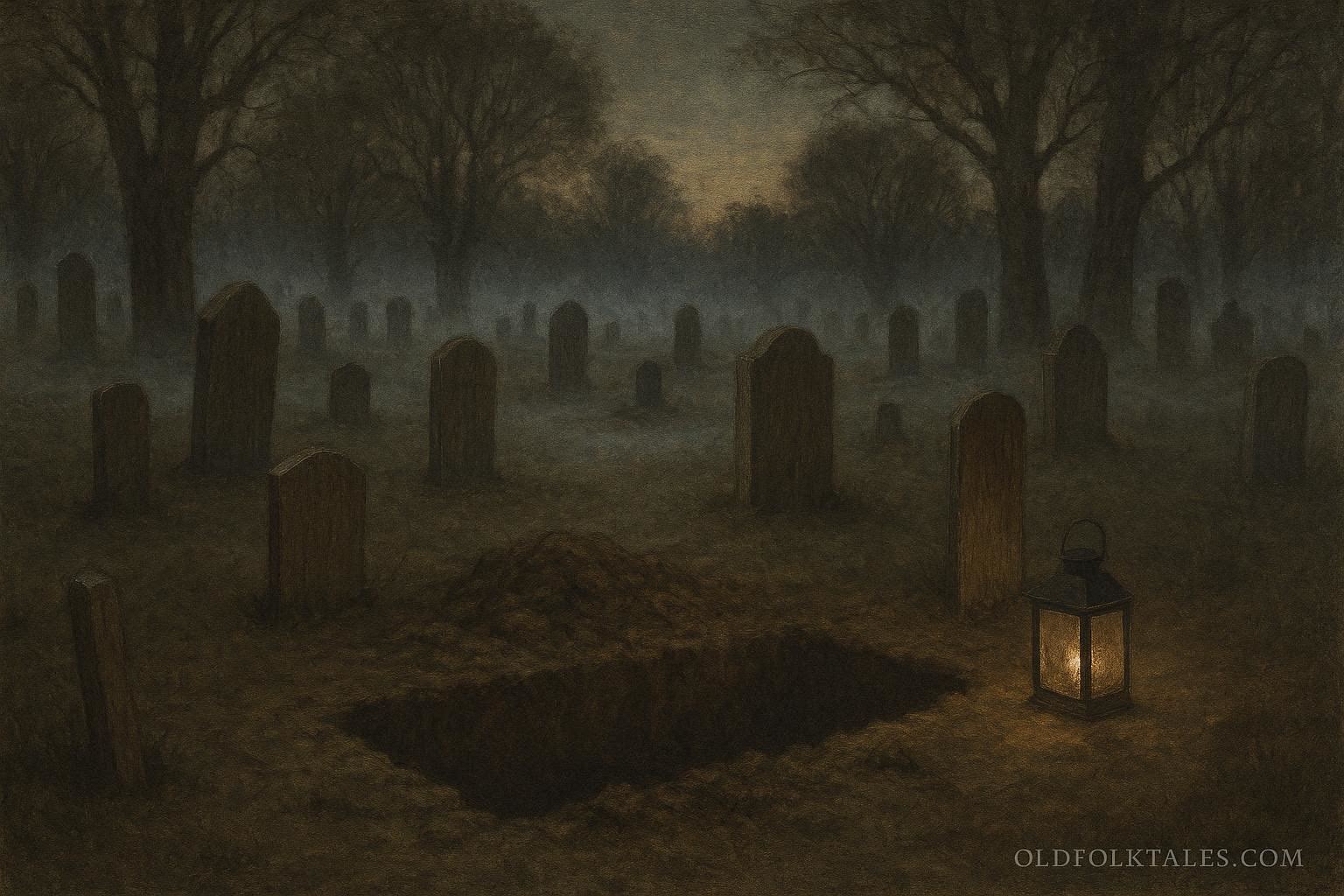
In the years when towns were small and everyone knew the sound of their neighbor’s footsteps, there stood a burial ground at the edge of Willow Crossing. It was not fenced, for fences were costly, and it was not marked by stone paths, only by grass worn thin from generations of mourning feet. The graves lay beneath old oak trees whose roots twisted through the soil like fingers remembering names long forgotten.
The people of Willow Crossing believed in order. They believed that the dead rested when the living behaved rightly. They believed that soil, once pressed flat, stayed flat unless disturbed by shovel or beast. For many years, this belief held true.
Then came the grave that would not stay covered.
It belonged to a man named Elias Crowe.
Elias had been known in life as respectable. He owned land, lent money, and sat near the front of the meeting house. His voice was calm, his coat always brushed clean. When he died suddenly one autumn morning, the town gathered without hesitation. They spoke of his generosity, his diligence, his steady presence. The preacher said Elias had left the world as he lived it, quietly and without complaint.
Discover chilling ghost tales and haunted places that echo through America’s towns and countryside.
The grave was dug deep. The earth was tamped down firmly. By dusk, the mound lay smooth beneath a simple wooden marker bearing his name and dates.
The next morning, a boy passing through the burial ground froze in place.
The soil above Elias Crowe’s grave had cracked open, as if something beneath had pushed upward. The mound had sunk inward, leaving a hollow large enough to catch rainwater and shadow.
At first, the townsfolk blamed weather. Night rain, shifting ground, perhaps a burrowing animal. They filled the grave again, pressing the soil harder this time. They laid stones atop it for good measure.
By the next dawn, the stones had slid aside. The earth had parted once more.
Murmurs began.
Graves did not behave this way. Even children knew that.
Again, the men of the town gathered. Again, they filled the earth. Again, they spoke little of it, believing that attention might worsen the matter.
But the grave refused silence.
Each time it was covered, it opened again. Sometimes the soil merely slumped. Other times it split wide, exposing the coffin lid beneath. Once, after a hard frost, the ground around the grave remained solid while the earth above Elias Crowe cracked as if struck from below.
Fear crept into Willow Crossing slowly, like cold through walls.
People began to recall things they had not spoken aloud before.
A woman remembered her husband returning pale from a meeting with Elias, speaking no details but refusing ever to borrow money again. A farmer recalled land boundaries shifting after Elias surveyed them. A widow remembered papers she had signed while grieving, never fully understanding their meaning.
Still, none spoke openly. Respect for the dead was strong, and accusation without proof was a dangerous thing.
The grave opened again.
The preacher declared it a test of faith. He led prayers at the burial ground. Psalms were spoken. The soil was blessed. The grave was sealed.
By morning, it had opened wider than before.
Now the children refused to pass that way. Dogs would not cross the burial ground at night. Even birds avoided the oak above Elias Crowe’s resting place.
Finally, an old woman named Mercy Hale spoke.
Mercy was not powerful, nor wealthy. She had outlived two husbands and buried three children. She was known for saying little, but when she did, people listened.
She stood by the open grave one afternoon and said simply that the ground was speaking.
Not in words, she explained, but in refusal.
She said that the earth does not hold what has not been made right.
Her words unsettled the town more than the grave itself.
That evening, people began to gather at Mercy’s house, not together, but one by one. They brought memories. They brought questions. They brought old papers and older regrets.
A pattern emerged.
Elias Crowe had taken advantage of trust. He had altered records. He had claimed land through silence rather than force. No single act was violent enough to call crime, but together they formed a weight that could not be ignored.
The soil, Mercy said, carried that weight now.
The town called a meeting.
It was the first time Elias Crowe’s name was spoken without honor. The preacher listened. The elders listened. The wrongs were laid out carefully, without shouting, without vengeance. They were acknowledged.
Then came the harder part.
Land was returned to rightful hands. Debts were forgiven where they had been unjustly claimed. Apologies were made publicly, though Elias himself could not hear them. The town admitted that respectability had blinded them to quiet harm.
Only after this was done did they return to the burial ground.
They did not bring shovels.
Instead, they stood around the open grave and spoke the truth of what had been hidden. They did not curse Elias Crowe, nor did they praise him. They named his actions plainly and accepted their own silence as part of the wrongdoing.
Then Mercy Hale placed soil back into the grave with her bare hands.
Others followed.
The earth settled.
They did not pack it tightly. They did not place stones.
They left.
The next morning, the grave was unchanged.
The soil remained still.
Days passed. Then weeks. Grass began to grow across the mound. The oak tree above it dropped leaves without disturbance. Dogs crossed the burial ground again. Children ran past without fear.
The grave stayed closed.
From that time on, Willow Crossing changed.
People spoke sooner. They questioned more. Respect became something earned, not assumed. And when the dead were buried, the living took care to examine what lay unresolved among them.
For they had learned that soil remembers what people try to forget, and that some wrongs refuse to stay buried.
Click to read all American Folktales — timeless oral stories passed through generations across the United States.
Moral Lesson
Unacknowledged wrongdoing does not disappear with time or death. Justice delayed beneath polite silence will surface until truth is faced and responsibility is accepted.
Knowledge Check
1 What caused the grave to reopen repeatedly?
Answer The unresolved wrongdoing of Elias Crowe and the town’s silence about it
2 Why did the townspeople initially ignore the strange behavior of the grave?
Answer They trusted Elias Crowe’s reputation and feared questioning the dead
3 What role did Mercy Hale play in resolving the disturbance?
Answer She recognized the grave as a moral sign and urged acknowledgment of truth
4 How did the town finally stop the grave from reopening?
Answer By admitting the wrongdoing and correcting the injustices Elias had caused
5 What did the community learn from the event?
Answer That hidden injustice cannot remain buried and must be addressed
6 Why did the grave stay closed after the truth was spoken?
Answer Because accountability restored balance between the living and the dead
Source
Adapted from American burial folklore preserved by the American Folklore Society
Cultural origin
Nineteenth century American settlements