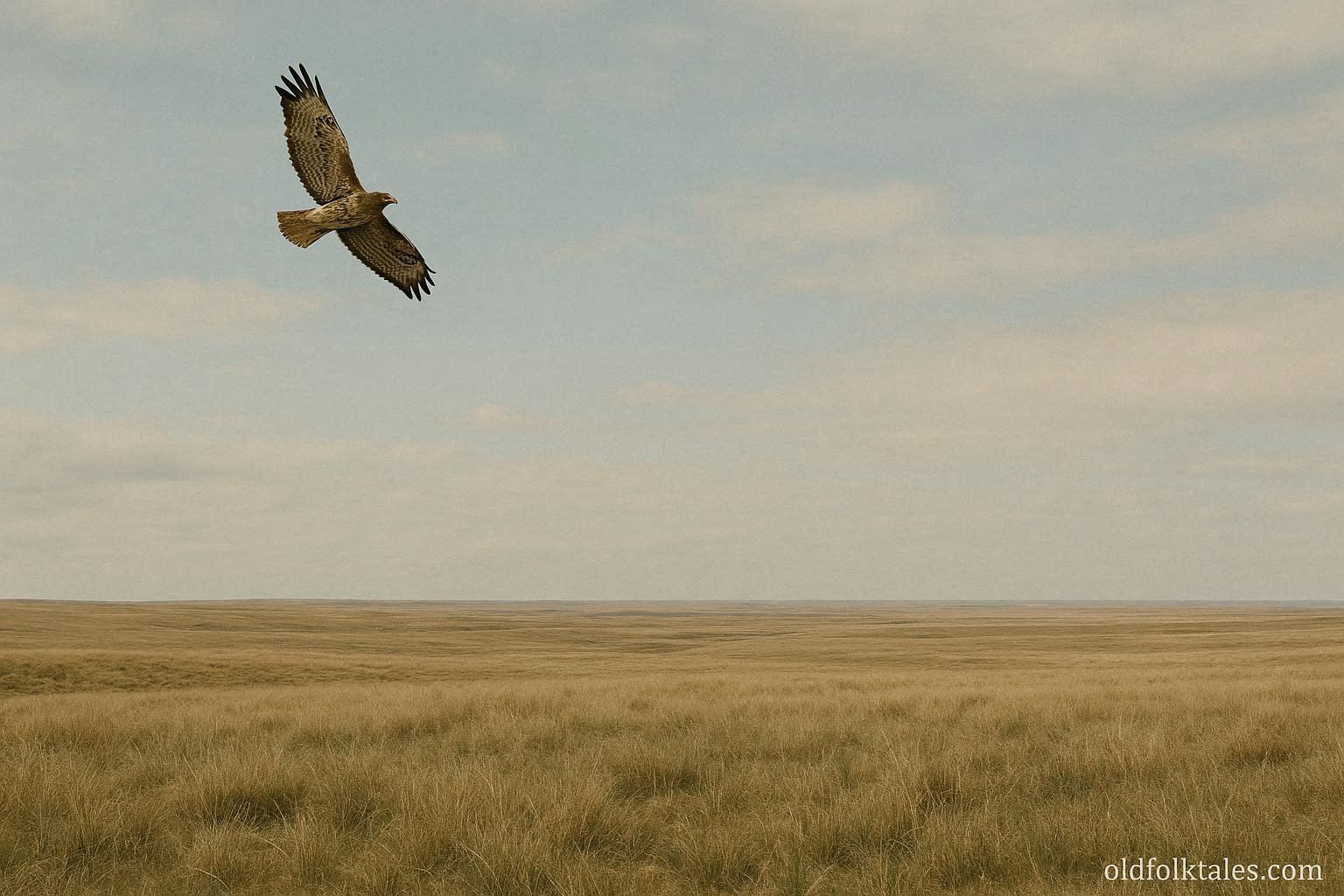
Across the open Plains, where the horizon stretches without interruption and the sky seems as important as the land itself, sight has always carried meaning beyond simple vision. To see clearly was not only a physical ability but a moral one. The Cheyenne understood that what a person noticed, ignored, or misunderstood shaped the fate of the community. Among all creatures of the sky, the hawk became the clearest teacher of this lesson.
Hawks were observed carefully, not as omens of fear but as examples of attention. They circled patiently, rarely wasting movement, holding still in the air while the world moved beneath them. Elders noted that hawks did not rush to judgment. They watched, adjusted, and only acted when understanding was complete. This behavior became a model for leaders, scouts, and decision-makers within the community.
Stories tell that in earlier times, when disputes arose or danger threatened, people would watch the hawks before acting. Not because the birds delivered messages in words, but because their behavior demonstrated how clarity was achieved. A hawk never focused on everything at once. It narrowed its attention, filtering noise from meaning. This ability, elders said, was the foundation of truth-seeking.
Explore the heart of America’s storytelling — from tall tales and tricksters to fireside family legends.
One story speaks of a young scout chosen for his speed but not his patience. He was eager to prove himself and often returned with information gathered too quickly. During a period of tension with a neighboring group, his reports caused confusion, leading elders to question what was truly happening beyond the hills. An elder instructed him to sit alone for a day and watch the hawks above the grasslands.
At first, the task seemed pointless. The scout grew restless, shifting his gaze constantly, trying to follow every movement in the sky. Only later did he notice that the hawks he watched were not doing the same. They remained still, letting understanding come to them. When he finally learned to slow his attention, he began to see patterns in the land below that he had missed before.
When the scout returned to his duties, his reports changed. He spoke less, but what he said carried weight. Elders recognized that his sight had deepened, not sharpened. The hawk had taught him that truth reveals itself when the observer becomes responsible for what they see.
Hawk vision was not believed to expose truth for curiosity’s sake. Seeing carried obligation. To notice danger meant taking action to protect others. To recognize deception meant choosing how to address it wisely. Elders warned that hawk sight without responsibility could be destructive, turning awareness into arrogance.
Leaders were often reminded that the hawk sees without interfering unless necessary. This lesson shaped how decisions were made. Immediate reaction was discouraged. Observation came first. Discussion followed. Action was taken only when understanding was shared. The hawk’s patience became a moral standard rather than a hunting technique.
In times of travel, scouts were said to invoke hawk awareness rather than speed. They were taught to read subtle changes in the land: disturbed grass, unnatural silence, unfamiliar movement. These skills were described as “seeing what hides in plain sight.” Hawks were believed to excel at this, not because they searched aggressively, but because they expected meaning to exist even when it was not obvious.
Ceremonial teachings reinforced this idea. Hawk feathers were sometimes associated with clarity of purpose rather than authority. Wearing such a feather was not a mark of power, but a reminder of accountability. The wearer was expected to speak carefully, observe fully, and avoid spreading uncertainty.
Children learned these lessons early through stories rather than instruction. Tales described hawks that guided lost travelers by drawing attention to overlooked landmarks or revealing the true nature of a situation through simple presence. In these stories, the hawk rarely intervened directly. Instead, it shifted the observer’s awareness, allowing them to reach understanding themselves.
The hawk was also said to see truth within people. Elders explained that the bird’s steady gaze reflected a form of self-recognition. Those who met a hawk’s eyes and felt uneasy were encouraged to examine their intentions. Truth-seeking was not only about external threats but internal honesty.
Over time, hawk vision became a metaphor woven into language and thought. To “see as the hawk sees” meant to separate emotion from observation without losing compassion. It meant recognizing that truth often existed alongside discomfort, and that clarity required patience.
During periods of hardship, when fear clouded judgment, elders would remind the community that panic narrowed sight. Hawks, they said, did not hunt while frightened. They waited until clarity returned. This teaching discouraged rash decisions and reinforced collective responsibility.
Even as circumstances changed and traditional lifeways faced disruption, the symbolism of the hawk endured. The stories adapted, but the core lesson remained intact. Truth was not something to seize or expose recklessly. It was something revealed through disciplined perception and ethical response.
The hawk did not promise certainty. It offered perspective. From above, the land appeared interconnected rather than divided. Paths crossed, dangers moved, and outcomes unfolded gradually. Leaders who embraced this view were said to guide with foresight rather than impulse.
In Cheyenne oral tradition, hawk vision represents a commitment to seeing clearly and acting carefully. It reminds listeners that perception shapes reality, and that truth, once seen, demands responsibility. The hawk continues to circle above the Plains not as a messenger, but as a silent, watchful, and deliberate.
Discover celestial myths of the sun, moon, and stars — and the heroes who bridged earth and sky.
Moral Lesson
True clarity comes from patient observation and ethical responsibility. Seeing the truth means being prepared to act wisely upon it.
Knowledge Check
- Why is hawk vision associated with truth rather than power?
Because hawk vision represents careful observation and understanding, not domination or control. - What lesson did the young scout learn from observing hawks?
He learned that patience and focused attention lead to more accurate and reliable understanding. - Why is patience emphasized in hawk symbolism?
Because clarity comes from waiting, observing patterns, and acting only when understanding is complete. - How were hawk feathers understood within the community?
They symbolized responsibility, ethical conduct, and the obligation to speak and act truthfully. - Why was immediate reaction discouraged in decision-making?
Because quick reactions often cloud judgment and prevent full understanding of a situation. - What responsibility comes with seeing the truth?
Those who see clearly are expected to act wisely and protect the community from harm.
Source
Adapted from Plains Indigenous symbolism collections archived by the Smithsonian
Cultural Origin
Cheyenne communities