In the rolling hills and quiet valleys of rural America, where rivers moved steadily through the land, people learned to observe nature closely. The flow of water, the shape of stones, and the rhythm of the earth were not seen as ordinary details, but as parts of a larger system that could offer understanding and, at times, healing.
Among these observations grew a simple but enduring belief.
That a stone taken from a river could carry away pain.
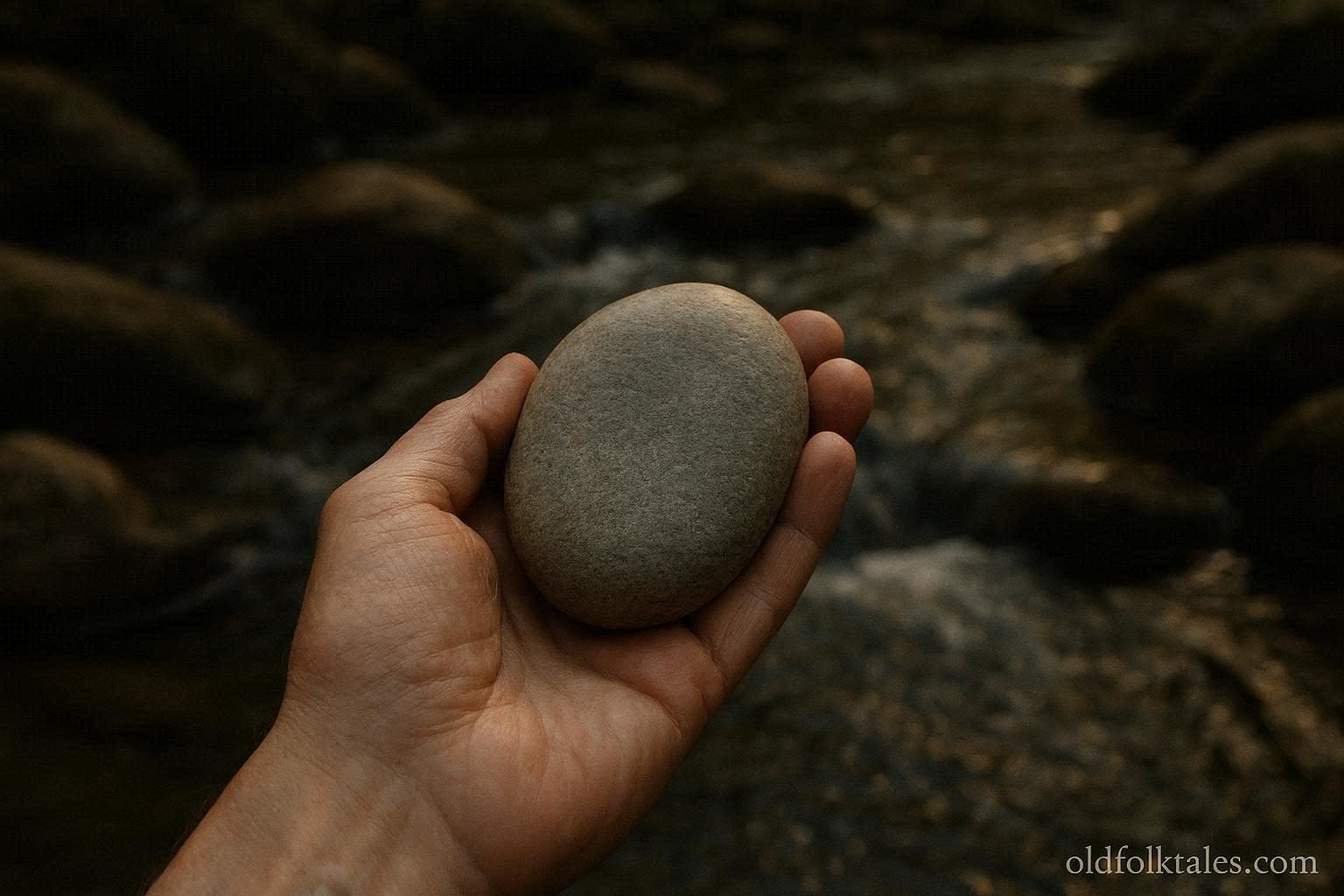
It was not just any stone that held this meaning. Those who followed the tradition spoke of stones shaped by water over time, worn smooth by constant movement. These stones were found along riverbeds, resting quietly beneath flowing currents or settled along the edges where water met land.
They were not sharp.
They were not rough.
They were shaped by patience.
To find such a stone was not done carelessly. A person would walk along the river, often in silence, allowing their attention to settle. The sound of water moving over rocks created a steady rhythm, one that seemed to quiet the mind. It was in this stillness that the search began.
Discover chilling ghost tales and haunted places that echo through America’s towns and countryside.
Hands would move through shallow water, feeling rather than looking. The right stone was not chosen for its size or color alone, but for the way it felt. Smooth, balanced, and steady in the palm.
When found, it was held for a moment.
Not examined.
But acknowledged.
There was an understanding that the stone had been shaped over time, that it carried with it the quiet endurance of the river itself. This endurance was believed to be what allowed it to take on another purpose.
To absorb.
To carry away.
To ease what was felt within the body.
The practice was simple. The stone would be kept close, often in a pocket or held in the hand. When pain was present whether in the body or brought on by fatigue and strain. The person would grip the stone, pressing it gently against the area of discomfort or holding it firmly as they sat in stillness.
There were no elaborate steps.
No spoken words required.
Only presence.
The belief was that as the stone was held, it would draw the pain away, slowly and quietly. Just as water had shaped it over time, it would now take in what the body could not release on its own.
Some described a feeling of warmth.
Others spoke of a gradual lightness.
Whether physical or felt through the mind, the experience was often described as calming.
Stories carried this belief forward. One told of a worker who, after long days of labor, would sit by the fire with a river stone in hand. Each evening, they would hold it in silence, allowing the weight of the day to pass into it. Over time, their strength remained steady, even as others around them struggled with exhaustion.
Another story spoke of a woman who carried her stone during a period of illness. She would hold it during moments of discomfort, focusing her attention on its smooth surface. Though her recovery took time, she credited the stone with helping her endure, giving her a sense of control over what she felt.
The stone was not seen as replacing effort or care, but as supporting it.
A companion.
A quiet presence.
There were also beliefs about what should be done with the stone after it had served its purpose. Some said it should be returned to the river, placed back into the water so that what it had absorbed could be carried away. Others believed it could be kept, continuing to serve as long as it remained intact and respected.
In both cases, there was an understanding that the stone was part of a cycle.
Taken from the river.
Used with intention.
Returned or kept with care.
Over time, as modern ideas of health and healing developed, the explanation of the practice began to shift. Some saw it as a form of focus, a way to direct the mind away from discomfort. Others connected it to the calming effect of touch, the way holding something steady could bring a sense of grounding.
Yet even with these perspectives, the tradition did not disappear.
It remained in small, quiet ways.
A stone kept in a pocket.
A hand resting on something smooth and cool.
A moment of stillness in the middle of strain.
The Stone Carried from the Riverbed became more than a belief about pain. It became a reflection of how people connect with the natural world, finding meaning in simple objects shaped by time and environment.
It also carried a deeper message about endurance.
The stone itself had been formed through constant movement, shaped by pressure and change. It did not resist the river but adapted to it, becoming smoother, more balanced with each passing moment.
In this way, it mirrored the human experience.
Pain, like the river, could not always be stopped.
But it could be endured.
It could be shaped.
It could be carried in a way that allowed strength to remain.
Even now, in places where rivers continue to move through quiet land, the tradition lives on. People still walk along the water’s edge, still reach down to feel the stones beneath the surface, still choose one that seems to hold something more than its form.
They carry it with them.
Not as proof.
Not as certainty.
But as a reminder.
That healing can be found in simple things.
That strength can come from stillness.
And that sometimes, the quiet act of holding on is what allows pain to pass.
Click to read all American Traditions & Beliefs — the living folklore of daily life, customs, and superstitions.
Moral Lesson
Strength and healing can come from patience, connection to nature, and simple acts of stillness and focus.
Knowledge Check
- What kind of stone is used in the practice?
A smooth stone shaped by river water over time. - How is the stone used for healing?
It is held or placed against the body to absorb pain. - Why is the river important in the tradition?
It shapes the stone and represents endurance and flow. - What do some people do with the stone after use?
They return it to the river or keep it with care. - What does the stone symbolize?
Endurance, balance, and the ability to carry and release pain. - What lesson does the story teach?
That healing can come from patience, nature, and mindful practice.
Source
Adapted from materials preserved by University of Virginia
Cultural Origin
Appalachian and rural folklore