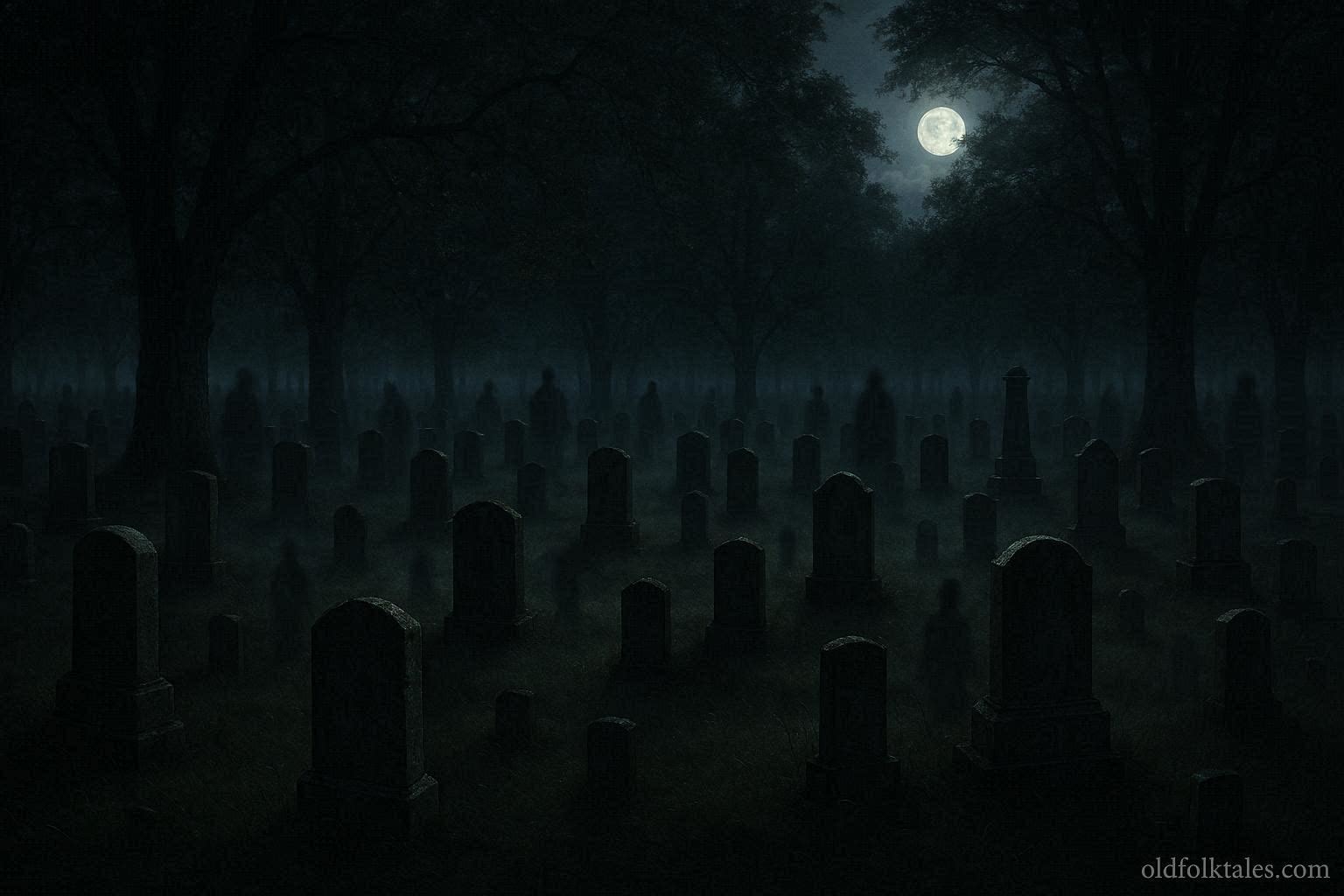
Across Indiana, historic cemeteries sit quietly at the edges of towns, bordered by trees, fences, and fading roads. By day, these burial grounds appear ordinary, their headstones weathered by decades of rain and sun. Names fade, dates blur, and grass grows unevenly around markers that once drew crowds of mourners. At night, however, many residents believe these cemeteries reveal another presence entirely, one shaped by grief that never fully settled.
The earliest reports came from caretakers and nearby residents who lived close enough to hear the grounds after dark. They described voices rising softly from between the graves, sometimes sounding like distant sobbing, sometimes like whispered conversation. These sounds did not follow predictable patterns. They appeared without warning and faded just as suddenly, leaving listeners uncertain whether they had truly heard anything at all.
In some towns, night watchmen reported seeing shadowy figures moving between headstones. These shapes were not solid enough to resemble living people, yet distinct enough to suggest form and intention. Witnesses said the figures drifted slowly, as if retracing familiar paths. When approached, they dissolved into darkness, blending seamlessly with the night air.
Encounter the strange and the unseen — from Bigfoot to regional monsters hiding in America’s forests.
Local historians note that many of Indiana’s cemeteries were established during periods of hardship. Epidemics, industrial accidents, and early settler conflicts left entire communities grieving at once. Some burial grounds contain mass graves or unmarked sections where records were lost or never kept. These forgotten spaces are often where the cries are said to be loudest.
Visitors who enter these cemeteries at night often describe a sudden heaviness. The air feels thicker, sounds carry strangely, and footsteps seem louder than they should be. Some say the ground itself feels restless beneath their feet, as though the land remembers what happened there. This sensation intensifies near older graves, especially those belonging to children or victims of sudden death.
The voices heard are rarely clear enough to form words. Instead, they convey emotion more than language. Witnesses describe overwhelming sadness, regret, or longing that washes over them without explanation. Even skeptics admit that the experience leaves a lasting impression, one that feels deeply personal despite having no obvious source.
In certain cemeteries, the cries are accompanied by visual disturbances. Lights flicker near grave markers. Mist gathers low to the ground even on dry nights. Shadows appear where no objects should cast them. These phenomena often occur together, reinforcing the belief that the voices are not merely tricks of sound or imagination.
Some residents believe the cries belong to spirits seeking acknowledgment rather than release. According to local tradition, the dead speak not because they wish to frighten, but because they were forgotten. Neglected graves, damaged markers, and abandoned plots are said to attract stronger activity. When communities restore or clean these areas, reports sometimes decrease.
Others interpret the cries as echoes rather than spirits. They believe intense emotion can imprint itself on a place, replaying under the right conditions. In this view, cemeteries act as vessels for accumulated sorrow, releasing it when the world grows quiet enough to listen.
Despite differing interpretations, many towns treat these cemeteries with respect. Residents avoid unnecessary visits at night. Children are warned not to wander among the graves after sunset. Those who must pass nearby often quicken their pace, unsettled by the possibility of hearing something meant for another time.
There are also accounts of comfort rather than fear. Some mourners visiting loved ones after dark claim to hear gentle murmurs that feel reassuring. They describe a sense of connection rather than dread, as though the cemetery itself responds to those who approach with care and remembrance.
Over generations, these stories have woven themselves into Indiana’s local identity. They are shared quietly, often prefaced with caution or disbelief, yet passed on nonetheless. The consistency of the reports across different towns and cemeteries gives the legend its strength.
What makes these tales endure is not spectacle, but familiarity. Cemeteries are places everyone eventually encounters, whether in grief or reflection. The idea that voices remain there speaks to a universal fear and hope that something of us lingers after death.
The Haunted Cemetery Cries of Indiana remind residents that the past does not vanish simply because it is buried. It rests beneath the surface, waiting for silence, darkness, and a listener willing to acknowledge its presence.
Discover chilling ghost tales and haunted places that echo through America’s towns and countryside.
Moral Lesson
Remembering the dead with care and respect helps quiet unresolved sorrow. When communities honor their past, even painful histories can rest more peacefully.
Knowledge Check
- Where are the cries most often reported?
Answer: In historic cemeteries across Indiana. - What do witnesses usually hear rather than clear speech?
Answer: Emotional sounds like sobbing or whispering. - What kinds of figures are sometimes seen?
Answer: Shadowy forms moving between graves. - Which areas of cemeteries are said to have stronger activity?
Answer: Older or neglected sections with unmarked graves. - How do some people interpret the cries?
Answer: As echoes of past emotion or spirits seeking acknowledgment. - What effect do restoration efforts sometimes have?
Answer: They may reduce reported activity.
Source
Adapted from Indiana urban legend repositories.
Cultural Origin
Various Indiana towns