The Plains were already vast before the horse arrived. Wind moved freely across tall grass, seasons shaped migration, and distance demanded endurance. Communities learned to live within these conditions by reading the land carefully, traveling deliberately, and respecting the limits of the human body. Power was measured through knowledge of terrain, coordination among people, and balance with the environment. Then a new presence entered the Plains, altering not only how people moved, but how they understood power itself.
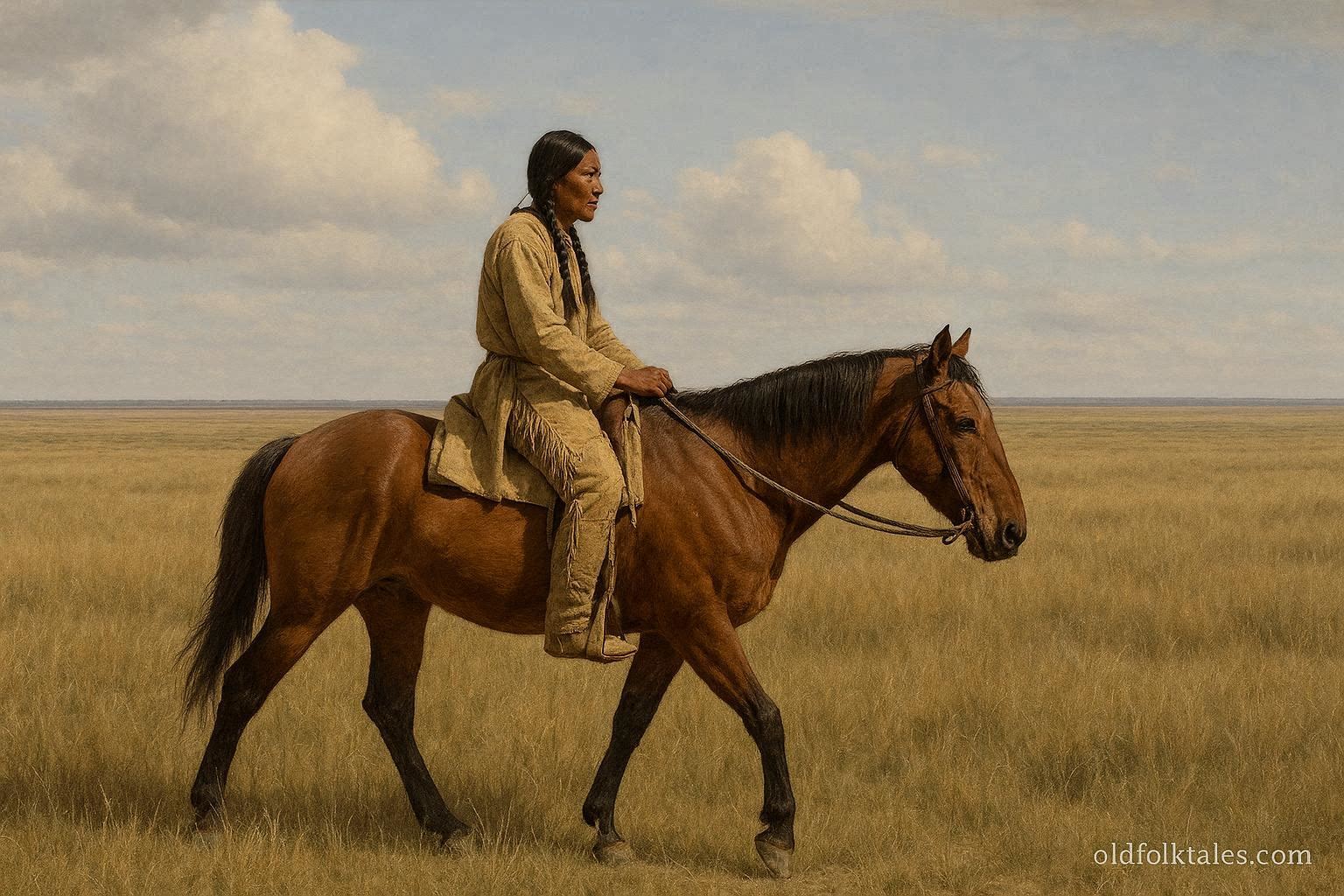
In Comanche oral tradition, the horse did not arrive simply as an animal introduced from elsewhere. It arrived as a force that carried intention and possibility. Stories describe its appearance as sudden yet meaningful, emerging from the horizon with speed and strength unlike anything previously known. The ground seemed to respond to its hooves, and its breath carried energy that unsettled established rhythms. People did not immediately claim ownership. Instead, they observed, cautious and curious, sensing that this being demanded relationship rather than control.
The first interactions were careful. The horse resisted domination, responding poorly to force and impatience. Those who attempted to subdue it without understanding were thrown, injured, or ignored. Elders later explained that this resistance was part of the lesson. Power, they said, could not be taken outright. It had to be shared, earned, and maintained through respect. The horse was not offering submission; it was offering partnership.
Discover African American wisdom, Native American spirit stories, and the humor of early pioneers in American Folktales.
As bonds formed, movement across the Plains changed dramatically. Journeys that once took days could be completed in hours. Hunting expanded beyond familiar territories. Trade networks grew wider and more fluid. The Plains themselves seemed to open further, not because the land had changed, but because human capacity within it had expanded. With this expansion came responsibility. Speed without awareness brought danger. Riders had to learn restraint as much as skill.
Warfare was transformed, but stories emphasize that success did not come from speed alone. Mounted conflict required trust between rider and horse. Horses sensed terrain, tension, and threat in ways humans could not. Many stories tell of horses that refused to advance moments before ambush, or shifted direction without command to avoid hidden danger. These actions reinforced the belief that horses carried awareness of their own, participating actively in survival rather than acting as tools.
Power transfer, in these stories, is never one-sided. Humans gained mobility, strength, and reach, but horses gained protection, care, and place within community life. A rider who mistreated a horse was believed to lose favor not only with the animal, but with the land itself. Injury, misfortune, or failure often followed such imbalance. Power, once disrupted, could not be forced back into place.
The arrival of the horse reshaped social structures as well. Wealth became linked not only to possessions, but to relationships with horses. A strong bond signaled discipline, patience, and leadership. Children learned from an early age that riding was not about dominance. They were taught to read posture, breathing, and movement, learning when a horse was willing, fearful, or exhausted. Listening became as important as command.
Ceremonial life adapted to reflect this transformation. Horses appeared in songs, designs, and stories as symbols of motion, endurance, and spiritual alignment. They were associated with visions and personal journeys, representing the expansion of identity beyond the individual body. To ride was not simply to travel, but to participate in a shared path shaped by two living beings moving as one.
Elders emphasized that the horse did not erase older ways of knowing. Knowledge of stars, weather, and land remained essential. Instead, the horse layered new understanding onto existing traditions. Power became dynamic rather than fixed, shaped by cooperation and adaptability. Change was not framed as loss, but as evolution guided by respect.
As relationships with neighboring groups shifted, the horse intensified both conflict and diplomacy. Increased mobility brought competition, but also greater exchange. The horse became a symbol of adaptability, demonstrating that survival required flexibility rather than rigid attachment to past forms. Those who adapted thoughtfully thrived; those who chased power without balance struggled.
Even when external forces disrupted Plains life, the stories of horse arrival endured. They were told not to glorify conquest or speed, but to remind future generations that power is never permanent. It flows, transfers, and reshapes itself through relationships. The horse taught that strength without responsibility collapses, while shared power sustains.
The horse did not simply change how people traveled or fought. It changed how they understood themselves. Identity expanded outward, linking human fate with animal awareness and environmental rhythm. The Plains remained demanding, but survival within them became a shared endeavor rather than an individual struggle.
In these stories, the horse is not remembered as an object of control, but as a turning point in human understanding. Its arrival marked the moment when power became relational, grounded in respect, balance, and mutual dependence. That lesson, elders say, remains relevant wherever strength is sought without understanding.
Explore ancient Native American creation myths and the symbolic tales that shaped America’s belief systems.
Moral Lesson
Power grows through partnership, not domination. When strength is shared responsibly, it endures.
Knowledge Check
- Why is the horse seen as a partner rather than a possession?
Answer: Because it actively participates in survival and requires respect to maintain balance. - How did the arrival of the horse change movement across the Plains?
Answer: It expanded travel range and speed while requiring new forms of awareness. - What role did horses play in warfare according to oral tradition?
Answer: They acted as perceptive partners, sensing danger beyond human awareness. - Why was mistreatment of horses believed to bring misfortune?
Answer: Because it disrupted the balance of shared power and responsibility. - How did horses influence social identity?
Answer: They became symbols of discipline, leadership, and adaptability. - What central idea defines “power transfer” in the story?
Answer: Power shifts through relationships and must be maintained through respect.
Source
Adapted from University of Wyoming Plains Indigenous oral history archives
Cultural Origin
Comanche communities