In the dusty wilds of the Texas frontier, where the horizon stretched wider than any man could see and the sunsets burned like fire, there lived a cowboy so wild, so daring, and so full of life that no other could match him. His name was Pecos Bill, and his legend grew as vast as the desert sky.
Bill’s story began on a wagon train bound west. His parents were settlers, braving untamed lands in search of a new life. But as fate would have it, the family wagon hit a rough patch of prairie, and baby Bill tumbled out, right into the wilderness. His family never noticed he was gone, and before long, a pack of coyotes found the tiny child lying under the stars. The old mother coyote, touched by his cry, took him in. She raised him as one of her own.
Journey through the lives of folk heroes, war legends, and hometown champions in our American Legends collection.
Bill grew up fast and strong. He howled at the moon, chased jackrabbits for fun, and wrestled rattlesnakes before he could walk straight. The desert became his playground, and every creature of the plains knew his call. He could outrun a prairie fire and swim across rivers so wide they seemed to have no end.
For years, Bill lived happily among his coyote brothers. But one day, as he was racing the wind through the scrubland, he met a strange two-legged creature on horseback, a cowboy. Bill stared in wonder at the hat, the boots, the spurs that jingled like tiny bells. Something stirred deep inside him. The cowboy looked at Bill and said, “Son, you look more human than wolf. Ain’t you one of us?”
Bill scratched his head, thought for a spell, and realized he was indeed a man. He said goodbye to his coyote family, promising to never forget them, and followed the cowboy back to camp. There, he learned the ways of man, how to rope cattle, ride horses, and chew tobacco. But Pecos Bill wasn’t one for doing things the ordinary way.
One morning, he saw a wild horse tearing across the plains, meaner than thunder and faster than a dust storm. “That’s the one for me,” Bill declared. He jumped straight onto the beast’s back, holding on tight as it kicked, bucked, and snorted. They tore through mesquite thickets, rolled through canyons, and splashed across the Rio Grande, but Bill never let go. By the time the sun rose again, that horse was tamed. Bill named him Widow-Maker, for no man but Bill could ever ride him and live to tell the tale.
From that day on, Pecos Bill became the wildest cowboy to ever straddle a saddle. He invented the lasso, twisting his rope in ways no man had seen, and taught every cowboy how to round up cattle faster than a twister. He roped hurricanes for fun, dug the Rio Grande River to water his herds, and even used a rattlesnake as a whip when he misplaced his rope.
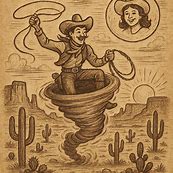
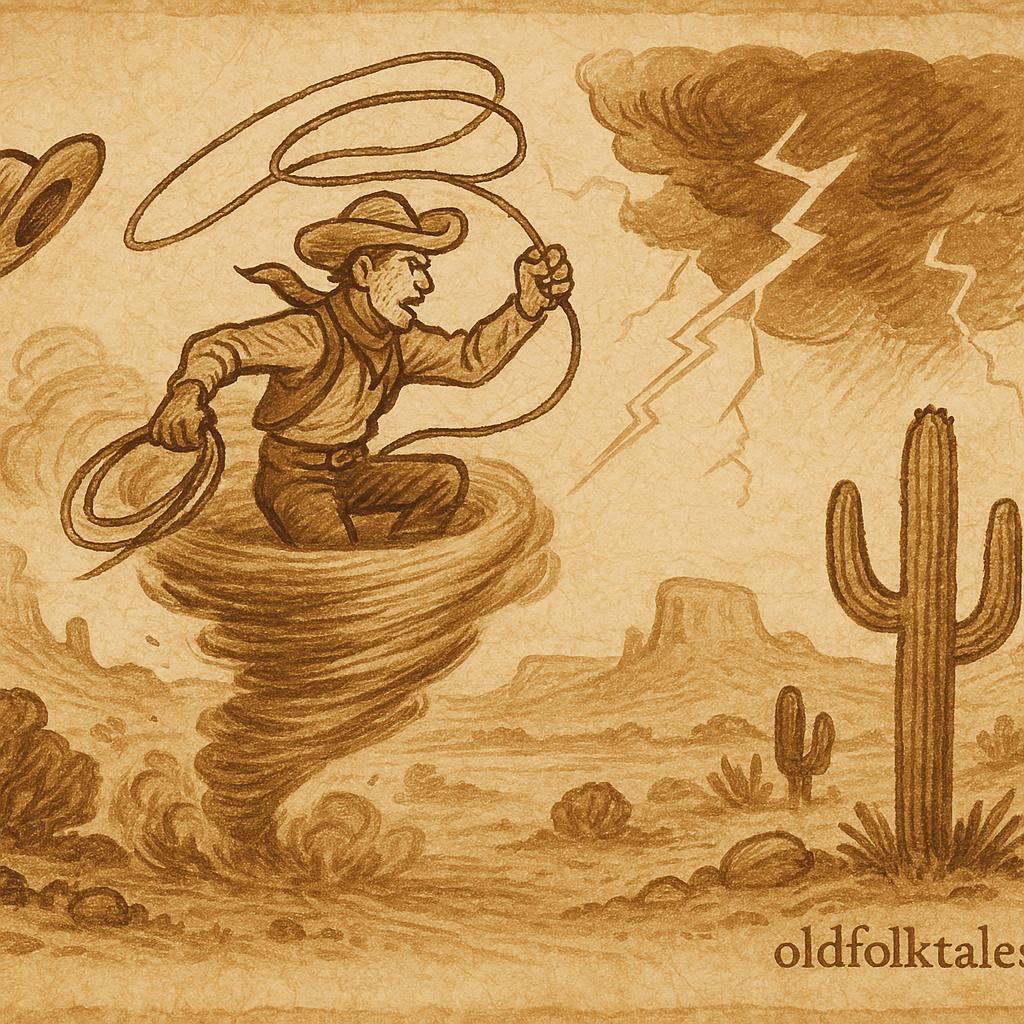
Folks say he once rode a cyclone clean across the desert, hanging on while the wind howled and lightning flashed. When the storm tried to throw him, Bill just laughed and dug in his spurs. He tamed that cyclone too, and when it finally dropped him, the desert sand had turned to glass from the storm’s fury.
But no legend of Bill is complete without his sweetheart, Slue-Foot Sue. She was as wild and free as he was, and prettier than a field of bluebonnets after rain. Bill fell for her the moment he saw her ride a catfish straight out of the Rio Grande. When they married, the whole West turned out to celebrate.
On their wedding day, Slue-Foot Sue decided she’d prove her spunk by riding Widow-Maker. “If Bill can handle him, so can I!” she declared. But Widow-Maker had other ideas. He bucked her sky-high, clear into the clouds. She came down and bounced right back up again! Her steel-hooped skirt worked like a spring, and no one could stop her. Up and down she went, higher each time, until at last she bounced all the way to the moon.
Some say she still sits there today, shining bright whenever the Texas night sky is clear. As for Bill, he kept riding, roping, and taming the West. His laughter rolled across the plains, and his stories grew taller than the cacti that dotted the desert.
They say Pecos Bill never died. He just kept riding on the horizon, chasing the next adventure, with the coyotes howling behind him and the stars lighting his trail. His spirit lives on wherever there’s open land, brave hearts, and a bit of mischief left in the wind.
Click to read all American Folktales — timeless oral stories passed through generations across the United States.
Moral Lesson
The legend of Pecos Bill teaches that courage, imagination, and a fearless spirit can turn any challenge into adventure. Though his tales are tall, they remind us that boldness and humor help people thrive even in the toughest of frontiers.
Knowledge Check
1. Who was Pecos Bill in American folklore?
Pecos Bill was a legendary cowboy from Texas known for his superhuman strength, wild adventures, and humorous feats on the Western frontier.
2. What animal raised Pecos Bill as a child?
He was raised by coyotes after falling from his family’s wagon as a baby.
3. What did Pecos Bill invent that changed cowboy life?
He is said to have invented the lasso, helping cowboys capture cattle with ease.
4. What lesson does Pecos Bill’s story teach?
It teaches courage, creativity, and the importance of embracing challenges with laughter and heart.
5. Who was Slue-Foot Sue and what happened to her?
She was Pecos Bill’s daring wife who bounced to the moon after trying to ride his horse, Widow-Maker.
6. What makes Pecos Bill an important American folk hero?
His tall tales celebrate the humor, bravery, and free spirit that defined life on the early American frontier.
Source: Adapted from The Adventures of Pecos Bill, collected in Edward O’Reilly’s Saga Magazine (1916–1923); public domain reprints via AmericanFolklore.net.
Cultural Origin: United States (Texas and Southwestern frontier folklore)