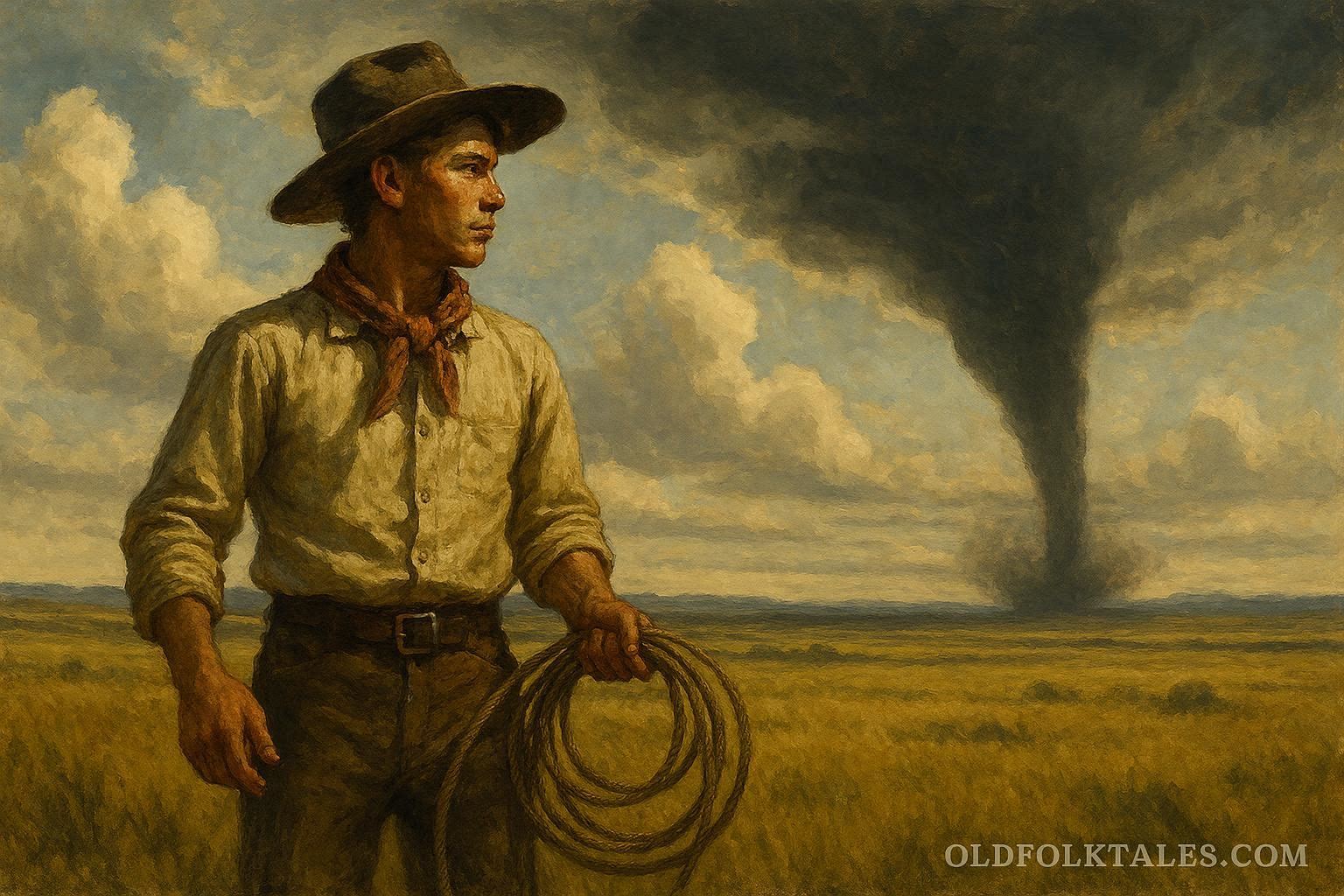
Long before fences stitched the Southern Plains into neat squares, the land rolled open and wide beneath a sky that never learned restraint. Wind was a constant companion there. It whispered through grass, howled across flat earth, and sometimes rose up furious and spinning, demanding attention from anyone foolish enough to ignore it.
In those days lived a ranch hand no older than sixteen named Jesse Crowder. He was lean, quick to laugh, and quicker to talk. Jesse worked on the Barrow Ranch, where cattle outnumbered men and storms arrived without invitation. He was good with a rope and better with a story. Around evening fires, he spoke as though the world existed mainly to test his courage.
Jesse had not yet learned the quiet language of fear. He mistook confidence for invincibility, and youth made the difference hard to see.
Explore how American legends shaped the nation — from frontier heroes to Revolutionary War tales.
One spring afternoon, the sky darkened in a way that made even seasoned ranchers uneasy. The wind dropped suddenly, leaving the air heavy and waiting. Clouds twisted high above the plains, folding into themselves like restless animals. Old Mr Barrow, who had seen more storms than birthdays, told the hands to move the cattle toward low ground.
Jesse grinned. “Just another blow,” he said. “I’ve seen worse.”
No one argued with him. They were too busy working.
As the cattle began to move, the wind returned with purpose. It roared instead of whispered. The sky turned the color of bruised iron. Far off, a funnel reached down from the clouds, thin at first, then widening as it touched the earth. The ground seemed to tremble beneath its spinning weight.
Some men ran for shelter. Others shouted warnings. Jesse watched, heart pounding, excitement flooding his chest. This was not fear. This was opportunity.
The cattle panicked, scattering in every direction. Jesse grabbed his rope and mounted his horse, riding hard toward the edge of the storm. Dust stung his eyes. The wind fought him with invisible hands.
Later, Jesse would say he did not think. He acted.
As the funnel drew closer, he claimed he saw a chance to do what no one else had dared. He swung his lasso, timing it with the wild rhythm of the wind. The rope flew outward, disappearing into the spinning gray.
Jesse swore it caught.
He said the tornado shuddered, just for a moment, as though surprised. He said the wind slowed enough for the cattle to find their way out of danger. He said he dug his heels into the ground and held on while the sky screamed above him.
What actually happened, no one could say for certain.
The storm passed as storms do. Sudden, violent, and gone before explanations could catch up. When the wind finally died down, the cattle were shaken but alive. The ranch still stood. Jesse lay on the ground, covered in dirt, rope wrapped loosely around his arm, staring up at a clearing sky.
The men found him laughing.
That night, Jesse told his story. He told it loudly and often. Each telling grew a little larger. The tornado became faster, stronger, closer. The rope became tighter. His grip firmer. The pause in the storm longer.
People listened. People doubted. People repeated the tale anyway.
By the time it reached neighboring towns, the story had settled into legend. A boy had lassoed a tornado and lived. Some said the wind itself respected his courage. Others said the Plains favored the bold.
Jesse enjoyed the attention. He leaned into it. He began to believe his own words. When storms rolled in, he stood a little taller. When warnings came, he waved them away.
“You can’t rope the wind twice,” Mr Barrow told him quietly one evening.
Jesse laughed. “You don’t know that.”
Summer arrived, bringing heat and dry skies. Then one evening, the wind returned with a familiar hunger. Another storm gathered, darker and faster than the last. Once again, cattle scattered. Once again, Jesse reached for his rope.
This time, no one followed him.
The funnel dropped without hesitation. It was wider, louder, and closer than before. Jesse rode toward it, heart racing, grin fixed in place. He swung his lasso and threw.
The rope vanished into the wind.
It did not catch.
The force ripped it from his hands and flung him from his horse. Jesse rolled across the ground, battered and breathless. He crawled until strong arms pulled him to safety.
The storm passed, leaving destruction in its wake. Fences were gone. A barn lay in pieces. The cattle survived again, but not because of any rope or boast.
Jesse did not laugh that night.
In the weeks that followed, he spoke less. When the story was told around fires, it was told by others. Jesse listened, eyes lowered. He no longer added to it.
In time, he learned what the older hands already knew. The Plains could not be challenged. They could only be respected. The wind did not respond to bravado, and storms did not care for legends.
Still, the tale lived on.
People said a boy once lassoed a tornado’s tail and slowed it long enough to save a herd. They did not always mention the second storm, or the lesson that followed. Tall tales rarely do.
But among those who worked the land and watched the sky closely, the story carried a quieter truth. Courage without wisdom is noise in the wind, and nature always has the final say.
Click to read all American Folktales — timeless oral stories passed through generations across the United States.
Moral Lesson
Bravery without humility can become recklessness. True strength lies in knowing when to act and when to respect forces beyond human control.
Knowledge Check
1 Why did Jesse ride toward the storm?
Answer: He believed his courage made him capable of controlling it.
2 What role did exaggeration play in the story?
Answer: It turned a moment of survival into a growing legend.
3 Why did the second attempt fail?
Answer: Jesse relied on pride instead of caution.
4 How did the community respond to the tale?
Answer: They repeated it, shaping it into a tall tale.
5 What lesson did Jesse eventually learn?
Answer: That nature cannot be mastered by bravado.
6 What does the tornado symbolize?
Answer: The uncontrollable power of the natural world.
Source
Adapted from storm and weather folklore archived by the American Folklife Center.
Cultural Origin
Southern Plains folklore tradition.