Long before towns spread across the hills and long before railroads split the land, there lived a woman whose name traveled faster than thunder and lingered longer than echoes in a canyon. Her name was Sally Ann Thunder Ann Whirlwind Crockett, and wherever the frontier stretched, her legend followed.
Sally Ann was said to have been born during a storm so loud that the river leapt its banks to see what was happening. The wind bent trees low as if bowing in greeting, and thunder rolled like laughter across the hills. When the midwife finally stepped outside with the newborn, lightning flashed, and someone swore the clouds paused to look. From that moment, folks said Sally Ann carried the weather in her bones.
She grew fast and strong, stronger than anyone expected and faster than anyone could explain. As a child, she outran horses just to feel the ground move beneath her feet. She lifted barrels that took three men to budge and laughed when told something was impossible. Her laughter itself became famous, sharp and bright, cutting through fear and doubt like sunlight after rain.
Explore ancient Native American creation myths and the symbolic tales that shaped America’s belief systems.
The frontier was not kind to women who refused to shrink themselves, but Sally Ann never asked permission to exist as she was. She wore buckskins patched with stories instead of silk, and she spoke plainly, her words landing heavy and honest. When men bragged about their strength, Sally Ann listened with a grin that warned them not to finish their sentences unless they were ready to prove them.
One winter, when hunger crept close and bears wandered nearer to settlements, a massive grizzly came down from the hills. It overturned smokehouses, crushed fences, and frightened whole communities into silence. Hunters tracked it for days, only to return shaking their heads. The bear seemed to vanish whenever they came near.
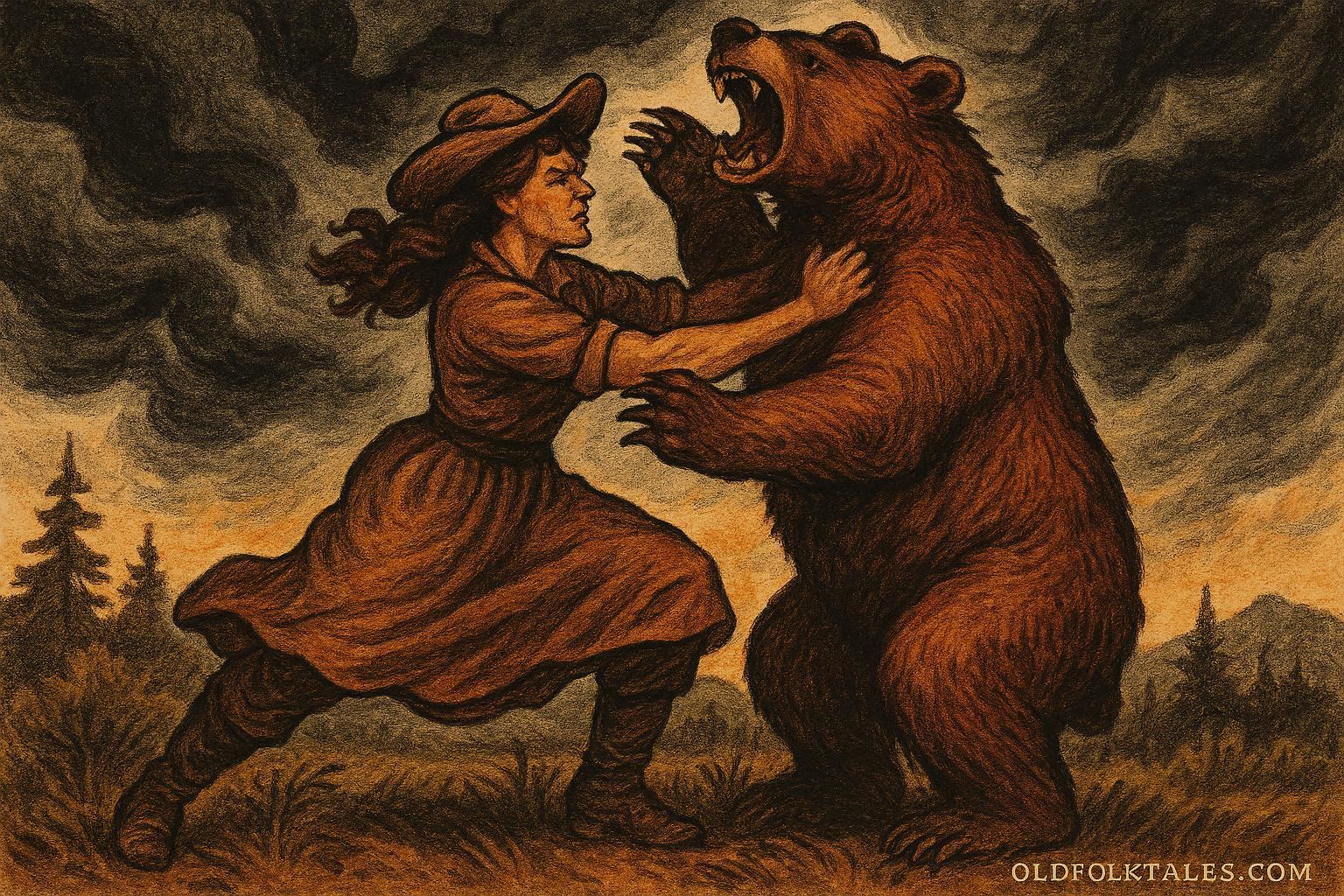
Sally Ann listened to their fear and laughed, not out of cruelty but confidence. She followed the bear’s trail alone, her boots sinking deep into snow. When she found it, standing taller than a cabin door and roaring at the sky, she did not raise a rifle. She rolled up her sleeves.
What happened next passed into legend. Some said the earth trembled as Sally Ann wrestled the bear. Others swore the clouds gathered to watch. The struggle lasted until the bear finally surrendered, sitting back on its haunches, confused and beaten not by force alone but by fearless joy. Sally Ann released it, warning it never to trouble humans again. The bear lumbered away, and winters grew quieter after that.
But it was not only animals that tested Sally Ann. Storms themselves seemed drawn to her. One summer, a drought cracked the land so deeply that rivers whispered instead of flowed. Crops failed, and people prayed. Sally Ann climbed the highest hill and called out to the sky, laughing and shouting challenges. Thunder answered her voice. Clouds rolled in thick and low. Rain fell hard and steady, soaking the ground until it sighed with relief.
Another time, when a storm threatened to tear apart a river settlement, Sally Ann ran straight into the wind. Witnesses said she grabbed the storm by its center, spinning it like a stubborn child until it lost its fury. The storm drifted away, gentle as mist, leaving the town untouched.
Yet for all her strength, Sally Ann was not cruel, proud, or careless. She helped build cabins, lifted wagons from mud, and shared food with strangers without asking their names. She believed strength meant responsibility and that laughter could hold communities together when fear tried to pull them apart.
As years passed, settlers moved farther west, carrying Sally Ann’s stories with them. Children dared each other to shout her name during storms. Travelers claimed they heard laughter riding the wind at night. Some said Sally Ann grew tired of human limits and stepped into the clouds one evening, carried off by thunder she once commanded.
Others insisted she never left at all. They said she became part of the land itself, her strength resting in hills, her laughter hidden in the wind, her courage waiting to rise whenever someone stood firm against impossible odds.
To this day, when storms roll across open plains and thunder sounds like laughter instead of threat, old-timers smile and say Sally Ann Thunder Ann Whirlwind Crockett is still watching, still laughing, and still reminding the world that strength does not belong to fear, but to those bold enough to carry it with joy.
Click to read all American Folktales — timeless oral stories passed through generations across the United States.
Moral Lesson
True strength is not proven by domination or pride, but by courage, generosity, and the ability to face fear with laughter and purpose.
Knowledge Check
1 What natural signs surrounded Sally Ann’s birth?
Answer Thunder, wind, and lightning
2 Why did Sally Ann confront the bear alone?
Answer She trusted her strength and feared nothing
3 How did Sally Ann help during the drought?
Answer She called the storm and brought rain
4 What role did laughter play in Sally Ann’s legend?
Answer It showed confidence and drove away fear
5 How did people believe Sally Ann influenced storms?
Answer She challenged and redirected them
6 What does Sally Ann symbolize in frontier folklore?
Answer Strength guided by responsibility and joy
Source
Adapted from American Folklore Society tall tale research publications
Cultural origin
American frontier folklore tradition