The day Stone Boy entered the world, the ground beneath the camp felt unusually still. The wind moved across the prairie, but it did not whistle. The grass bent, but without sound. Even the birds nearby seemed to pause, as if the land itself was holding its breath.
Inside a small lodge near a ridge of exposed stone, a woman labored through the night. The midwives worked carefully, offering prayers and burning sage, asking the earth for guidance. When the child finally arrived, there was no cry to announce him. Instead, there was weight.
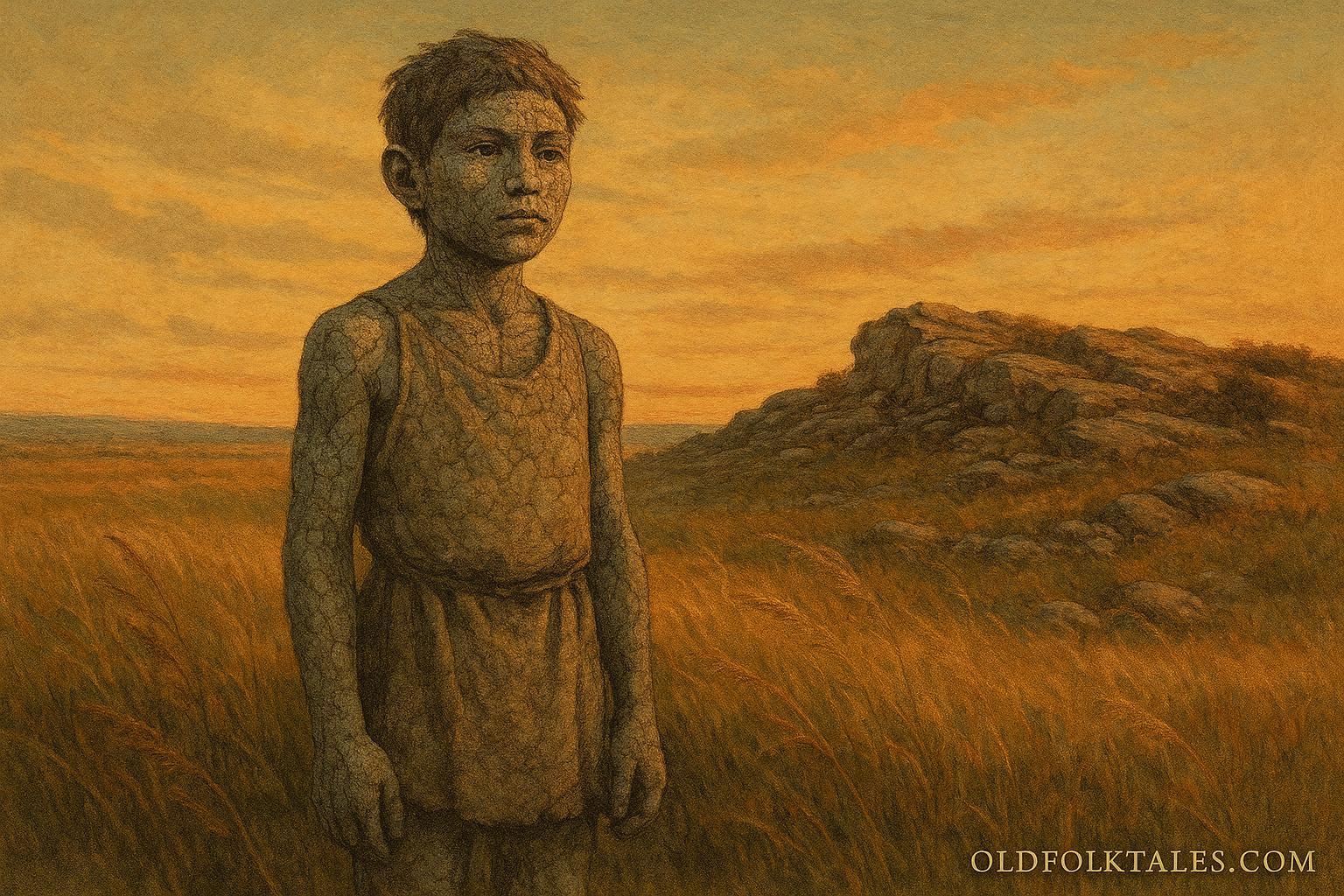
The baby was heavy in the midwives’ hands. His skin was smooth and gray, cool like stone warmed by the sun but never softened. His limbs were solid, his chest unmoving except for a slow, steady breath. Fear passed through the lodge. Some believed the child was a warning. Others whispered that he did not belong among people.
Explore ancient Native American creation myths and the symbolic tales that shaped America’s belief systems.
The mother reached for him anyway.
She held the child against her and felt something deeper than warmth. She felt steadiness. She felt endurance. She named him Stone Boy, not as an insult, but as recognition of what he was.
Stone Boy grew, though not like other children. His body remained hard and unyielding. He did not bruise easily. He did not tire quickly. But he also did not laugh often, and when he fell, he rose slowly, as if learning movement again each time.
Other children avoided him. Some were curious at first, touching his arm and pulling back in surprise. Others threw small pebbles at him, laughing when they bounced harmlessly away. The elders watched in silence. No one could decide whether Stone Boy was a blessing or a burden.
As seasons passed, Stone Boy learned to walk the prairie. His steps were heavy, leaving deeper impressions in the soil. He listened more than he spoke. When storms came, he stood without fear, letting rain strike his stone skin. When winters grew harsh, he endured the cold without complaint.
Hardship followed him closely.
During a time of hunger, when game became scarce and the people grew desperate, some began to resent Stone Boy. They said he consumed food but offered little in return. They said he was strong but slow. They said stone did not belong among flesh.
One evening, after a long council, the people decided Stone Boy should leave the camp and prove his worth. They sent him to the ridge where the stones rose from the earth, believing he might belong there more than with them.
Stone Boy did not argue. He nodded once and walked away alone.
The ridge was quiet. Wind moved freely there, shaping the grass around the rocks. Stone Boy sat among the stones and listened. He felt the ground beneath him, solid and ancient. For the first time, he did not feel different.
Days passed. Then weeks.
When storms came, Stone Boy remained. When hunger pressed in, he endured. He learned to lean against the rocks, to rest without breaking. He learned patience from the stones that had waited through countless seasons without moving.
One morning, he noticed something strange. Where his hands rested against the ground, the soil held moisture longer. Grass began to grow thicker around him. Small animals returned, drawn to the shelter of the ridge.
Stone Boy understood then that endurance was not only about surviving hardship, but about allowing life to gather around steadiness.
When he returned to the village, the people were weaker than before. He did not speak. Instead, he worked. He carried heavy loads others could not. He stood firm against strong winds to shield fires. He helped rebuild lodges damaged by storms.
Slowly, attitudes changed.
Children followed him, learning that strength could be quiet. Elders watched him and nodded, recognizing something ancient in his presence. Stone Boy did not boast. He did not seek praise. He simply remained.
Years passed.
Stone Boy grew taller, broader, heavier. His movements became slower, but more deliberate. The earth seemed to pull at him. One evening, he called the people together.
“My time among you is ending,” he said. “I was never meant to stay forever.”
The people protested. They had come to rely on him. They feared losing his strength.
Stone Boy knelt and placed his hands on the ground. “You have learned what you need,” he said. “Endurance does not mean hardness alone. It means knowing when to stand, and when to return.”
As the sun set, his body began to change. His legs fused with the earth. His skin grew rougher, darker. By morning, Stone Boy was no longer flesh and stone, but stone alone, rising from the prairie as part of the ridge itself.
The people mourned, but they also understood.
From that place, the land became stronger. Storms broke differently. Grass grew deeper. The ridge became a place of teaching. Elders brought children there to remind them that resilience does not shout. It waits.
To this day, the Lakota and Dakota say that human strength comes from knowing where you belong, enduring what must be endured, and returning to the earth when the time is right.
Click to read all American Folktales — timeless oral stories passed through generations across the United States.
Moral Lesson
True strength lies in endurance, humility, and knowing when to stand firm and when to return to one’s origins.
Knowledge Check
1. Q: What made Stone Boy different at birth?
A: He was born with a body of stone.
2.Q: Why was Stone Boy sent away from the camp?
A: Some believed he did not belong and needed to prove his worth.
3. Q: What did Stone Boy learn while living among the stones?
A: That endurance allows life to grow around steadiness.
4. Q: How did Stone Boy help the village when he returned?
A: By carrying heavy loads, protecting fires, and rebuilding structures.
5. Q: What happened at the end of Stone Boy’s life?
A: He returned to the earth and became part of the stone ridge.
6. Q: What lesson do elders teach from Stone Boy’s story?
A: Strength comes from resilience, belonging, and balance.
Source
Adapted from University of North Dakota Plains oral tradition archives
Cultural Origin
Lakota and Dakota communities