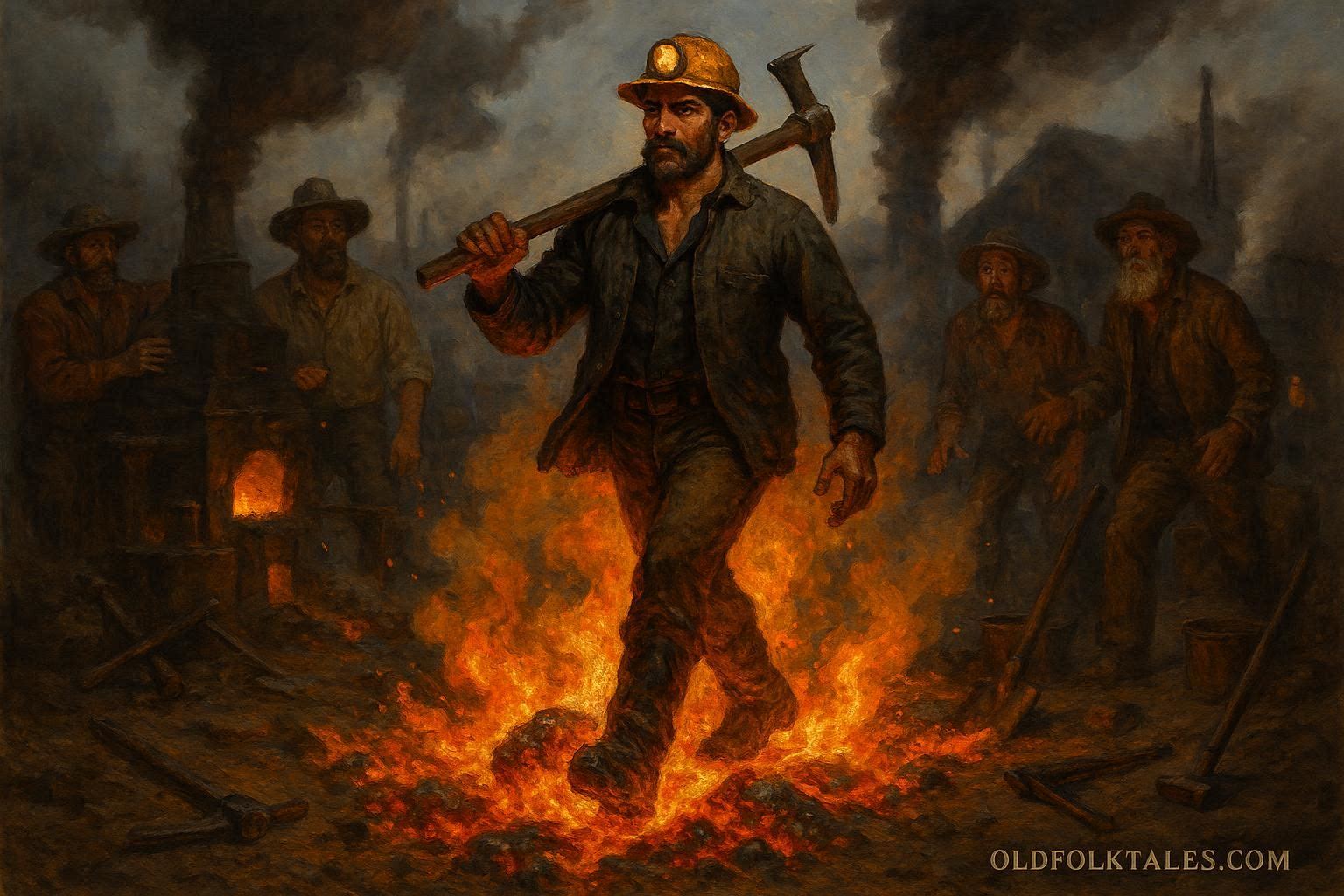
The air in the Sierra Nevada gold camps was thick with smoke and the metallic scent of molten ore. Miners labored day and night, chipping rock, shoveling dirt, and tending to the blazing furnaces that separated gold from stone. Among them, a figure loomed larger than life in stories told around the fire: the Firewalker. He was no ordinary miner; legend claimed he could stride through flames and molten ore with neither harm nor hesitation, a living symbol of courage in a land where danger was constant.
It was said that his real name had been forgotten over time, and all who spoke of him simply called him Firewalker. One of the earliest tales recounts a winter night when a mine shaft collapsed, trapping workers beneath tons of rock. Flames from overturned lamps and a leaking furnace ignited timber supports, sending sparks flying through the narrow passage. Panic rippled through the men as smoke filled the shafts, but the Firewalker appeared seemingly from nowhere, his boots unscathed by the flames, his long coat trailing behind him as he moved with calm precision.
“Stay close to me!” he commanded, his voice firm but steady. Miners scrambled to follow as he led them across blazing debris, stepping through molten ore with a careful rhythm that defied reason. Sparks showered around him, yet his steps were confident, deliberate, and unbroken. One young apprentice, trembling with fear, called out, “How are you not burning?” Firewalker glanced back, his eyes reflecting both flame and determination. “Fear is worse than fire,” he said. “Keep moving, and you will see the way to safety.”
Discover African American wisdom, Native American spirit stories, and the humor of early pioneers in American Folktales.
By morning, the trapped miners were led out into the open air, shaken but alive. The legend spread quickly through the camp: a man who could walk through fire itself, who feared nothing and inspired courage in the hearts of others. Over time, stories painted him as a near-mythical figure. Some claimed he could melt ore with a single touch or walk through furnace doors without singeing a hair. Others told tales of him entering a raging blaze to rescue a child’s lost dog or carrying a wounded miner through flames that no one else dared approach.
Yet the stories were never merely about daring feats. They celebrated resourcefulness, quick thinking, and leadership under extreme danger. Firewalker taught miners to respect both the power of fire and the value of courage. In some tales, he demonstrated how to divert molten ore using sand and timber, or how to navigate the heat and smoke of a furnace safely. Children who grew up near the mines learned these lessons in hushed tones, imagining themselves following his steps through infernos, becoming careful and courageous in turn.
One particularly famous account tells of a night when a furnace exploded, sending a wave of molten rock spilling toward the sleeping miners. The Firewalker leapt into the danger, guiding each man and woman to safety by creating a path of cooled stones and swinging molten ore aside with quick, precise movements. Miners who survived that night swore they saw him emerge without a single burn, his coat scorched but his spirit unbroken. From that point on, any new recruit was taught: “Follow the path Firewalker would take, and you will survive.”
The Firewalker legend became intertwined with the culture of the Gold Rush. Beyond literal feats, he symbolized the courage and determination required to survive in the unforgiving Sierra Nevada. Miners lived in constant danger: cave-ins, fire, heat exhaustion, and accidents were daily threats. In every exaggerated tale of Firewalker’s bravery, listeners were reminded that fearlessness, clever thinking, and readiness to help others were the qualities of true heroism.
Tales were shared around campfires, in saloons, and in letters sent home to Eastern families. Sometimes, exaggeration took hold, and the stories became wilder: Firewalker leaping over molten rivers, carrying entire carts of ore through flames, or single-handedly extinguishing fires that threatened entire mines. While clearly embellished, these tales reinforced the values the mining communities held dear courage, resourcefulness, selflessness, and the belief that heroism could be found in ordinary people who acted extraordinarily under pressure.
As the years passed, the Firewalker became a figure of inspiration. Modern miners, historians, and folklore collectors note that the legend reflects not only human fascination with danger and daring but also the cultural identity of Sierra Nevada mining communities. The story endures because it blends practical knowledge, human ingenuity, and imaginative heroism. In the camps, it was not just about surviving fire. it was about meeting life’s challenges with determination, skill, and courage.
Even today, descendants of the Gold Rush tell the tale of the Firewalker, teaching that bravery is not the absence of fear but the mastery of it. Visitors to mining museums and historical sites in California often encounter retellings of his feats, with reenactments that allow them to experience, in part, the danger and drama of a miner walking through fire to save others. The legend continues to inspire resilience, courage, and a sense of wonder, reminding us that heroism is timeless, especially when faced with the elements of nature and the trials of life.
Explore ancient Native American creation myths and the symbolic tales that shaped America’s belief systems.
Moral Lesson
Courage, ingenuity, and selflessness define true heroism. Facing danger with skill and calm, while helping others, transforms ordinary acts into legendary deeds.
Knowledge Check
- Who is the central hero in the Firewalker legend?
A miner capable of walking through flames and molten ore to save others - How did the Firewalker inspire Gold Rush communities?
By demonstrating courage, cleverness, and leadership in life-threatening situations - What practical skills were attributed to the Firewalker?
Navigating furnaces safely, diverting molten ore, and rescuing trapped miners - How did the legend combine realism and exaggeration?
Stories included real dangers of mining enhanced with imaginative feats of heroism - Why were children and apprentices taught about the Firewalker?
To instill courage, resourcefulness, and the value of helping others in dangerous situations - Why is the Firewalker considered an American hero myth?
Because he embodies bravery, skill, selflessness, and legendary leadership in a frontier setting
Source
Adapted from California folklore and mining community archives
Cultural Origin
Sierra Nevada mining folklore