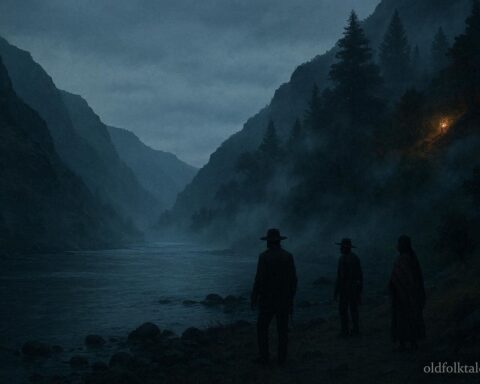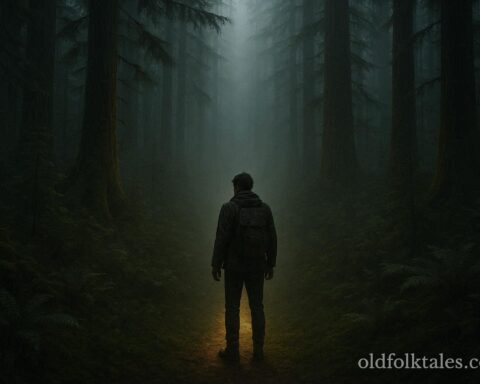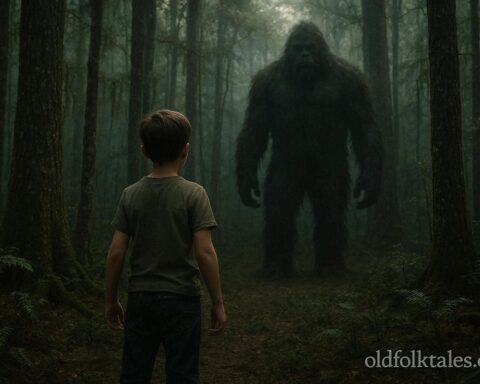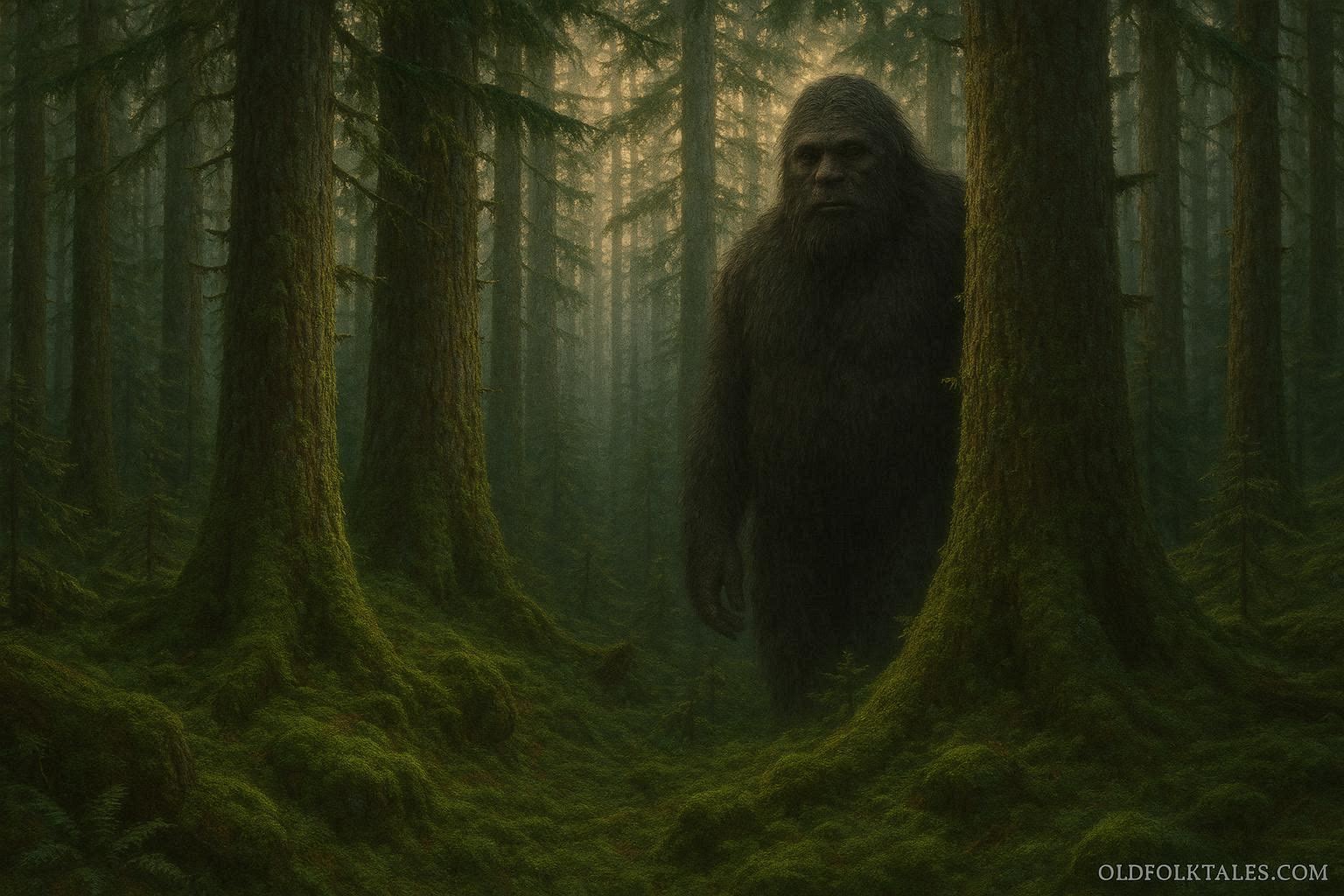
Deep within the forests of the coastal Northwest, where towering trees block sunlight and moss covers the ground like a living carpet, stories speak of beings who walk silently among the shadows. These beings are tall, broader than any human, and entirely covered in long dark hair. They move carefully through the forest, leaving few signs of their passing. Those who encounter them rarely do so directly. More often, they sense movement just beyond sight or hear heavy footsteps fade into the trees.
The forests where these giants dwell are ancient. Long before roads or towns, these lands were shaped by rain, wind, and time. Elders say the giants belong to the forest in the same way the mountains and rivers do. They are not invaders or spirits of punishment. They are residents who existed before modern settlements and who continue to exist alongside them, unseen by most.
Witnesses describe the giants as standing far taller than any person, with powerful shoulders and long arms. Their faces are humanlike but heavily shadowed by hair, making features difficult to distinguish. The beings do not wear clothing or carry tools. They rely entirely on the forest for movement and survival. When spotted, they rarely linger. The giants turn away and disappear into dense vegetation with surprising speed.
Discover chilling ghost tales and haunted places that echo through America’s towns and countryside.
The giants are known for avoiding humans. Encounters occur mainly when people wander far from known paths or travel alone through remote areas. Hunters have reported feeling watched without seeing anyone. Others describe finding footprints larger than any animal they know, pressed deeply into soft earth near rivers or berry patches.
Children sometimes ask why the giants do not approach villages. Elders explain that the giants understand boundaries. The forest is their home, and human settlements belong to another world. Crossing too often between these spaces disrupts balance. The giants observe from a distance, maintaining separation rather than conflict.
Stories emphasize that the giants are not hostile. They do not hunt people or attack settlements. Instead, they withdraw when humans approach. In rare cases, witnesses describe a giant standing still, watching quietly before turning away. The encounter feels more like acknowledgment than threat.
The giants are believed to communicate with one another through subtle sounds. Low knocks against trees, distant calls, and rhythmic movements through underbrush serve as signals. These sounds are often mistaken for animals or natural shifts in the forest. Elders say these communications allow the giants to avoid humans and protect their own territory.
Animals react strongly to the presence of the giants. Birds fall silent. Deer change direction suddenly. Dogs refuse to continue along certain trails. These reactions are taken as signs that the giants are near, even if unseen. The forest itself seems to respond, growing still as if holding breath.
Some traditions suggest the giants act as guardians of the forest. They ensure that areas remain undisturbed and that overuse does not go unnoticed. When humans take too much or behave carelessly, they may experience disorientation or lose their way. Elders say this is not punishment but a reminder that the forest demands respect.
The giants are rarely seen during daylight. Most encounters occur during early morning or evening when light shifts and visibility changes. These moments blur the line between presence and absence, allowing the giants to remain hidden while still observed.
As logging and development expanded, sightings became less frequent near populated areas. However, in deep protected forests, stories continue. People who spend long periods in wilderness areas still report signs that suggest something large and intelligent moves beyond their awareness.
Elders caution against seeking the giants. Curiosity without respect invites imbalance. The giants are not meant to be proven or captured. Their purpose is not to confirm belief but to maintain separation between worlds. The forest does not reveal everything to those who demand answers.
In oral traditions, the giants represent coexistence rather than domination. They remind people that humans share the land with other beings who follow different rules. Survival depends on recognizing limits and honoring spaces that do not belong to us.
The Hair Covered Forest Giants endure as symbols of wilderness itself. They embody strength without aggression, presence without intrusion, and knowledge without speech. Their continued existence depends on the forest remaining wild enough to hold them.
Those who walk respectfully through the woods may never see a giant. Those who ignore boundaries may sense something watching from the trees. In either case, the lesson remains the same. The forest is not empty. It is shared.
Click to read all American Cryptids & Monsters — creatures of mystery and fear said to inhabit America’s wild landscapes.
Moral Lesson
Respecting natural boundaries and accepting coexistence allows balance between humanity and wilderness.
Knowledge Check
- Where are the forest giants believed to live?
In remote forested areas of the Northwest Coast. - How are the giants physically described?
They are tall, human shaped, and fully covered in hair. - Do the giants seek contact with humans?
No, they avoid human settlements. - How do animals react when giants are nearby?
They become silent or change direction. - What role do the giants play in tradition?
They represent guardianship and coexistence. - Why should people not seek the giants intentionally?
Because curiosity without respect disrupts balance.
Source
Adapted from Smithsonian Northwest Coast ethnographic reports
Cultural Origin
Salish and coastal Northwest communities