When the first settlers arrived in Clearfield Valley, they believed they had reached the end of their wandering. The land lay wide and open beneath a steady sky, bordered by low hills and crossed by a gentle stream that never seemed to dry. The soil was dark and rich, and the forests stood close enough to promise warmth, shelter, and tools for years to come. For families who had traveled far and lost much along the way, the valley felt like an answered prayer.
Cabins rose quickly. Fields were cleared with urgency. Corn, beans, and wheat were planted as soon as the ground could be worked. Survival came first, and every settler understood that winter showed little mercy to those who delayed.
Among these people was a man named Samuel Carter. He arrived alone, without a wife or children, and with few belongings beyond a mule, a wagon of tools, and a crate filled with young saplings carefully wrapped in damp cloth. While others hurried to stake claims near the stream or clear fields for grain, Samuel chose a gentle hillside slightly apart from the main settlement.
Discover chilling ghost tales and haunted places that echo through America’s towns and countryside.
Instead of planting food crops, he began spacing the saplings across the slope. He worked slowly and deliberately, measuring distances, turning soil by hand, and setting each young tree upright with care. He marked rows where none were yet visible and watered the roots even when the rains were generous.
The neighbors noticed. At first, they assumed he would plant crops later. But weeks passed, and Samuel continued tending trees instead of sowing grain. Some shook their heads in disbelief. Others laughed openly, calling it foolishness to spend good land on fruit trees that would not bear for many years.
One evening, a neighbor finally asked him directly why he wasted his labor on an orchard when winter would not wait.
Samuel paused, wiped his hands on his trousers, and said that a man should leave something behind that he did not need for himself. The answer puzzled them. Survival demanded immediate reward. The future, they believed, would take care of itself if the present was secured.
Yet Samuel did not argue. He continued his work.
Seasons passed, and the settlement grew. Children were born. Fences expanded. Fields yielded harvests both good and poor. Through it all, Samuel tended the orchard. He pruned branches in early spring, protected young trunks from grazing animals, and replaced saplings lost to frost or illness.
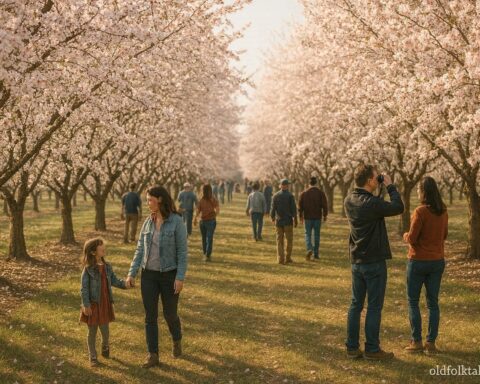
The orchard slowly took shape. Slender trees grew taller, and blossoms appeared each spring, pale and fragile against the sky. They promised fruit that would not come yet, but they filled the air with sweetness and the hillside with life.
Children began to play among the rows. They ran between trunks and climbed low branches, asking Samuel when the apples would be ready. He told them that some harvests belonged to the future and that patience was part of caring for the land.
As years passed, Samuel aged. His hair thinned and grayed. His steps grew slower, and his hands stiffened in the cold. Still, he planted new trees when older ones failed. When asked why he continued, he answered that the land had given him shelter, and he owed it his effort in return.
One winter, Samuel fell ill. Neighbors came to sit by his fire, bringing broth and wood. In the flickering light, they asked him if he regretted planting trees he might never harvest.
Samuel smiled faintly and said that a community should never live as though it were the last to walk the land. He died before spring.
The orchard stood silent through the season of blossoms that followed. No one claimed it as private property. The settlement agreed without words that the orchard belonged to all, even though its fruit was still sparse.
Years later, the trees matured. Branches bent beneath the weight of apples and pears. The first true harvest filled baskets and barrels. Cider presses were built. Children who once played among saplings now worked beside elders, gathering fruit and sharing stories of the man who planted trees for people he would never meet.
During lean years, the orchard fed many. During plentiful ones, its harvest was shared freely with travelers and newcomers. When disputes arose, elders pointed to the orchard as proof that thinking beyond oneself created peace that lasted.
Each spring, when blossoms returned to the hillside, the people of Clearfield Valley remembered that the strongest communities were built by those willing to plant for the unborn.
Click to read all American Folktales — timeless oral stories passed through generations across the United States.
Moral Lesson
True stewardship is measured not by what we take from the land, but by what we prepare for those who come after us. Planning for the future is an act of responsibility, generosity, and wisdom.
Knowledge Check
1 Why did Samuel Carter choose to plant fruit trees instead of food crops?
Answer: He wanted to leave a lasting gift for future generations
2 How did the community initially react to Samuel’s orchard?
Answer: Many believed it was impractical and foolish
3 Did Samuel live to see the orchard fully mature?
Answer: No he died before the first full harvest
4 What role did the orchard play in later years?
Answer: It became shared land that fed and united the community
5 How did the children interact with the orchard as it grew?
Answer: They played among the trees and later helped gather fruit
6 What lesson does Samuel’s orchard teach about foresight and responsibility?
Answer: That caring for the future benefits the entire community and builds lasting harmony
Source
Adapted from American agricultural folklore, Library of Congress
Cultural origin
Early American farming communities