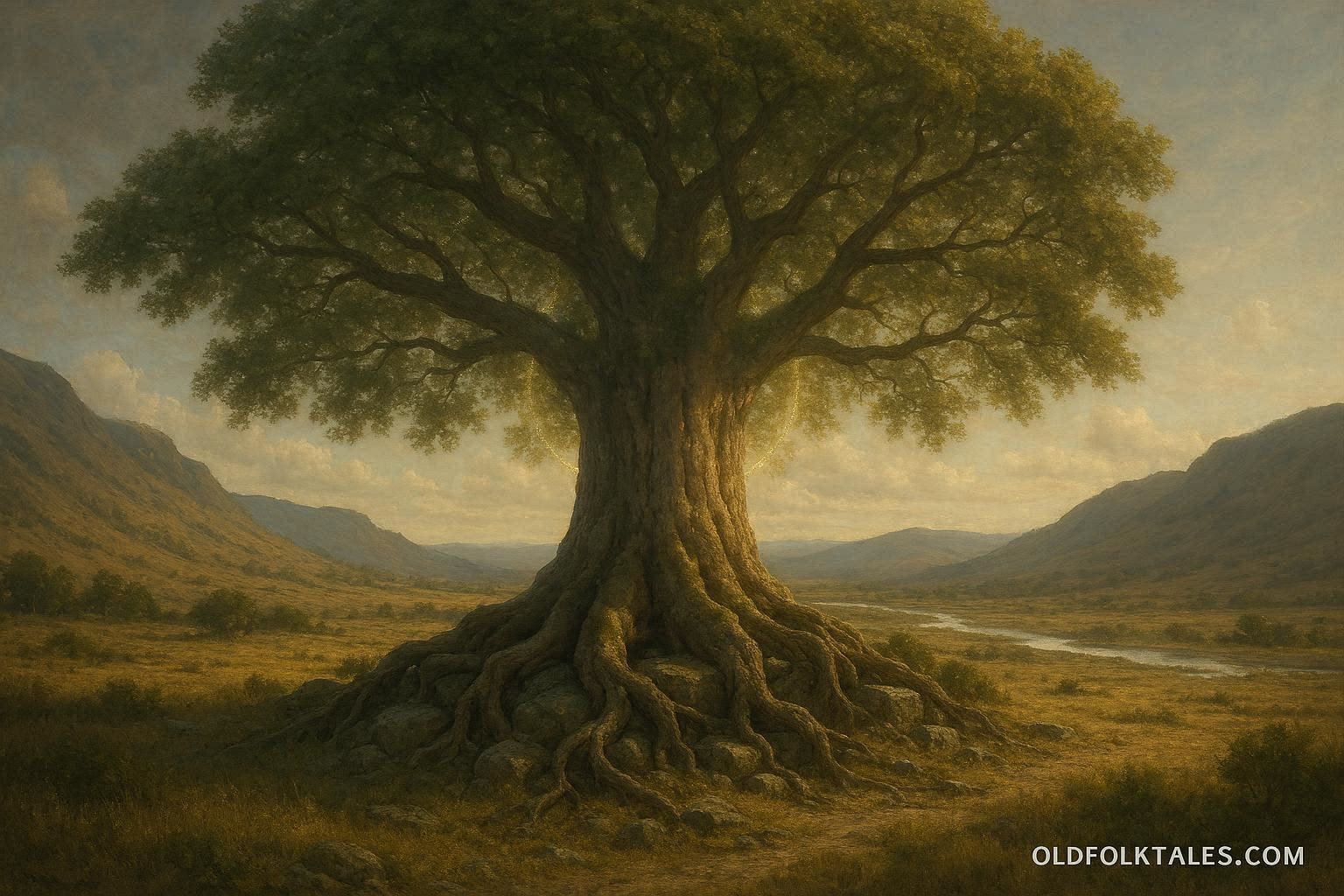
In a valley where the sun warmed the earth and the river curved gently through the plains, there stood a tree unlike any other. Its trunk was wide, its roots deep, and its branches stretched higher than most could see. The elders said it had been planted at the beginning of memory, a living bridge between what was seen and what was unseen. Its bark shimmered faintly in sunlight, its leaves whispered even in the stillest wind, and its roots drank not only water but the stories of generations.
People came from far and near to see the tree, not only for its size but for the quiet power that seemed to hum through the air. It marked a place where humans and spirits could meet in understanding, where boundaries were acknowledged but never crossed lightly. Children were told never to harm it, hunters never to take from its shade without permission, and travelers never to pass it without offering respect. For those who ignored these customs, the tree had a way of reminding them.
Over time, curiosity and greed drew some to test it. They brought fire and axes, believing that a tree so magnificent could be felled like any other. They circled it with torches, they struck its bark with steel, and yet the tree endured. Sparks fell harmlessly on the ground, axes bent or shattered against its trunk, and even the wind seemed to shield it. The people who had come with intent to harm left bewildered, the lesson of the tree etched into their minds.
Encounter the strange and the unseen — from Bigfoot to regional monsters hiding in America’s forests.
The elders explained that the tree’s endurance was more than physical strength. It lived because it was sacred. It existed as a sign, a boundary between what humans could touch and what belonged to the spirits. It reminded people that some things were not meant to be dominated or destroyed. The tree was a witness to human behavior, holding memory of every act, every thought, and every intention directed toward it.
One year, a fire swept across the valley. It consumed grass and shrubs, leaving charred earth in its wake. Villagers feared the tree would fall, that its sacred presence would be lost, and yet it remained untouched. Smoke curled around its branches, but no leaf blackened, no branch fell. People marveled, whispering that the tree held the flames at bay, guarding itself as it had guarded generations before.
Over decades, the tree became central to teaching lessons. Parents would bring children to its base and recount how the tree had survived axes and fire, explaining that respect, patience, and recognition of the sacred were the forces that protected it. Children learned that the world was larger than their desires, that power existed beyond strength or speed, and that some things demanded reverence rather than conquest.
Travelers who passed the valley told stories of the tree in distant settlements. Some doubted, believing the tales exaggerated. Yet those who visited and attempted harm were met with the same endurance. No human act could diminish it. Its roots reached the waters beneath the valley, drinking not only to live but to remember. Its branches reached to the skies, carrying messages to the unseen. It became a symbol of resistance, continuity, and sacred space.
In the quiet of the evenings, elders would sit under the tree and tell stories of the unseen. They spoke of spirits that moved between worlds, visible only to those who sought balance rather than power. They explained that the tree’s presence made their world safer, that its endurance preserved the line between what could be touched and what was forbidden. The tree reminded all who came near that life was not only about survival but about wisdom, respect, and the choices humans made when faced with temptation or fear.
Generations passed, yet the tree remained, a sentinel for both the living and those who had gone before. Children who had once played under its shade grew to become elders themselves, teaching the next generation the lessons they had learned. Visitors came, sometimes hoping to see the miracle for themselves, sometimes seeking guidance, and always leaving with a quiet understanding that the tree existed to teach, to protect, and to remind.
The tree never spoke. It did not move. Yet every person who came near it felt its presence as power, as guidance, and as warning. Those who sought to destroy it left with lessons engraved on their hearts. Those who approached with respect felt the comfort of connection. The tree endured because it held the memory of all intentions, both good and ill. It refused to burn because it was sacred, because it carried the balance of worlds in its roots and branches, and because it existed as a bridge between the seen and unseen.
In time, the valley became a place of pilgrimage. People came from distant lands to sit under the tree, to listen to the wind in its leaves, and to contemplate their own actions. Travelers and locals alike left with a deeper understanding of boundaries, reverence, and continuity. The tree continued to watch silently, unshaken by fire, human hands, or time itself, a constant reminder that some forces are greater than mortal will, and some spaces are sacred beyond measure.
Explore the heart of America’s storytelling — from tall tales and tricksters to fireside family legends.
Moral Lesson
Respect the sacred and honor boundaries beyond what you see. Strength alone cannot overcome reverence, and true wisdom comes from acknowledging forces greater than oneself.
Knowledge Check
- Why was the tree considered sacred?
Answer: Because it marked a boundary between the human and unseen worlds - How did people attempt to harm the tree?
Answer: They used fire, axes, and other destructive methods - Why did the tree survive these attacks?
Answer: Its sacred nature protected it, and it represented forces beyond human power - What lessons did children learn from the tree?
Answer: Respect, patience, reverence, and the importance of boundaries - How did elders use the tree to teach morality?
Answer: By telling stories under its shade and explaining its endurance - What did travelers learn when visiting the tree?
Answer: That some things must be respected and cannot be conquered
Source
Adapted from University of Oklahoma Southeastern tribal folklore archives
Cultural Origin
Muscogee Creek communities